If you are deciding whether to buy Bitcoin now, supply is one part of the research. Compare the purchase methods, costs and delivery terms separately from any long-term investment thesis.
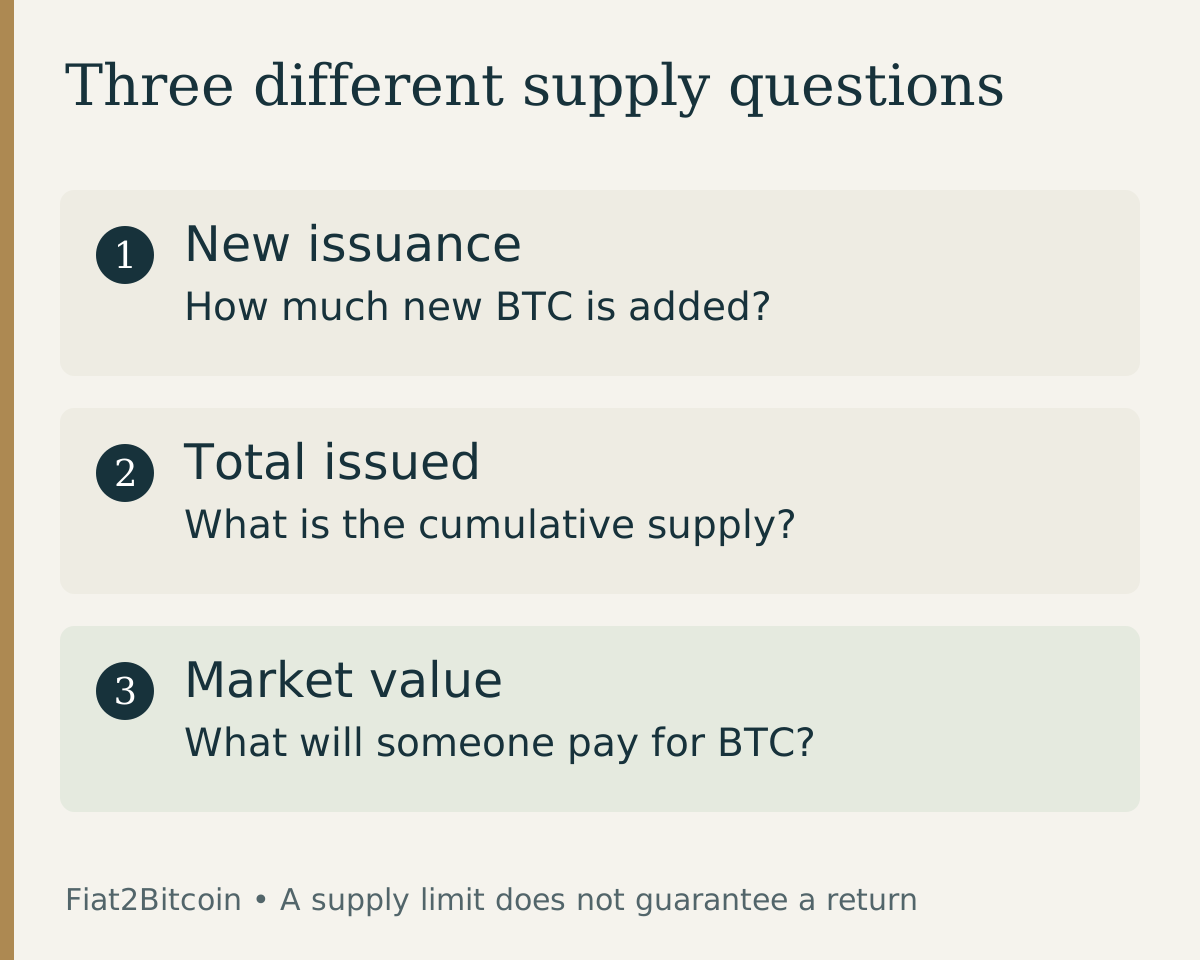
Supply inflation and price inflation are different
In a Bitcoin supply discussion, inflation usually refers to the creation of additional BTC. In everyday economic reporting, inflation refers to a broad rise in the prices of goods and services. The Federal Reserve's explanation of inflation uses that economy-wide price meaning.
A lower rate of new BTC creation therefore does not mean groceries cost less, the dollar price of BTC must rise or Bitcoin will preserve your spending power over a particular period. Those are separate claims.
Scroll across the table to see all columns.
| Term | What it measures | What it does not establish |
|---|---|---|
| Supply growth | New BTC added through issuance | The next market price |
| Declining supply growth | The rate of issuance becomes smaller | That previously issued BTC disappears |
| Consumer-price inflation | A broad increase in goods and services prices | Bitcoin's return over the same period |
| Purchasing power | What an asset or amount of money can buy | A guaranteed future outcome |
Why Bitcoin's supply still increases
Under the current protocol, miners may receive a block subsidy consisting of newly issued BTC. Bitcoin.org's halving explanation describes the subsidy reduction every 210,000 blocks. This is roughly a four-year interval, not an exact calendar timer.
The subsidy after the 2024 halving is 3.125 BTC per block. At block 1,050,000 it is scheduled to become 1.5625 BTC, with the date estimated in 2028. Both are positive amounts: the later subsidy adds fewer new coins, rather than subtracting coins already issued.
A miner's total block revenue can also include transaction fees. The subsidy is the newly created portion; fees paid from existing coins are not new issuance.
Does the 21 million cap make Bitcoin deflationary?
The cap limits cumulative issuance under the current rules. Bitcoin.org's FAQ distinguishes the initial growth of the monetary base from its eventual stability. A stable issued supply and a shrinking issued supply are different descriptions.
People also use ‘deflationary’ to express a belief that a limited asset will buy more over time. That is an economic expectation, not the same statement as a programmed issuance schedule.
Ask the speaker which meaning they intend. ‘Fewer new coins per block,’ ‘fewer accessible coins’ and ‘higher future purchasing power’ should not be treated as interchangeable claims.
A halving reduces new issuance, not your wallet balance
Here is a simplified arithmetic example using 100 blocks at each subsidy. It excludes fees and does not estimate how quickly those blocks will arrive.
Scroll across the table to see all columns.
| Subsidy per block | Blocks in the example | New BTC from the subsidies |
|---|---|---|
| 3.125 BTC | 100 | 312.5 BTC |
| 1.5625 BTC | 100 | 156.25 BTC |
The second example creates 156.25 fewer BTC than the first. It still creates 156.25 BTC. That is the difference between a smaller increase and an outright decrease.
A buyer holding 0.01 BTC does not have that balance halved by the subsidy change. The protocol event concerns new issuance, not a split or reduction of every holder's units. The fractional-Bitcoin guide explains BTC quantities and satoshis.
What about lost Bitcoin?
Coins whose spending keys are permanently unavailable cannot be used by their owner. Bitcoin.org discusses lost wallets as a way the usable supply can fall. This does not give a buyer an exact, independently knowable count of all lost coins.
An address that has not moved funds for years is not proof that its keys are gone. It may belong to someone who chooses not to spend. Avoid treating a dormant-balance estimate as a verified deduction from the number of coins that could ever move.
Loss of access is also a custody risk for you, not just a scarcity argument. Understand who controls the receiving wallet and how recovery works before arranging delivery.
What does this mean before you pay?
A supply limit does not create a guaranteed buyer for your BTC at a higher price. Demand, market conditions and the terms on which you can actually transact still matter. Use the Bitcoin loss-risk guide to consider outcomes beyond a favorable price story.
For an ACH purchase, understand bank verification, authorization and release conditions. For a wire purchase, verify the instructions and quote acceptance for that request. A network supply schedule does not determine either payment's completion time.
Compare the total dollars paid with the net BTC to be delivered. Keep the purchase-fee explanation and the provider's current offer alongside your supply research. An investment thesis does not replace a clear purchase record.
Sources & further reading
General payment information and purchase-specific details serve different purposes. Review the current offer and terms before proceeding.
- Federal Reserve: Meaning of consumer-price inflation
- Bitcoin.org: Halving schedule and subsidy
- Bitcoin.org: Supply, deflation and lost wallets
Original Fiat2Bitcoin guide. Examples are illustrative; they are not live quotes or customer transactions. How we prepare our guides.