Review the risks before choosing a Bitcoin purchase method. A credit-card purchase adds borrowing costs, while debit card, ACH and wire transfer use different payment processes without protecting Bitcoin's future value. Fiat2Bitcoin remains prelaunch.
Could Bitcoin actually become worthless?
Bitcoin.org's FAQ explicitly recognizes that possibility and says the future cannot be predicted. Bitcoin's limited supply does not establish a guaranteed buyer or resale price. Demand matters as well as supply.
The CFTC's virtual-currency advisory describes market-driven value, volatile price movements, platform risks and cyber risks. Those are reasons to assess possible losses, not a way to assign a reliable probability or date to a zero-price outcome.
Keep two statements separate: a loss is possible, and a loss is certain. Neither a confident bullish prediction nor a dramatic collapse headline establishes what will happen. This guide does not calculate a target price or recommend a time to buy.
Does losing your Bitcoin require its market price to reach zero?
Scroll across the table to see all columns.
| Risk | What may happen | What remains a separate question |
|---|---|---|
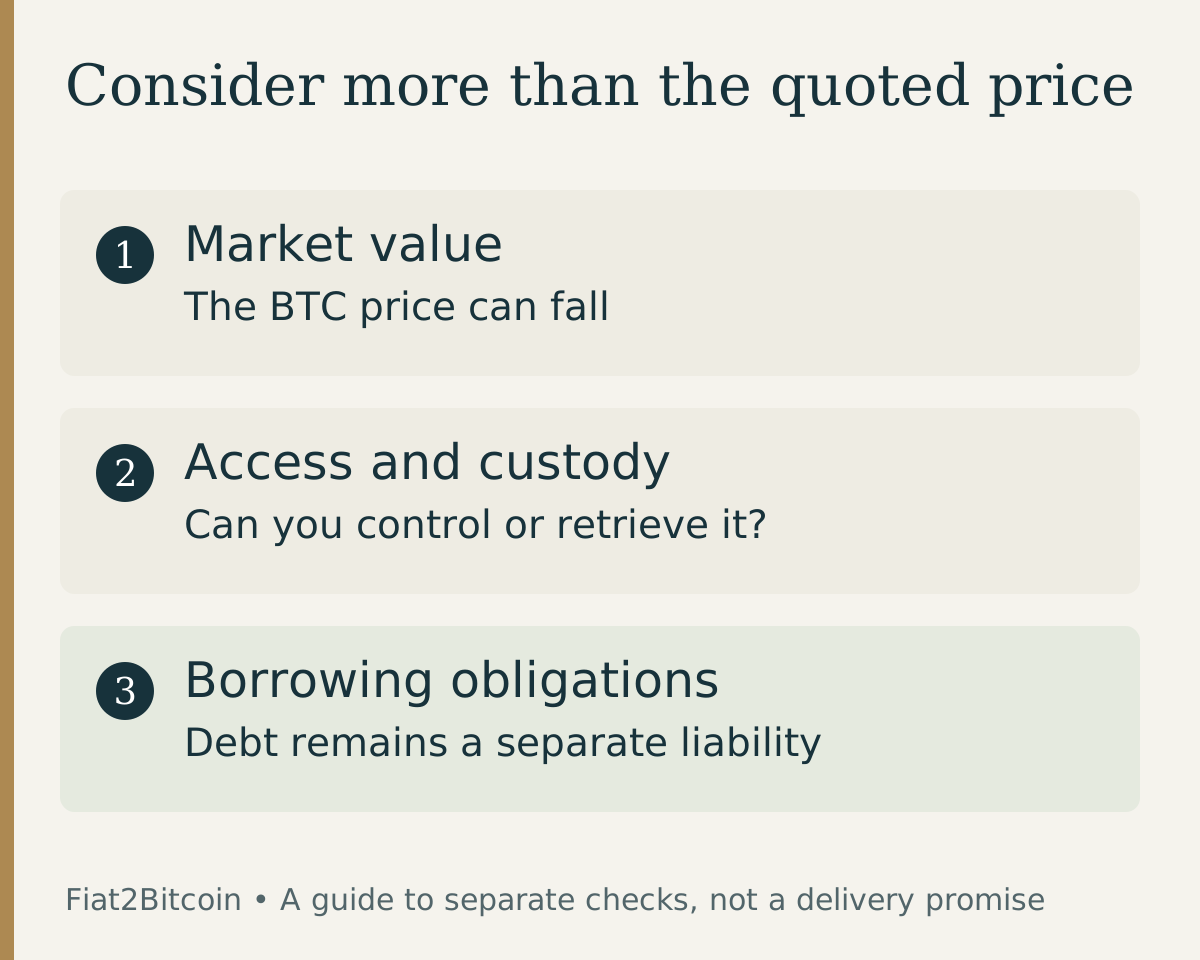
| Market value | The price you could sell for falls | Whether you still control the BTC |
| Access or custody | Keys are lost, funds are stolen or a provider cannot return assets | Whether Bitcoin still has a quoted market price |
| Purchase and borrowing costs | Fees and interest add to your outlay | Whether the asset later rises enough to offset them |
For example, a wallet can show the same BTC quantity while its dollar estimate falls. That is a price change. Being unable to access the BTC is a different problem. A provider's displayed balance is not, by itself, proof that you can withdraw or spend it.
Before buying, identify what will be delivered and who controls it. The types-of-Bitcoin guide separates BTC from similarly named assets and investment products; what Bitcoin looks like explains why an image or screen balance alone is not evidence of control.
What would a large price decline mean in dollars?
The example below starts with BTC worth $1,000 immediately before a hypothetical price change. It excludes purchase fees, sale costs, taxes and borrowing. It is arithmetic, not a forecast or a claim that these outcomes are equally likely.
Scroll across the table to see all columns.
| Price decline | Remaining value | Decline in value |
|---|---|---|
| 20% | $800 | $200 |
| 50% | $500 | $500 |
| 90% | $100 | $900 |
| 100% | $0 | $1,000 |
A complete loss is not the only outcome that can disrupt a budget. In this example, a 50% drop leaves half the starting value. Recovering from $500 to $1,000 would then require a 100% increase from the lower value, before costs.
Use an amount relevant to your own planning rather than a promotional upside example. Buying a fraction changes the number of dollars exposed; it does not remove the percentage price risk. Our fractional-Bitcoin guide explains units and minimums.
Does a price collapse erase a credit-card balance?
No. The purchase's later market value and your obligation to the lender are separate. If you borrow $1,000 to fund a purchase, a fall in the asset's value does not automatically cancel the borrowed principal or applicable charges.
The CFPB's grace-period guidance explains that cash advances generally accrue interest from the transaction date. Ask your issuer how it classifies the proposed cryptocurrency purchase; do not assume purchase-rate or rewards terms apply. The cash-advance fee guide covers those cost questions.
For a straightforward purchase funded entirely with your own money, the price-loss exposure in the example is the value of the BTC held. Borrowing, leverage and other obligations introduce different risks. Do not treat the example as a maximum loss for a loan, derivatives position or any other arrangement.
Is Bitcoin protected by FDIC insurance?
No. The FDIC's deposit-insurance guidance lists crypto assets among products that are not covered. Funding a purchase from an insured bank account does not turn the Bitcoin you receive into an insured deposit.
A provider mentioning a bank relationship is not evidence that BTC market losses are insured. Identify precisely what any protection claim covers, who provides it and which asset or account it applies to.
The FTC's scam guidance warns about promised investment returns and fake crypto platforms. Guaranteed profit or a demand for another payment to release funds should prompt verification, not an assumption that the original investment is safe.
Questions to answer before you pay
- Would losing the full planned outlay prevent you from meeting essential expenses or existing obligations?
- Are you using your own available money or taking on debt and interest?
- Do you understand the exact asset, complete costs and delivery terms?
- Who will control the BTC, and what would you do if access or withdrawal failed?
- Are you relying on a predicted price increase to repay a balance or meet a near-term expense?
- Does anyone's guarantee conflict with the actual risks or written terms?
If the decision depends on a personalized assessment of your finances, discuss it with a qualified financial adviser. Understanding a payment method does not establish that the purchase is suitable for you.
For a larger amount, the OTC quote guide explains execution terms to check. A firm purchase price can clarify what a trade costs at acceptance; it does not guarantee the asset's value after delivery.
Sources & further reading
General payment information and purchase-specific details serve different purposes. Review the current offer and terms before proceeding.
- Bitcoin.org: Possibility of becoming worthless
- CFTC: Risks of virtual-currency purchases
- FDIC: Products excluded from deposit insurance
- CFPB: Credit-card grace periods
- FTC: Cryptocurrency and investment scams
Original Fiat2Bitcoin guide. Examples are illustrative; they are not live quotes or customer transactions. How we prepare our guides.