Use this guide before completing a debit-card Bitcoin purchase or credit-card Bitcoin purchase. Fiat2Bitcoin remains prelaunch; each eligible purchase provider determines its checkout fields and supported cards.
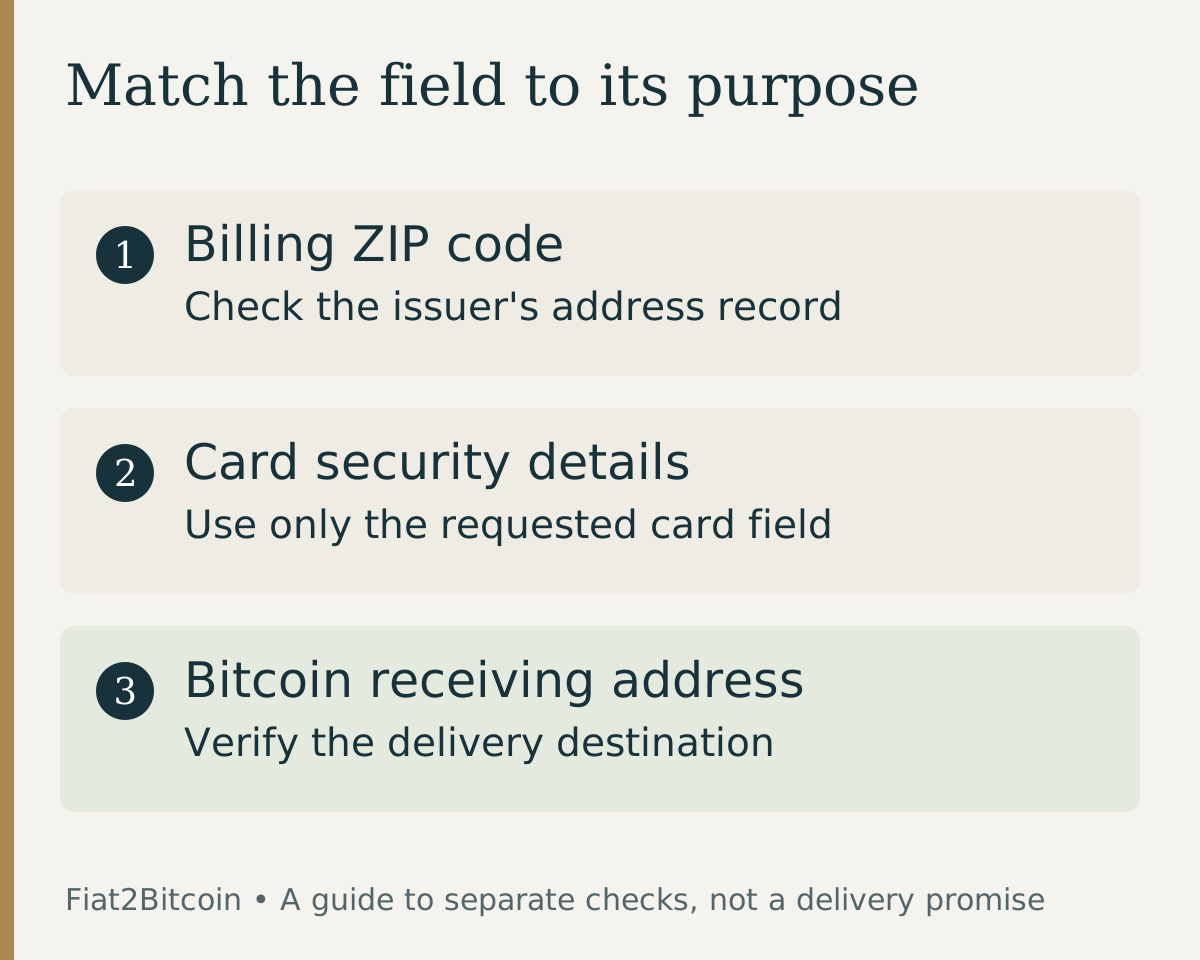
Where do you find your billing ZIP code?
- Open the card issuer's official app or website directly.
- Select the exact card you intend to use, then check its billing-address information.
- Compare that record with the address on your current statement. If they differ, ask the issuer which details apply.
- Enter the requested postal information in the verified provider's checkout, checking that autofill has not inserted an old address.
Chase's ZIP-code explanation identifies a U.S. credit-card ZIP code as part of the card's billing address and points customers to their online account information. A public ZIP-code search can identify a place, but it cannot tell you which address your issuer has on file.
For a debit card, check the bank's record for that card and account. Capital One's debit-card guide explains that online payments can require billing information alongside the card details. Do not assume the ZIP code is printed on the card or encoded in its final digits.
Billing ZIP, CVV, PIN and wallet address: which is which?
Scroll across the table to see all columns.
| Field | What it refers to | What not to substitute |
|---|---|---|
| Billing ZIP / postal code | Postal part of the card's billing address | A PIN, security code or nearby ZIP code |
| Card security code / CVV / CVC | The card's security-code field | Your billing ZIP or bank-login password |
| Card PIN | A separate issuer-managed personal identification number | A ZIP code or one-time authentication code |
| One-time verification code | A code for the specific verification request | A permanent card detail |
| Bitcoin receiving address | The destination for the Bitcoin transfer | Your street address or card billing details |
A Bitcoin purchase can ask for both billing information and a cryptocurrency receiving address because they serve different purposes. The postal address relates to the card payment; the Bitcoin address relates to delivery. Neither substitutes for the other.
Enter sensitive payment or verification details only in the verified flow that requested them. A support message asking you to send a bank password or wallet recovery phrase is not a normal way to establish your billing ZIP.
Which ZIP code applies if you moved or are travelling?
Your current physical location is not automatically your billing address. If you are travelling, use the issuer's actual billing record rather than a hotel or temporary location. If you moved, update the issuer through its official process and confirm which details are effective before paying.
Chase's billing-address guidance explains where its customers can find and update their records. Other issuers have their own processes. Changing an address in browser autofill does not update the bank.
For example, imagine your browser remembers your former address but your issuer has already confirmed the new one. Before starting a purchase, correct the saved checkout information to match the current record. This is a hypothetical address-maintenance example, not a recommendation to try multiple ZIP codes until a payment succeeds.
If an account lists both a mailing address and a residential address, ask the issuer which billing details the card check expects. Do not infer the answer from where a replacement card was delivered.
What about a non-U.S. address or a virtual card?
A U.S. ZIP field and an international postal-code field may accept different formats. Select your true billing country and follow the provider's supported format. If the form cannot accept your genuine address, ask whether the offer supports your card and country. Do not invent a U.S. address or enter placeholder zeros.
A virtual card number does not make billing information irrelevant. Capital One's virtual-card help tells its users that the entered billing address must match its card record. That is an issuer-specific example, not a guarantee that every virtual card is accepted for Bitcoin.
If you use a saved card through a digital wallet, check which underlying card is selected. Our Google Pay Bitcoin guide separates the wallet checkout, card decision and Bitcoin delivery.
What if the ZIP is correct but the purchase fails?
An address match is one check, not a purchase approval. The issuer may have other restrictions, the provider may require further verification, or the order may have reached a different stage.
Once an error occurs, use the AVS mismatch guide for address-check outcomes and pending-charge questions. The broader debit-card decline checklist covers other causes. Check the original order and bank entry before another attempt.
Keep the error text and order reference, but avoid putting full card details into an ordinary support message. The bank can confirm its billing record; the purchase provider can explain its checkout and order status.
Sources & further reading
General payment information and purchase-specific details serve different purposes. Review the current offer and terms before proceeding.
- Chase: Finding the ZIP code associated with a card
- Chase: Finding and updating a billing address
- Capital One: Debit-card information for online purchases
- Capital One: Virtual-card billing-address checks
Original Fiat2Bitcoin guide. Examples are illustrative; they are not live quotes or customer transactions. How we prepare our guides.