The network stage can follow a debit-card, credit-card, ACH or wire-transfer purchase. Fiat2Bitcoin remains prelaunch and makes no live delivery-time commitment. If no BTC has been sent yet, start with the pending-purchase checklist.
Does Bitcoin always arrive in ten minutes?
No. Bitcoin.org's confirmation explanation gives an average of about ten minutes between blocks, with individual blocks arriving sooner or later. It is a network average, not a guaranteed time from pressing Buy to receiving spendable BTC.
A transaction also has to be selected for a block. The fee conditions and other waiting transactions can matter. A block arriving does not mean that every transaction waiting on the network was included.
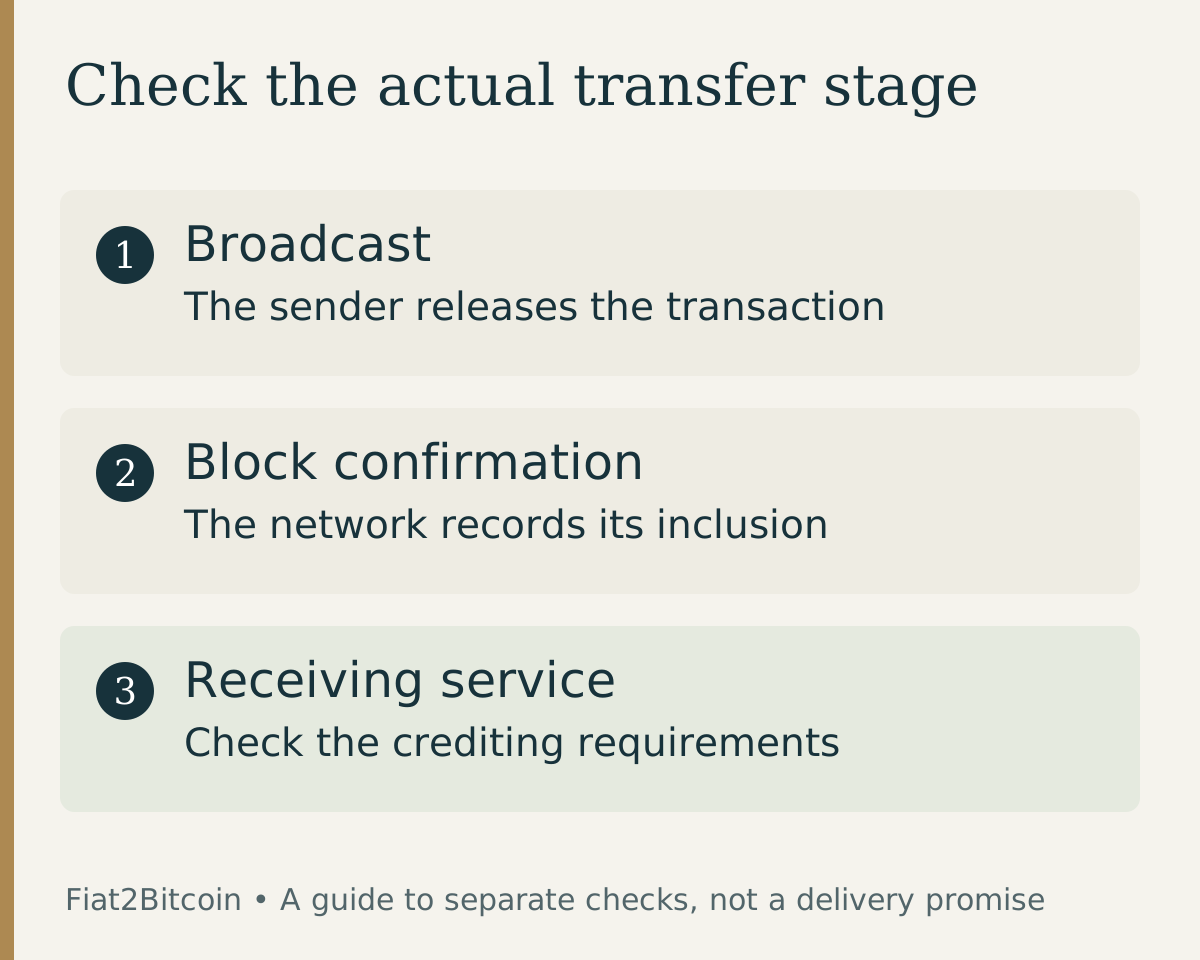
Start the timeline at the correct event. An approved card payment, a received bank transfer and a transaction broadcast to Bitcoin's network are different events. Before broadcast, waiting for more Bitcoin blocks will not finish a provider's outstanding purchase review.
What does each transfer status mean?
Scroll across the table to see all columns.
| Status | What it tells you | Next check |
|---|---|---|
| Provider is preparing delivery | The provider has not yet established network delivery | Ask whether BTC has been broadcast and request its reference |
| Broadcast, zero confirmations | A transaction is being reported without block inclusion | Verify the intended destination and the sender's status |
| One confirmation | The transaction has been included in a block | Check the recipient's required confirmation count |
| Required confirmations reached | The stated network threshold has been met | Check the receiving wallet or service's crediting status |
The Bitcoin developer guide explains confirmations as the transaction's inclusion in a block followed by additional blocks. Zero confirmations and one confirmation are different states. The receiving service decides when it treats a deposit as available under its own requirements.
Do not assume every destination uses the same count. A personal wallet's incoming display and a provider account's available balance can describe different stages. A transaction can be visible before the recipient treats it as ready to use.
An example: three confirmations are not a thirty-minute promise
This timeline is hypothetical. It illustrates a recipient that requires three confirmations; it does not state a Fiat2Bitcoin rule or predict the next transfer.
Scroll across the table to see all columns.
| Time | Event | What has happened |
|---|---|---|
| 12:00 | Sender broadcasts | The transaction is awaiting inclusion |
| 12:18 | Transaction enters a block | First confirmation |
| 12:22 | A later block is added | Second confirmation |
| 12:41 | Another block is added | Third confirmation |
| Afterward, as applicable | Receiving service updates its account | Its own crediting step is checked separately |
In this example, three confirmations take 41 minutes from broadcast. The important lesson is the sequence, not the sample duration. Starting a thirty-minute timer at payment authorization would mix the provider and blockchain stages.
Kraken's processing guidance explicitly says its estimates assume inclusion in the first available block and can take longer otherwise. Its confirmation policy is an example of recipient-specific requirements, not a universal Bitcoin deadline.
Why might a Bitcoin transfer take longer?
Coinbase's pending-transaction guidance identifies network volume, insufficient fees and network-communication issues among possible causes. It also distinguishes pending crypto transfers from pending purchases or bank deposits. Use the status for the correct operation.
The sender controls the transaction it creates. If a purchase provider is sending the BTC, contact that provider about its broadcast and fee handling. Do not assume that a fee-control button in your own receiving wallet can change a transaction the provider sent.
For an on-chain reference, compare the full destination and amount with your order. A transaction ID by itself is not proof that the transfer pays your wallet. If the reported transaction cannot be found, ask the sender to confirm the correct network, reference and broadcast status.
This article concerns native BTC transfers on Bitcoin's blockchain. An internal account transfer, a Lightning payment or a wrapped token has a different process. Check the actual route rather than applying one timing estimate to all products.
What should you ask when delivery is late?
- Has the provider finished reviewing and releasing this purchase, or is BTC still awaiting dispatch?
- If BTC was broadcast, what is the transaction reference and intended receiving network?
- Does the transaction pay the complete destination and BTC amount agreed in the order?
- How many confirmations does the recipient currently report and require?
- If that threshold is reached, what receiving-account check is still outstanding?
Keep timestamps with timezones and the original order reference. Ask about the existing delivery before placing a replacement order. Our Taproot-versus-native-SegWit guide helps with an address-format issue; it does not establish a faster confirmation time.
Be cautious about a separate payment demanded to unlock a transfer. The FTC's cryptocurrency-scam guidance describes fake platforms and withdrawal-payment demands. Confirm any request through the original provider's verified channel, and never share wallet recovery information.
For a future purchase, compare the payment methods by their funding and release conditions as well as the final network step. The fastest bank or card action does not necessarily produce the earliest usable BTC.
Sources & further reading
General payment information and purchase-specific details serve different purposes. Review the current offer and terms before proceeding.
- Bitcoin.org: Confirmation timing
- Bitcoin developer guide: Confirmation states
- Kraken: Recipient processing assumptions
- Coinbase: Pending crypto transactions
- FTC: Cryptocurrency scams
Original Fiat2Bitcoin guide. Examples are illustrative; they are not live quotes or customer transactions. How we prepare our guides.