The destination check applies whether you plan to pay by debit card, credit card, ACH or wire transfer. Fiat2Bitcoin remains prelaunch. This guide does not confirm a supported address type for every future provider offer.
What is the difference between native SegWit and Taproot?
Scroll across the table to see all columns.
| Feature | Native SegWit, version 0 | Taproot |
|---|---|---|
| Mainnet address prefix | bc1q | bc1p |
| Address encoding | Bech32 | Bech32m |
| Technical output name | P2WPKH or P2WSH | P2TR |
| Asset being received | BTC | BTC |
| Before using it for a purchase | Confirm the sender supports the address | Confirm the sender supports the address |
The prefixes above are incomplete labels, not usable receiving addresses. BIP 350 specifies Bech32 for version-0 witness addresses and Bech32m for version 1 and later. BIP 341 specifies the Taproot output rules.
Wallets sometimes use SegWit as shorthand for different account options. Trezor's account-type explanation distinguishes native bc1q addresses, older formats and bc1p Taproot addresses. Check the full label in your own wallet rather than relying on the word SegWit alone.
Which address should you use for a Bitcoin purchase?
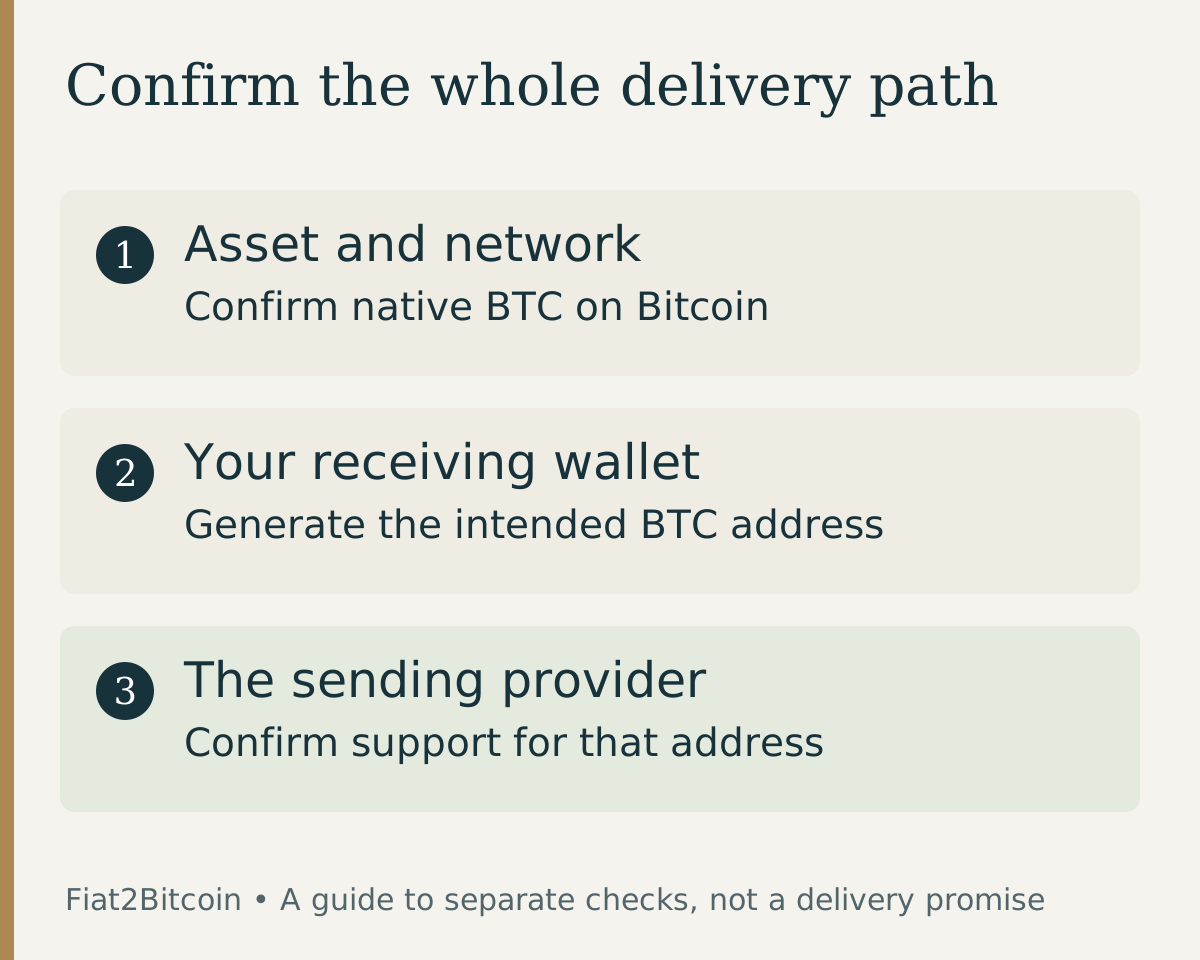
Start with compatibility between your receiving wallet and the service sending the BTC. The wallet must generate the address for the intended BTC account, and the purchase provider must accept that format for delivery. A wallet's support does not establish the provider's support.
Trezor explains that its native SegWit option can avoid compatibility problems with services that do not properly support Taproot. That is useful context, not a universal promise that every provider accepts either format. Check the current instructions attached to the actual offer.
Ledger's Taproot implementation explanation illustrates why sending to Taproot and managing a Taproot account are separate capabilities that software implements. Ask the sender about delivery to the address, not only whether its app mentions Taproot.
You do not need to convert BTC into a token called Taproot or native SegWit. If an offer instead names BCH, WBTC or another asset, that is a separate asset-selection issue covered in our types-of-Bitcoin guide.
Is Taproot always cheaper, faster or more private?
No address prefix guarantees those outcomes. BIP 341 describes improvements to scripting privacy, efficiency and flexibility, including revealing less information about unused spending conditions. It does not make every payment anonymous or promise that every transaction costs less.
Network fees depend on the transaction being constructed and the fee conditions at the time. A purchase provider can also apply its own disclosed delivery charges. Compare the actual quote using the purchase-fee guide instead of inferring the final cost from bc1q or bc1p.
For the stage after broadcast, see Bitcoin transfer time and confirmations. An address choice also does not bypass identity checks, card authorization, ACH settlement, wire review or the provider's release process. For unresolved timing, check the pending-payment guide rather than creating another order with a different address.
Bitcoin transaction information is public. Bitcoin.org's privacy explanation makes clear that Bitcoin is not anonymous. A format upgrade is not permission to ignore the privacy implications of sharing your transaction or address publicly.
What if the provider rejects your receiving address?
- Confirm that the order and receiving wallet both refer to native BTC on the intended Bitcoin network.
- Check the provider's current list of accepted BTC address formats. Preserve the exact error without exposing recovery information.
- Open the receiving screen in your own verified wallet and check the intended account and complete address.
- If the provider requires another supported BTC format, follow the wallet maker's instructions to generate an address for an account you control. Do not edit the existing address.
- If an order already exists, ask the provider whether and how its destination can be updated. Do not assume that changing a saved address changes an accepted order.
For example, a hypothetical provider rejects a bc1p address and states that it accepts native SegWit. If your wallet supports an appropriate BTC account, it can generate a separate bc1q receiving address through its normal process. Replacing the letter p with q in the first address would not perform that conversion and could produce an invalid destination.
A prefix is only a clue. Verify the complete address through the wallet's supported verification process, including the hardware-device display when applicable. Do not use a sample address from an article, a search result or an unsolicited support message.
What should you confirm before approving delivery?
- The purchase is for the exact BTC asset you intended.
- The receiving account belongs to you and supports the intended Bitcoin network.
- The sending provider accepts the complete address and its format.
- The order records the intended destination, amount and disclosed charges.
- Any later address change follows the provider's verified order process.
Compare the Bitcoin payment methods once the destination is clear. Keep the purchase reference and verify delivery separately from the fiat payment. No sender needs your wallet recovery phrase or private key to use your public receiving address.
If the offer involves a token on another network, use the wrapped-Bitcoin compatibility guide. A BTC address-format choice does not solve a token or network mismatch.
Sources & further reading
General payment information and purchase-specific details serve different purposes. Review the current offer and terms before proceeding.
- BIP 350: Bech32m and witness-address versions
- BIP 341: Taproot output rules and design goals
- Trezor: Bitcoin account formats and compatibility
- Ledger: Taproot sending and account support
- Bitcoin.org: Bitcoin privacy limitations
Original Fiat2Bitcoin guide. Examples are illustrative; they are not live quotes or customer transactions. How we prepare our guides.