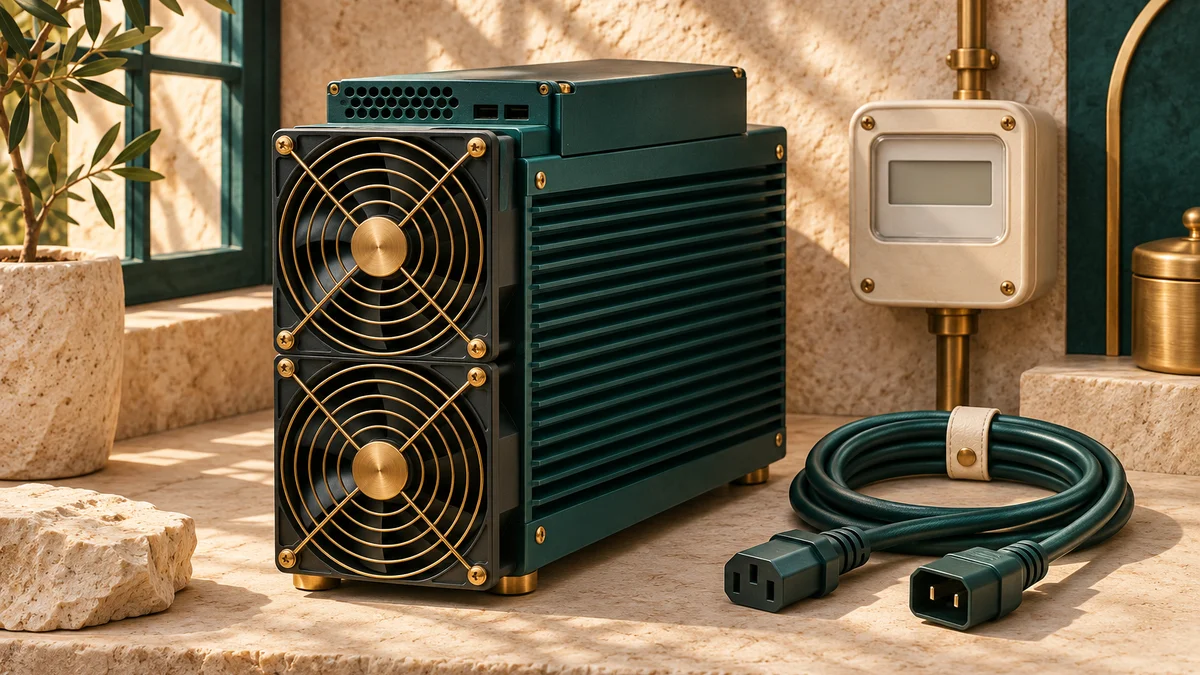
You find a used Bitcoin miner and the listing shows an estimated daily payout. Before comparing that number with the price of the machine, check how much power it uses at the wall. Your electricity rate alone can change the result.
What does a Bitcoin miner do?
A miner repeatedly hashes candidate block headers, looking for a result below the network’s target. When a valid block is accepted, its coinbase transaction can claim the block subsidy and transaction fees. An ASIC is a chip built for a particular task. Bitcoin mining ASICs are designed to perform those hash calculations efficiently.
When you compare machines, read the hash rate and the power draw together. Hash rate tells you how many attempts the machine makes per second. Power draw determines how much energy it uses while running. Check both figures for the operating mode you plan to use.
Solo vs. pool mining
The difference shows up in how often you might get paid and who sets the payout terms.
Scroll across the table to see all columns.
| Question | Solo mining | Pool mining |
|---|---|---|
| How do you earn? | You get the block reward when your setup finds an accepted block. | The pool pays according to its rules and the work you submit. |
| How steady are payouts? | A small setup can run a long time without finding a block. | Payouts can be more regular. Check the payout method, threshold and schedule. |
| What do you need to manage? | Your own setup for building and submitting blocks, plus power, cooling and monitoring. | Pool connection, payout address and account terms, plus power, cooling and monitoring. |
| What can reduce what you keep? | Power, hardware, downtime and operating costs. | The same operating costs, plus any pool or payout fees. |
Worked example: what does a 3 kW miner cost to run?
Suppose the miner draws 3,000 watts at the wall, runs 24 hours a day, and each additional kilowatt-hour costs $0.12. Use your bill or utility rate schedule to check the price for the hours you plan to mine.
Scroll across the table to see all columns.
| Measure | Calculation | Result |
|---|---|---|
| Power draw | 3,000 W ÷ 1,000 | 3 kW |
| Energy per day | 3 kW × 24 hours | 72 kWh |
| Electricity per day | 72 kWh × $0.12 | $8.64 |
| Electricity over 30 days | $8.64 × 30 | $259.20 |
At $0.18 per kWh, the same machine would cost $12.96 per day to power. If a pool estimate shows $10 per day after pool fees, the $0.12 rate leaves $1.36 after miner electricity and before other expenses. At $0.18, miner electricity alone exceeds that estimated revenue by $2.96 per day. The payout is hypothetical. Mining difficulty, BTC price, pool terms and uptime can change the result.
What to check before you buy a miner
Put the machine’s upfront cost and its monthly operating estimate on separate lines.
- Find the power draw at the wall, hash rate and voltage for the exact model and mode.
- Check your utility’s rate for the hours you’ll run it, including applicable charges tied to additional usage.
- Confirm the circuit can handle the continuous load with a qualified electrician. Plan for heat, ventilation and noise.
- Budget for hardware, shipping, electrical work, extra cooling and repairs. Include hosting charges if you will run it elsewhere.
- Read the pool’s payout method, fees and minimum withdrawal. Test your estimate at a higher power price and a lower payout.
If your goal is to receive BTC without running mining equipment, the Buy Bitcoin guide explains direct purchase methods and what to check in a quote.
Sources & further reading
General payment information and purchase-specific details serve different purposes. Review the current offer and terms before proceeding.
- Bitcoin developer guide — Mining, solo operation and pool shares
- U.S. Energy Information Administration — Watts and kilowatt-hours
- Braiins Pool — Example of pool rewards and payout terms
Original Fiat2Bitcoin guide. Examples are illustrative; they are not live quotes or customer transactions. How we prepare our guides.