This guide was checked on October 19, 2026. It explains the next subsidy event, rather than presenting a live block counter, a guaranteed event date or a forecast for Bitcoin’s price.
If you are preparing a purchase, use the Bitcoin buying-method pillar to compare payment routes and the buying-readiness checklist to assess the decision itself. Fiat2Bitcoin purchases remain unavailable during launch preparation.
When is the next Bitcoin halving?
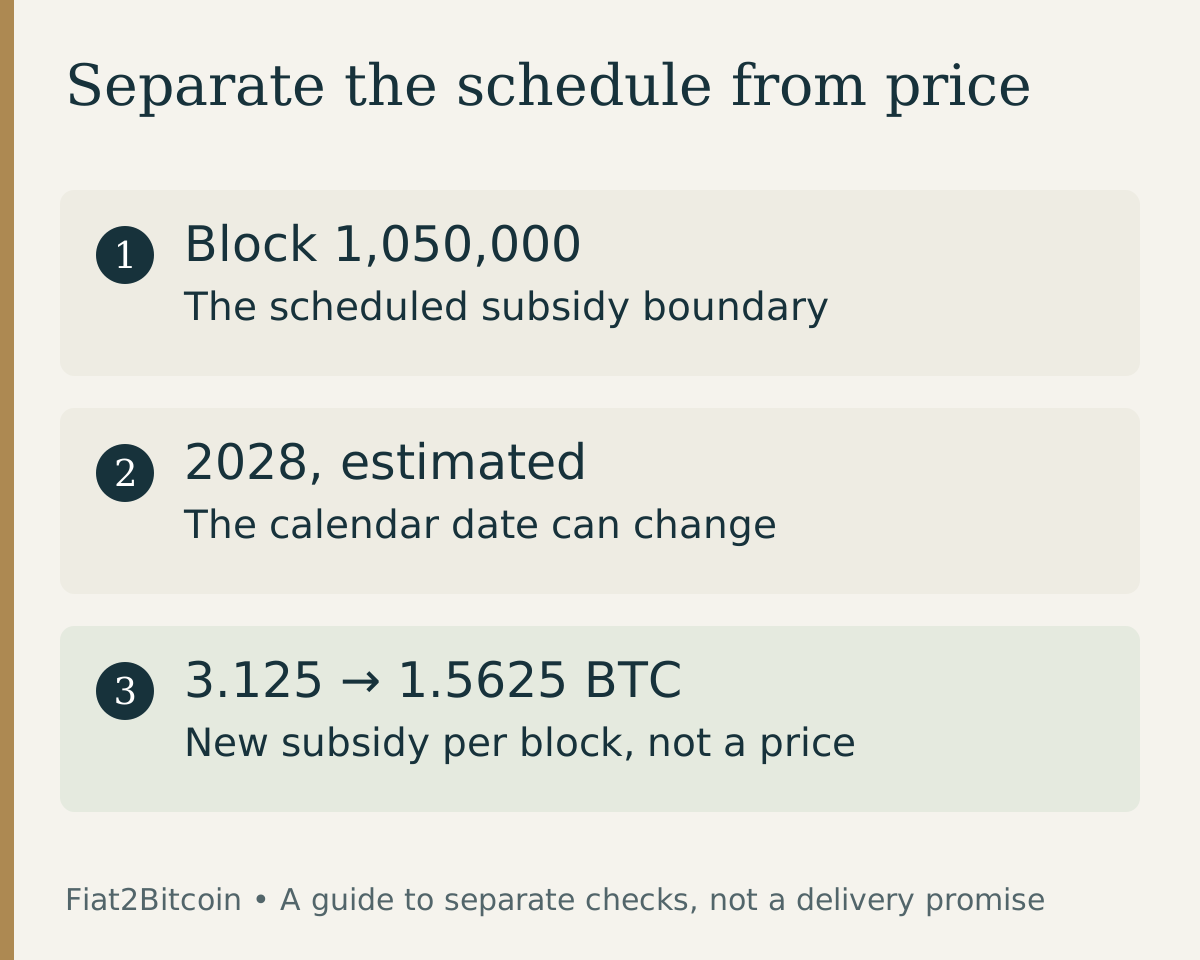
The next event is scheduled for Bitcoin block 1,050,000 and is generally estimated in 2028. Bitcoin.org’s halving overview lists that target after the 2024 event at block 840,000. The year is an estimate, not a protocol appointment on a particular day.
A page that still calls the 2024 halving the next event is describing an earlier period. Before relying on a countdown, check its update date, target block and whether its displayed block height is actually current.
This article deliberately does not publish an exact day or a seconds-remaining timer. Without a current block-height observation and a stated estimation method, that precision would be misleading.
What gets cut in half?
The block subsidy is the newly created BTC that a qualifying mined block can claim under Bitcoin’s rules. Bitcoin Core’s subsidy calculation starts from 50 BTC and reduces it according to the number of completed halving intervals.
For the next interval, 3.125 divided by two is 1.5625 BTC. Those values describe new issuance per block, not the amount a buyer receives for a fixed dollar payment. The miner can also collect transaction fees; the halving does not mechanically cut every component of block revenue in half.
Scroll across the table to see all columns.
| Item | Before block 1,050,000 | From block 1,050,000 under current rules |
|---|---|---|
| Block subsidy | 3.125 BTC | 1.5625 BTC |
| Transaction fees in a block | Depend on included transactions | Still depend on included transactions |
| An existing wallet balance | For example, 0.025 BTC | The halving itself leaves that 0.025 BTC unchanged |
| Market price | Set by trading and market conditions | No price is specified by the subsidy rule |
Why is the date estimated if the block is fixed?
The main-network parameters in Bitcoin Core specify a 210,000-block subsidy interval and a ten-minute target spacing. The trigger is a block height, rather than a calendar date.
Ten minutes is a target average, not a promise for each block. An actual run of blocks can be faster or slower. A date estimate changes as the network advances and as the estimator’s assumed pace changes.
That is why “about every four years” is useful shorthand but not a rule to add four years to the last event’s date. Track the block target and treat the displayed day as provisional.
How does a halving countdown work?
A basic estimate subtracts the observed block height from the halving target, then multiplies the remaining blocks by an assumed average block interval. It converts that estimated duration into a date using the observation time.
For a fictional arithmetic example, suppose the observed height were 1,049,856. The target of 1,050,000 would leave 144 blocks. At an assumed ten minutes per block, that is 1,440 minutes, or 24 hours. This is a worked example, not today’s block height or a statement that the halving is tomorrow.
A useful countdown should explain when its height was observed and how its pace was calculated. A stale input can produce a precise-looking timer with an outdated result. Different estimation windows can also produce different dates without changing the actual subsidy boundary.
- Check that the countdown tracks Bitcoin mainnet and the intended halving block.
- Check the observation time and reported network height.
- Look for the assumed block pace and whether it updates.
- Treat the resulting date as an estimate; verify the event from the chain once the target block is reached.
What happened at the previous halvings?
The completed events below provide context for the interval. The last row is the upcoming event, not a completed milestone. Dates are shown in UTC to avoid treating a different local calendar date as a different network event.
Scroll across the table to see all columns.
| Event | Date or estimate | Block height | Subsidy after the event |
|---|---|---|---|
| First halving | November 28, 2012 | 210,000 | 25 BTC |
| Second halving | July 9, 2016 | 420,000 | 12.5 BTC |
| Third halving | May 11, 2020 | 630,000 | 6.25 BTC |
| Fourth halving | April 20, 2024 (UTC) | 840,000 | 3.125 BTC |
| Next, fifth halving | 2028, estimated | 1,050,000 | 1.5625 BTC |
The historical dates and upcoming estimate are documented in Bitcoin.org’s halving history. For the distinction between slower new issuance and a shrinking existing supply, read the Bitcoin inflation and deflation guide.
Does the next halving guarantee that Bitcoin will rise?
No price is encoded in the halving rule. It changes the subsidy schedule. A buyer still pays the price available in the actual market or provider quote, with the applicable costs and terms.
A historical sequence of halving dates does not establish the return from a new purchase. Nor does a smaller issuance amount answer whether someone can bear a loss, afford borrowing costs or control the receiving wallet. Our Bitcoin loss-risk guide separates those concerns.
Do not treat a countdown as a deadline that requires a purchase. Review the budget, complete costs and custody plan in the buying-readiness guide, including the option to wait or not buy.
Does the halving change your purchase or payment timeline?
A network subsidy event and a customer’s purchase follow different processes. A bank payment, provider review, accepted quote and Bitcoin delivery remain separate milestones. A countdown does not establish that an order will be completed before a particular block.
If you compare ACH purchases with wire-transfer purchases, read the actual bank-processing and provider conditions. Paying by a different route does not move the network’s halving target or guarantee a price.
Use the payment-method comparison to choose a route you understand. Check the asset, receiving address, complete quote, expiry and delivery conditions. For a pending payment, follow the existing order before authorizing another attempt; the Bitcoin transfer-time guide explains the separate on-chain stage.
Sources & further reading
General payment information and purchase-specific details serve different purposes. Review the current offer and terms before proceeding.
- Bitcoin.org: Halving history and next-event estimate
- Bitcoin Core: Main-network halving interval and block-spacing target
- Bitcoin Core: Block-subsidy calculation
Original Fiat2Bitcoin guide. Examples are illustrative; they are not live quotes or customer transactions. How we prepare our guides.