This guide supports preparing a Bitcoin purchase by wire transfer. It explains payment terminology and a review checklist; it does not supply receiving-bank details or confirm that a particular account is eligible to fund an order.
What does remitter mean on a bank transfer?
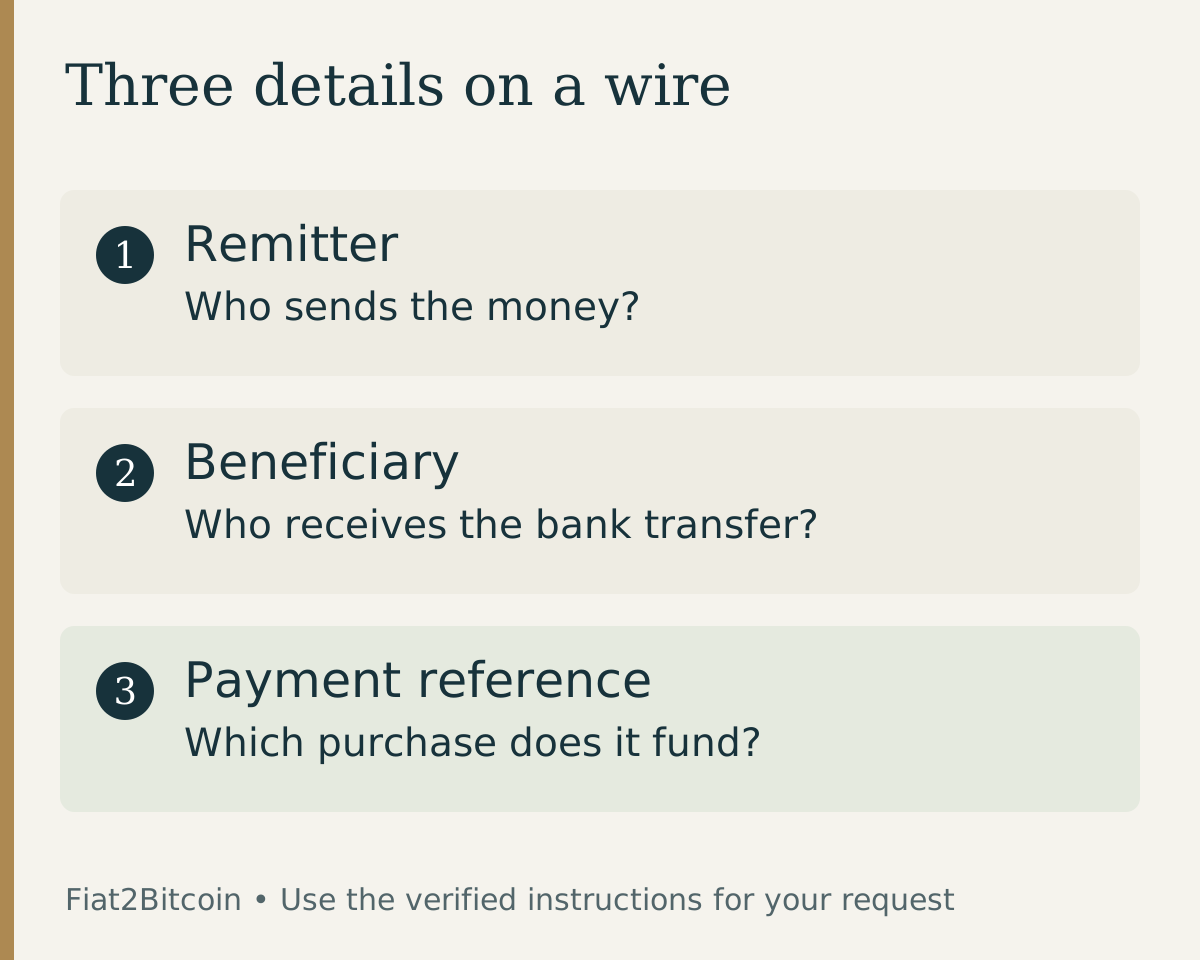
The remitter is the party sending the money. For example, East West Bank’s wire guide uses remitter for the sender and beneficiary for the recipient. The term identifies a role in a payment, not the reason for the purchase or the person who operates the bank website.
If you send a wire from your own eligible personal account to pay for your own Bitcoin order, you are generally the remitter. The destination named on the verified wire instructions is the beneficiary for the bank transfer. Receiving Bitcoin later is a separate transaction.
This guide uses the banking meaning. The word also appears in other settings, including legal writing. A definition from another context should not determine what you enter on a bank-transfer form.
Remitter vs. beneficiary vs. remitting bank
Scroll across the table to see all columns.
| Field or term | Meaning in this context | Where to check it |
|---|---|---|
| Remitter or sender | The person or business sending the funds | The paying-account record and bank instructions |
| Remitting or sending bank | The institution sending the wire | Your bank’s transfer process |
| Beneficiary | The recipient named for the bank transfer | Verified instructions for this purchase request |
| Beneficiary bank | The institution receiving the wire for that recipient | The same verified instruction sheet |
| Payment reference | Information used to identify or allocate the payment | The request-specific instructions |
For a fictional example, Jordan Lee sends funds from an eligible account at Bank A to a recipient’s account at Bank B. Jordan is the remitter, Bank A is the sending bank, and the named recipient is the beneficiary. This example contains no usable payment instructions.
An intermediary bank or for further credit instruction may add another routing or allocation detail. Neither changes which account actually supplied the money.
Whose name belongs in the remitter-name field?
Use the sender information that your bank requires for the actual paying account. A personal account, joint account and company account can have different official account titles. Do not replace a business account’s name with your personal name merely because you are the person entering the wire.
If the form fills in the sender name automatically, review it against the account you selected. A nickname such as “Main checking” is not an official account-holder name. Our bank-account nickname guide explains that distinction.
If the bank record and your verified purchase profile differ, ask the provider whether the account is eligible and what evidence is needed. An abbreviation, changed legal name or joint owner may require clarification. Do not assume every difference causes rejection or that every difference will be accepted.
Permission to use another person’s account does not establish that a provider accepts third-party funding. Resolve that question before sending. Changing the name in a free-text field cannot change the underlying account ownership.
What should you check before sending?
- Confirm which purchase request the wire will fund and whether the intended paying account is eligible.
- Check the selected account and its official sender details with your bank.
- Obtain and verify the current request-specific beneficiary and bank instructions through the established channel.
- Compare each required field, including any reference, intermediary or further-credit instruction.
- Ask your bank to explain any field you cannot map confidently; do not move information into a random memo field.
- Review the amount, currency, fees and final transfer summary before authorizing the wire.
Chase’s wire FAQ describes recipient and bank details as information needed to arrange a wire. Use your own bank’s current process and the actual recipient’s instructions; a different bank’s example is not a template for your Bitcoin payment.
Fiat2Bitcoin’s wire process uses instructions supplied for the individual request after review. Do not reuse another customer’s instructions or assume a previous request has the same destination. The wire-instruction verification guide covers that check in more detail.
What if the sender name or account is wrong?
Before submission, stop and clarify the field with the bank. If the selected account is wrong, select the intended eligible account and review the entire transfer summary again. Correcting one visible label is not enough to establish that all payment details are correct.
After submission, contact the sending bank promptly with the wire reference and explain the specific error. Tell the purchase provider which order is involved through its verified support process. Ask what correction or investigation is possible; do not assume a sent wire can be edited or recalled.
Keep the original instructions and confirmation. If asked for a document establishing account ownership, clarify the required facts before requesting a bank verification letter. Do not alter a statement or fabricate a sender record.
Does a remitter receipt prove the Bitcoin purchase is complete?
No. Sender details identify who paid, while a wire receipt records a bank-transfer event. Neither alone establishes that the provider matched the payment to your order, completed review or sent Bitcoin to the intended destination.
If the payment is missing, start with the existing transfer and order references rather than sending another wire. Our wire-tracking guide explains which records to gather. Keep the bank-transfer reference separate from any later Bitcoin transaction ID.
For support, describe the issue and supply the requested reference through the verified channel. Full account numbers, identity documents and bank statements belong only in an appropriate secure process when actually required.
Sources & further reading
General payment information and purchase-specific details serve different purposes. Review the current offer and terms before proceeding.
Original Fiat2Bitcoin guide. Examples are illustrative; they are not live quotes or customer transactions. How we prepare our guides.