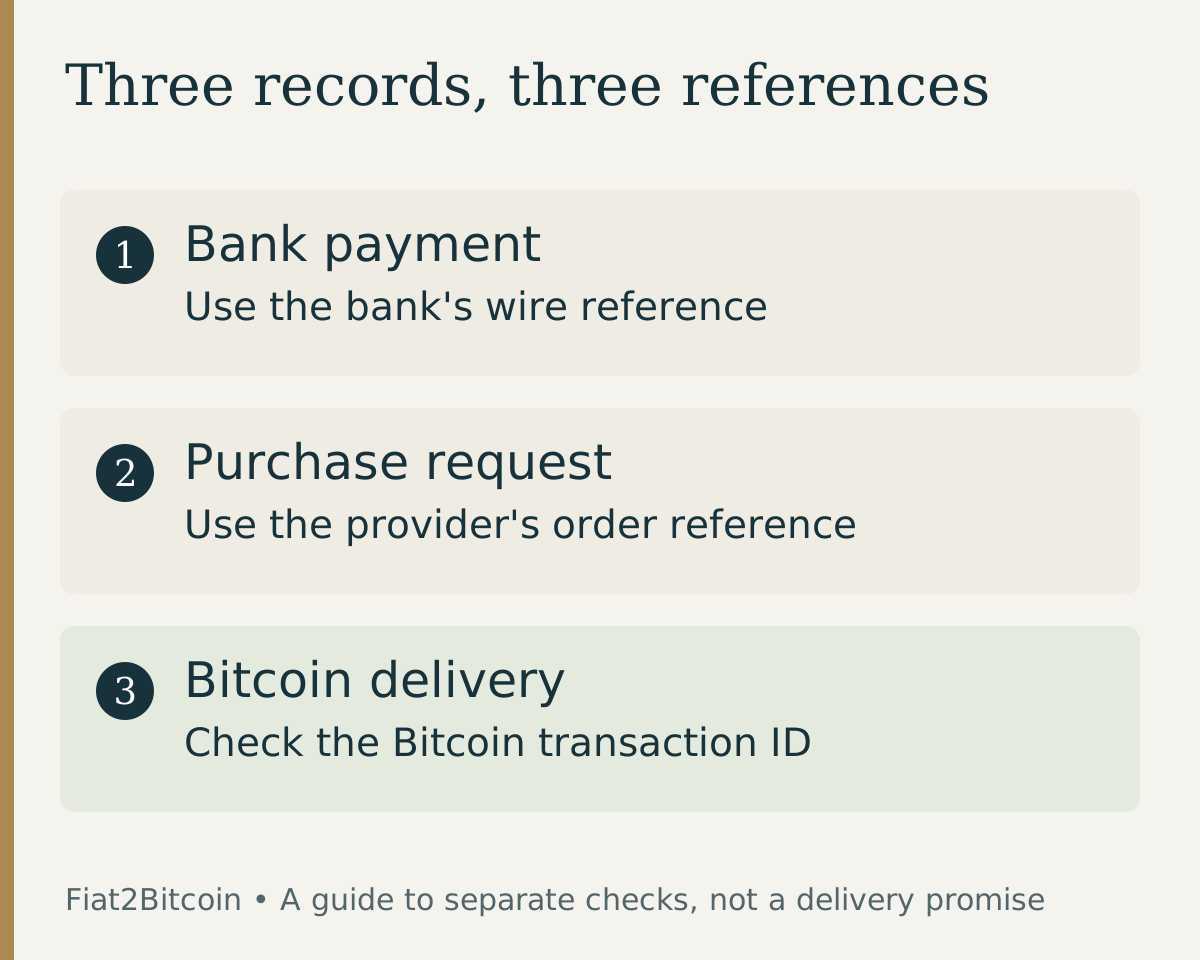
Start with the bank that sent the wire
Open the bank's official app or site and find the original transfer. Save its amount, date, status and reference. Ask what the displayed status means for this particular payment. Do not start with a tracking website from an advertisement or an unsolicited support message.
Bank labels have specific meanings. For example, Wells Fargo defines a completed digital wire as successfully sent. That does not establish the status of a separate Bitcoin order. Your bank's terminology may differ, so ask whether it means scheduled, released, credited or something else.
The wire-transfer purchase guide explains Fiat2Bitcoin's planned sequence. The bank payment must be connected to the reviewed request; its receipt, clearance, quote and wallet delivery need their own evidence. Fiat2Bitcoin's public site remains prelaunch, with accounts and payments unavailable.
What are IMAD and OMAD numbers?
IMAD means Input Message Accountability Data; OMAD means Output Message Accountability Data. They identify messages processed through Fedwire. Federal Reserve Financial Services says successfully processed messages contain both identifiers. Ask your bank which identifier it can provide and how to use it in an investigation.
You may see a separate confirmation number in the bank's app. Do not assume it is an IMAD, an OMAD or proof that the beneficiary has been credited. A number copied into an email also needs verification against the bank's actual record. The bank can explain the payment system used and the reference it recognizes.
An IMAD is not a Bitcoin transaction ID. It cannot be pasted into a Bitcoin block explorer to find dollars moving between banks. You also should not have to disclose your banking password or wallet recovery phrase to someone claiming to trace a wire.
Scroll across the table to see all columns.
| Reference | What it identifies | Who can explain it |
|---|---|---|
| Purchase request or order reference | The provider's record of your request | The purchase provider |
| Bank confirmation or wire reference | The bank's record of the dollar payment | The sending bank |
| IMAD / OMAD, when applicable | A Fedwire message | The bank handling the wire investigation |
| Bitcoin transaction ID | A transaction on the Bitcoin network | The delivery provider and your wallet records |
Gather a small, useful evidence packet
Keep the purchase instructions and bank record together so you can compare what was requested with what was submitted. Share only the details requested through a secure, verified channel. A public forum is not the place to post a bank receipt, account number or identity document.
- Record the amount, currency, submission time and time zone, plus the bank's actual sending date if different.
- Save the bank confirmation and its current status. Ask whether the wire has left the sending bank.
- Match the beneficiary and payment reference against the instructions issued for this request. Use the full details privately, not a public screenshot.
- Ask the bank for the appropriate wire reference and whether it can investigate receipt or credit to the beneficiary.
- Tell the purchase provider the request reference and bank findings. Ask which funding or purchase step remains unresolved.
- Keep each case number, response and promised follow-up date with the original record.
The Fedwire service explanation describes bank-to-bank investigation messages used to confirm receipt and credit. Your bank handles that process; finding an identifier does not give you direct access to the banking network.
A follow-up message you can adapt
To the sending bank: ‘I submitted a wire for [amount and currency] on [date and time]. Its status is [status] and my confirmation is [reference]. Has it been released? Which reference applies to tracing it, and can you confirm receipt or start an investigation? Please give me a case number and the next follow-up date.’
To the purchase provider: ‘My purchase request is [reference]. My bank says [status] for the wire sent on [date] for [amount]. Can you confirm whether the funds have been received and matched to this request? Please identify what remains before the next purchase step.’
These are original templates, not instructions to send personal banking records by ordinary email. Use the organization's verified support route and follow its secure-document process if evidence is required. Never include a password, one-time sign-in code, private key or recovery phrase.
What if the wire cannot be found?
If the sending bank has not released it, ask what is needed and when to check again. If it was sent but is unmatched, ask the bank to investigate while the provider checks its request records. If details were wrong or fraud is suspected, contact the bank immediately about cancellation or return options. Do not issue a duplicate payment while the first remains unresolved.
If someone gives you a UETR instead of a familiar bank reference, ask which payment system and tracking service applies. Swift explains UETRs as end-to-end payment references. That does not mean a public website can access every wire, or that Fiat2Bitcoin accepts an international funding route.
If the bank payment is resolved but Bitcoin is still missing, move to the order and delivery records. The pending-payment guide explains that handoff. Before any future transfer, use the wire-instruction checklist and check the wire timing guide.
Sources & further reading
General payment information and purchase-specific details serve different purposes. Review the current offer and terms before proceeding.
- Federal Reserve Financial Services: Fedwire confirmations and investigations
- Wells Fargo: Wire statuses, cancellation and returns
- Swift: Unique End-to-end Transaction References
Original Fiat2Bitcoin guide. Examples are illustrative; they are not live quotes or customer transactions. How we prepare our guides.