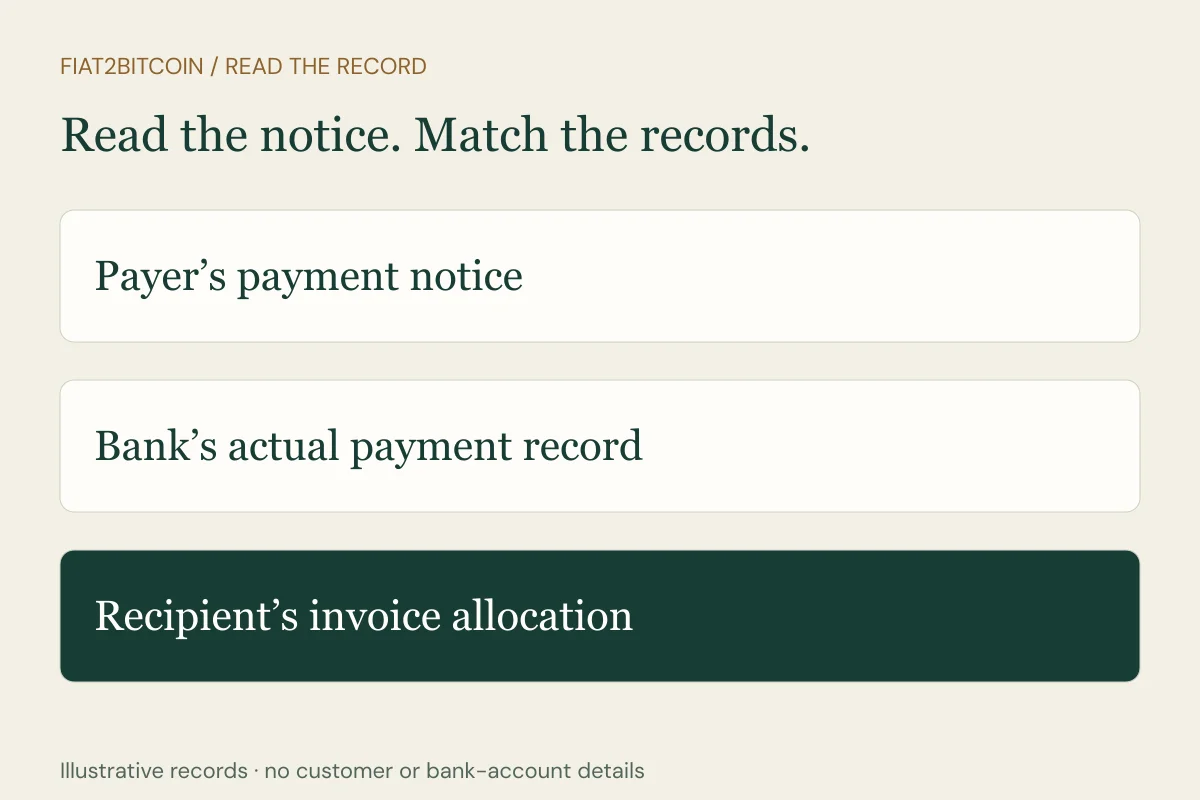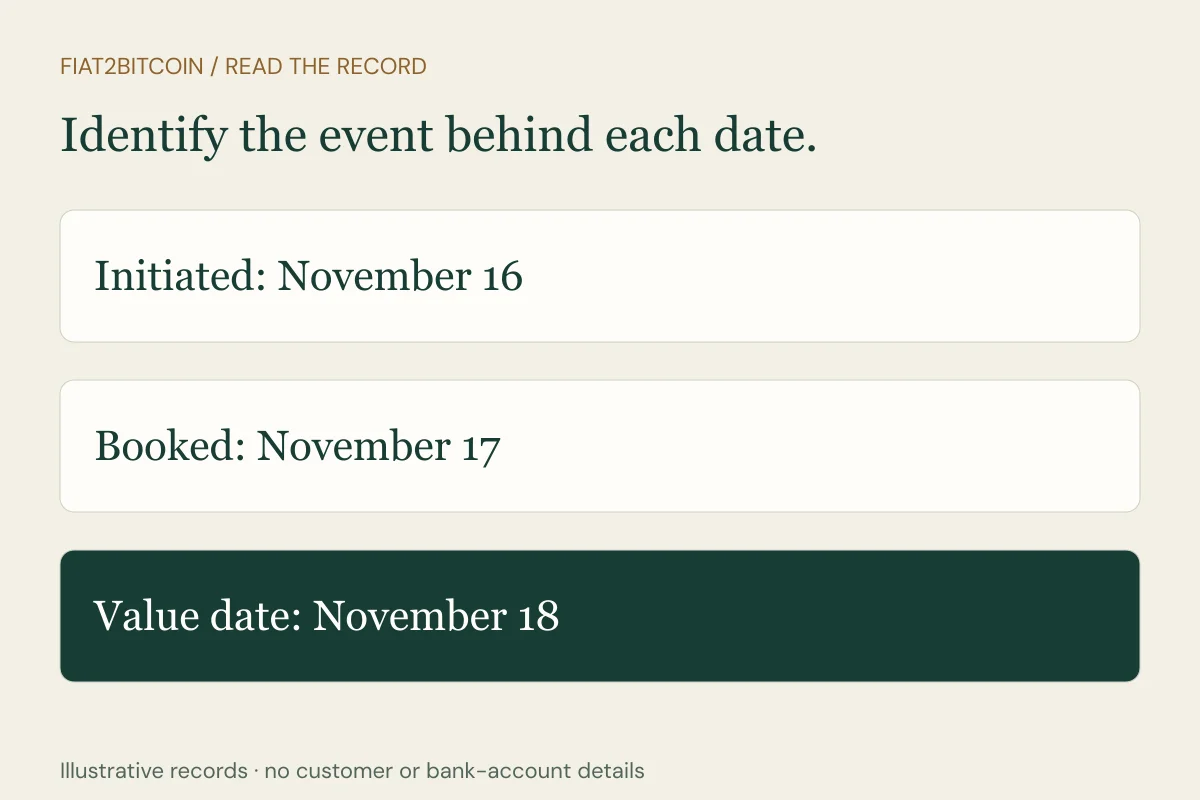
A transfer was requested on one date, booked on another and given a third value date. That can be confusing without anything being missing. Begin with the labels in the bank’s own statement or transaction details, and check whether a date is actual or expected. This is a bank-record guide, not a derivatives or foreign-exchange trading guide.
Which date should you use from a debit advice?
A bank debit advice may display several date fields. Match each label to its bank-defined event and keep the processing status beside it. For a missing wire, the receipt guide explains how the date, amount, currency and tracing references work together in an inquiry.
What does value date mean on a bank record?
The bank assigns a date for giving a transaction its financial effect under the relevant account or reporting rules. In some statement formats this is explicitly the interest date. The definition should come from the bank and the particular record, rather than a universal assumption about all transfers.
For example, Nordea’s Corporate Netbank statement-format guide defines booking date as when an entry is entered in its records and describes interest date, also called value date, as when the entry carries interest. This is a specific technical format example, not a promise about another bank’s retail display or release policy.
Ask your bank: “What does value date mean on this entry, is it actual or expected, and how does it relate to the posted status and available balance?” Its answer should identify the record and account being discussed.
Value date, booking date and transaction date
These labels often describe different events. A transaction date can refer to when you initiated a payment or when a purchase happened. A booking or posting date describes recording it in the bank’s books. The value date describes the bank-defined effective treatment. A receiving service may have separate receipt and allocation dates.
Scroll across the table to see all columns.
| Label | Question it may answer | Check before relying on it |
|---|---|---|
| Transaction / initiation date | When did the customer request or make the payment? | Does this include a time zone, and was the request accepted? |
| Booking / posting date | When did the bank record the entry? | Is the entry booked, pending, reversed or expected? |
| Value date | From which date does the bank apply the stated financial treatment? | What does this bank’s format or account agreement mean? |
| Available balance / release estimate | What can currently be used, or when might restrictions end? | Which holds and conditions are included? |
| Recipient allocation date | When did the recipient match the funds to an order? | Does the recipient confirm this, rather than just the sender? |
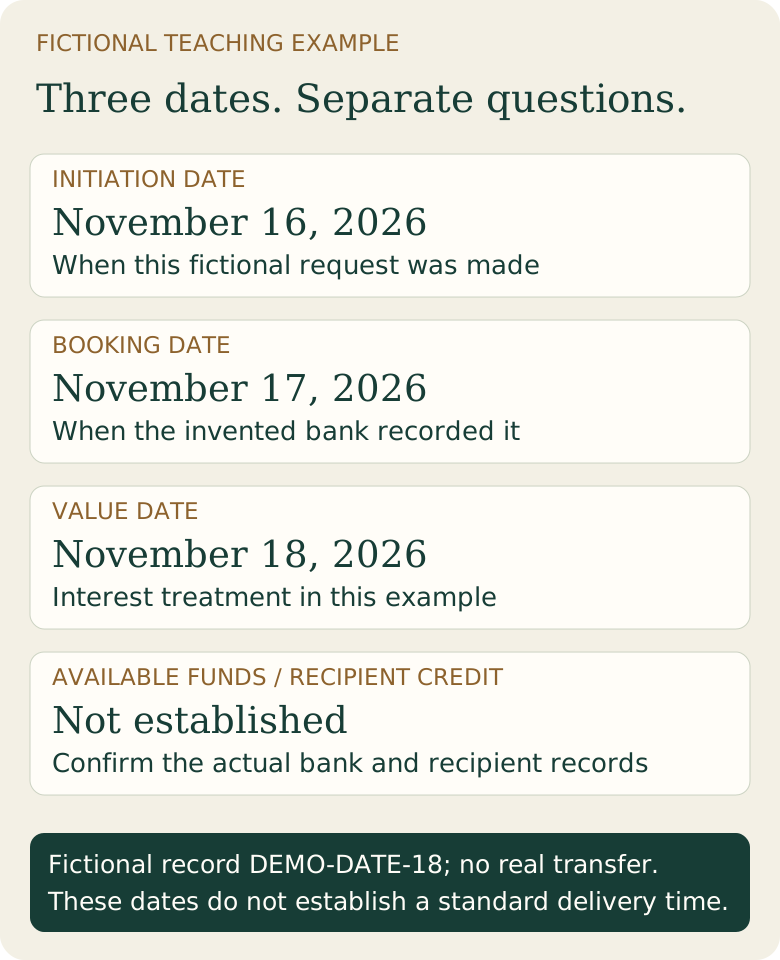
A fictional bank record with three dates
An invented payment record DEMO-DATE-18 shows initiation on November 16, booking on November 17 and a value date of November 18, 2026. The fictional bank explains that its value-date field describes interest treatment. No account number, real transfer or standard processing interval is shown.
Those dates let you ask three separate questions about that record. They do not establish a rule that all payments take two days, that the recipient was credited on November 18, or that the full amount can be spent today. The bank’s actual status, restrictions and available-balance record are still needed.
If a different record marks a date as expected while its entry remains pending, keep the expectation separate from a completed event. A later change to a forecast date is not by itself a second payment or proof of a lost transfer.
Does a reached value date mean the money is available?
Do not decide from the date alone. Read the available balance and any hold, account restriction or release condition your bank actually reports. Ask whether the date concerns interest, expected settlement, an effective credit or something else in that bank’s system.
The current-versus-available balance guide explains why a recorded balance may differ from the amount presently usable. The pending-transaction guide covers an entry that has not completed posting. Neither a scheduled date nor an advice email replaces those account records.
This distinction also matters when a payment provider applies its own review or delivery hold after a bank event. Check the provider’s conditions and stated release time separately from the bank’s dates.
What should you check when the dates look wrong?
Compare the same account, transaction identifier, currency, amount and status across the app, downloadable statement and recipient record. A different report can use a different date field. Check whether each date includes a time zone and whether a correction or reversal appears as a separate entry.
Ask the bank to explain the field rather than changing or ignoring a date yourself. If a wire is missing, use its actual bank reference and the wire-tracking checklist. Keep any remittance advice as supporting information with its issuer and stated status.
If the receiving organization cannot find the payment, ask it to distinguish receipt from matching to your invoice or order. An overdue forecast should lead to an inquiry about the existing payment, rather than an automatic duplicate.
A bank value date does not identify a Bitcoin transaction
Bank dates describe the bank-payment side. A provider’s order status describes its purchase process, and a Bitcoin transaction ID describes a separate blockchain transaction once broadcast. Record those events separately when reviewing a bank-funded purchase.
Fiat2Bitcoin does not receive customer wires, issue wire instructions or hold purchase funds. Use the actual provider’s payment and delivery records. For context, start with the ACH-learning hub or compare current purchase methods.
Sources & further reading
These sources explain the payment systems and rules discussed in this guide. For your purchase, check the provider’s current offer and terms.
- Nordea: Booking date and interest/value date in its statement format
- Wells Fargo: Available balance and pending bank records
Published by Fiat2Bitcoin. Worked examples use fictional figures and records; they are not current prices or customer transactions. How we prepare our guides.