You receive a document called Debit Advice after arranging a transfer. Its total exceeds the payment amount, or its status differs from the recipient’s records. Start by identifying the issuing institution, the account and the individual payment or charge. This guide covers bank-payment notices rather than supplier debit notes or advice about managing debt.
What is a debit advice from a bank?
It is a notice explaining a debit-related account event, often for a transfer, charge or another processed payment. The bank’s document and account record provide the details. The phrase on its own does not identify the merchant, reason for the charge or complete state of a payment.
ANZ Transactive Global’s payment-alert guidance gives a qualified example. For its listed China, Hong Kong and Singapore debit-advice alerts, payment processing can have a Completed or Completed with Error status. Read the actual status and any exception details rather than treating the alert title as the whole result.
Account notices can arrive separately from the entry they describe. Check whether the document reports an executed transaction, a processing event or another stage defined by the issuer. For date labels, the value-date guide explains the distinction between the bank’s effective date and other transaction dates.
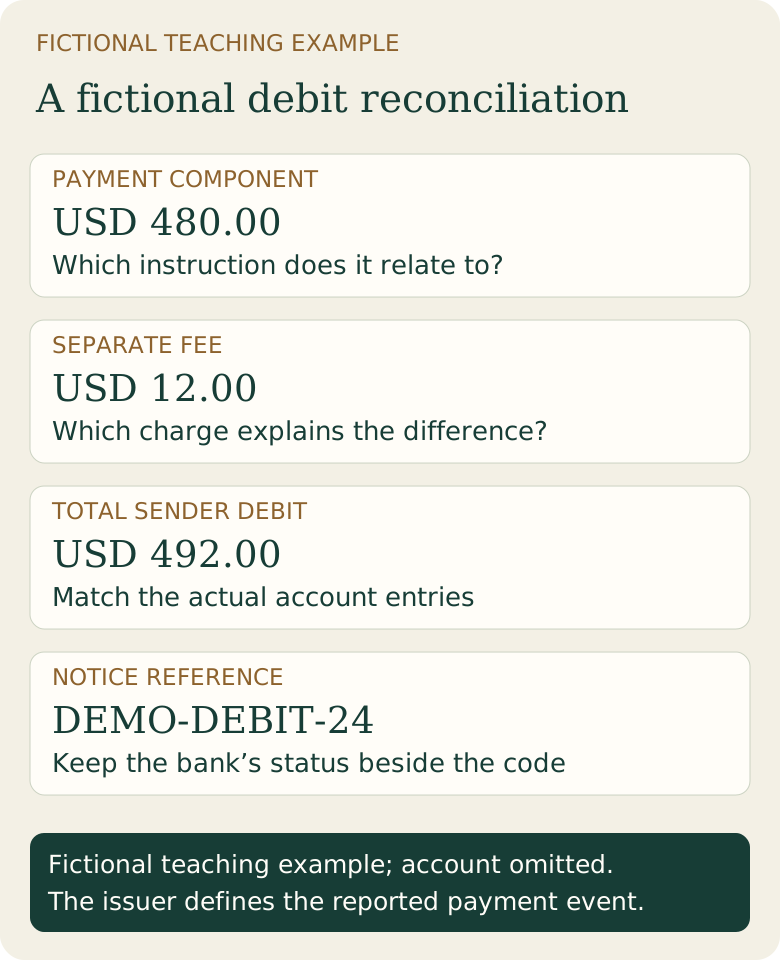
A fictional debit advice with a payment and separate fee
In this invented example, a bank records a USD 480.00 payment and USD 12.00 fee against Alex Example’s account. The total sender debit is USD 492.00. The notice uses DEMO-DEBIT-24 as its fictional reference; the account number is omitted. No customer payment or outcome is represented.
The useful reconciliation is USD 480.00 + USD 12.00 = USD 492.00. Ask whether the bank booked those components together or separately. The fee amount belongs to the sender’s charge record in this example; the recipient must separately match its incoming payment.
Scroll across the table to see all columns.
| Notice item | Amount or record | Question to answer |
|---|---|---|
| Payment component | USD 480.00 | Which instruction does this debit relate to? |
| Separate fee | USD 12.00 | Which charge explains the difference? |
| Total sender debit | USD 492.00 | How does this match the account entries? |
| Notice reference | DEMO-DEBIT-24 | Which bank record should support investigate? |
Debit advice versus credit advice: whose account event?
A debit advice concerns the account being debited or the debit-related event described by the bank. A credit advice concerns an incoming credit. Ask which account, amount and event the issuer is referring to, especially when a payment crosses several institutions.
In the same ANZ product guidance, its listed credit-advice alert is triggered when a credit is deposited into an entitled account. That illustrates the different account perspectives. It does not make every credit-advice document from another institution identical.
A remittance advice may instead explain how the payer intends to allocate a payment among invoices and credits. A wire receipt may describe the sender’s transfer record. Keep the issuer and event beside each document so the records can be reconciled.
Where do you find the debit advice or payment confirmation?
Open your bank’s official transaction history or reporting menu and select the relevant account and entry. Look for advice, confirmation or document options. For a business account, the report may require account permissions or be available to the person responsible for payments.
Spuerkeess’s S-Net help page describes one institution’s process: its transfer or standing-order debit advice is available on the working day after execution, while a payment confirmation is available immediately after execution. That timing belongs to that service. Ask your own bank when its document becomes available and which record to use meanwhile.
If the entry has a different description or the report is missing, provide the bank with the amount, currency, date and account ending through its verified channel. Ask it to identify the payment and supply the applicable notice or statement record. Use the payment-reference guide to keep the bank’s code separate from a recipient reference.
Is debit advice the same as a direct debit or supplier debit note?
A direct debit is a payment arrangement in which an authorized party collects funds from an account under the applicable scheme. A debit advice is information about an account or payment event. Whether an institution supplies a particular notice for a direct debit depends on its service.
The Spuerkeess page explicitly distinguishes its direct-debit documentation from transfer debit advices. Its example helps explain why a notice can be available for one payment method but absent for another.
A supplier’s debit note belongs to the commercial billing relationship and can describe an adjustment to what is owed. Read the issuer and purpose rather than using the word debit to treat a supplier document as a bank account entry. For accounting treatment, have the responsible accountant reconcile the actual transaction, invoice and bank record.
What should you do about an unfamiliar debit advice?
Find the corresponding entry in your authenticated bank account before using links in an unexpected email. Compare its reference, amount, currency and date with payments, fees and arrangements you recognize. Ask the bank to explain an unclear description or exception status.
If you suspect an unauthorized debit, contact the bank promptly using the official app or a known contact route and ask about its reporting and account-protection process. Keep the original notice and the bank’s case reference. The available process and deadlines depend on the account, payment method and location.
If the debit relates to a transfer the recipient cannot find, ask the bank to investigate the original payment using the relevant network reference. The wire-tracking guide separates sending, receiving-account credit and recipient matching. For a purchase, the provider named in checkout handles payment and delivery questions; review current purchase options for the routes actually offered. Fiat2Bitcoin does not receive customer purchase wires or issue bank instructions.
Sources & further reading
These sources explain the payment systems and rules discussed in this guide. For your purchase, check the provider’s current offer and terms.
- ANZ: Institution- and geography-specific debit/credit alerts
- Spuerkeess: Debit advice, confirmation and direct-debit documentation
Published by Fiat2Bitcoin. Worked examples use fictional figures and records; they are not current prices or customer transactions. How we prepare our guides.