Your invoice shows one reference, your bank confirmation shows another, and a support agent asks for a payment reference number. All three can be describing different records. The useful first question is: who created this identifier, and which event does it identify?
What is a remittance number, and is it the reference you should send?
A remittance number is an identifier issued for a payment or remittance record. Its exact meaning depends on the issuer. It may identify the service’s transfer, the sender’s bank record or an allocation notice. Ask who assigned it and where the requested number appears before copying it into an invoice-reference field.
Western Union’s MTCN explanation gives a concrete example: its tracking number is a unique 10-digit value found on the transfer receipt or in account history. That format belongs to its service, not all remittance numbers. Western Union says to share it only with the receiver or its representative; do not post it publicly.
For an invented payment, DEMO-REMIT-63 could identify the transfer while DEMO-INVOICE-63 identifies the recipient’s bill. Label both with their issuer and role. A bank-issued UETR is another separate identifier. None of these teaching values is usable for tracking a real payment. A lookup should use the actual issuing institution’s official channel, not an unrelated “universal remittance tracker.”
Is the requested reference a UETR or a bank confirmation?
For a Swift payment, a UETR helps the banks follow the same payment through the chain. The sending app can separately assign a confirmation code, while the recipient uses its own invoice or order reference. The receipt checklist helps identify which code each team needs.
What if the reference came on a remittance advice?
A remittance advice can link one payment to several invoices or credits. Keep the issuer and payment status beside its reference. The bank’s confirmation identifier and the recipient’s allocation record may still be separate.
A date printed beside the reference can describe scheduling, processing, posting or another event. The value-date guide explains why a bank’s effective date can differ from its booking date and your own initiation date.
What is a payment reference number?
The phrase is used for more than one thing. A recipient may issue a code for matching an incoming payment to an invoice, customer or order. A bank may label its own transaction identifier a reference number. Read the surrounding instructions and record the issuer with the value.
Wise’s bank-transfer instructions give a provider-specific example: its checkout supplies a unique reference to include with the bank payment so it can identify the deposit and link the transfer. That policy belongs to Wise. Another institution can require a different format or field.
A reference can contain letters as well as digits. Preserve the exact code and any formatting instructions supplied for your payment. Do not copy a teaching example, invent a customer number or assume every reference is globally unique.
Example: the invoice reference and bank reference differ
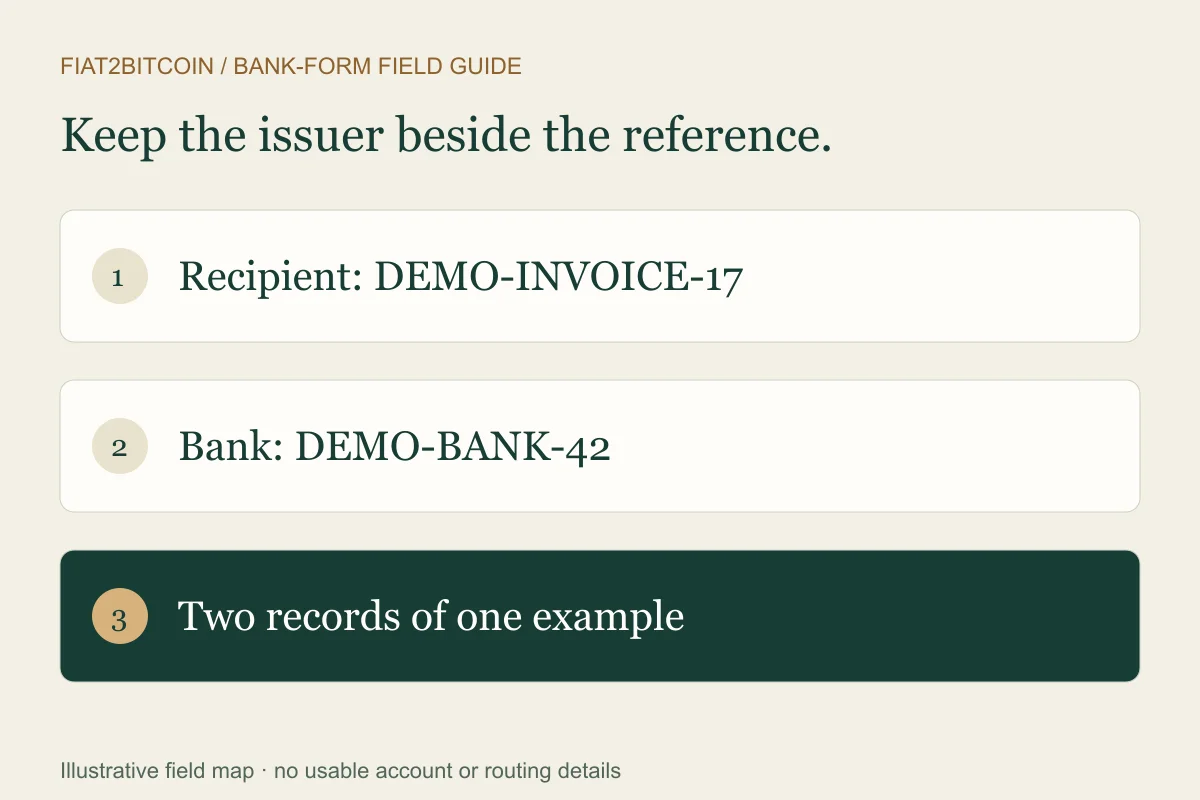
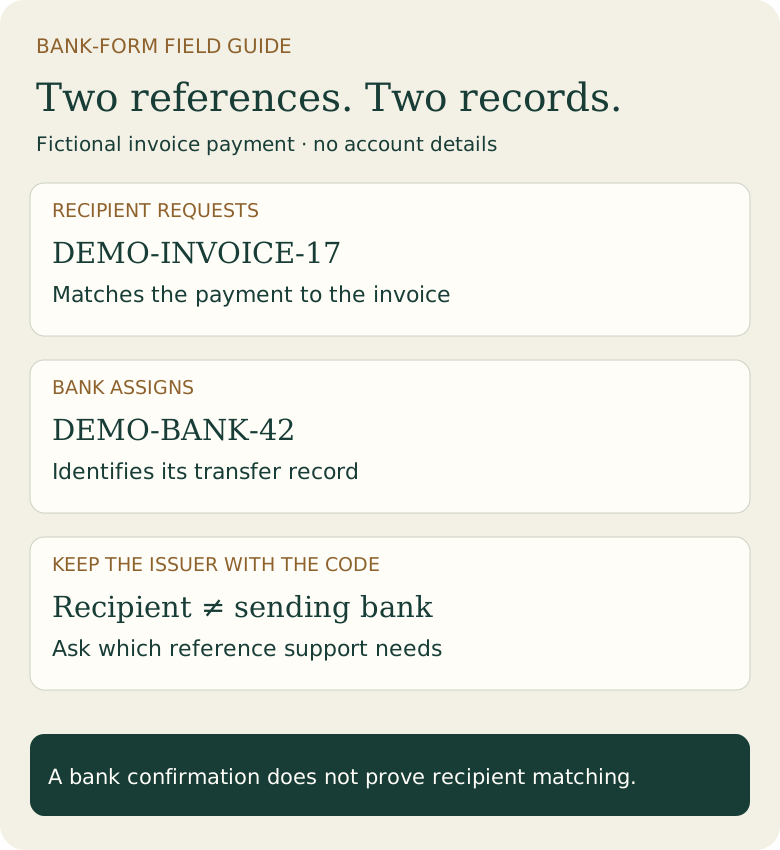
Alex Example pays a fictional invoice from Example Studio LLC. The studio requests DEMO-INVOICE-17 in the transmitted payment reference. After sending, Alex’s bank assigns DEMO-BANK-42 to its own record. Both invented values are useful, but they answer different questions.
Scroll across the table to see all columns.
| Record | Invented reference | What it helps identify |
|---|---|---|
| Recipient’s invoice/instructions | DEMO-INVOICE-17 | The invoice or order the recipient should match |
| Sending bank’s confirmation | DEMO-BANK-42 | The bank’s record of the transfer |
| Recipient’s support case | DEMO-CASE-9 | The investigation or customer-service conversation |
| Bitcoin delivery, if any | No TXID in this bank-payment example | A separate blockchain transaction after a provider sends crypto |
Where can you find your payment reference?
Before paying, read the invoice, payment request or verified checkout instructions. Look for a reference, customer ID, invoice number or order code that the issuer explicitly asks you to transmit. For a completed bank payment, open its detailed receipt or confirmation and check both the bank-created identifier and any message sent to the recipient.
A saved recipient nickname may be visible only inside your app. A private note or personal memo may also differ from the information transmitted with the payment. Ask your bank which field actually reaches the receiving institution and whether its receipt shows the complete transmitted value.
If support asks for “the reference,” clarify whether it wants the bank transaction ID, its own order number or the reference carried with the payment. Supplying each with an issuer label is clearer than guessing which code to send.
Reference, account number, wire trace and TXID
An account number identifies an account; it does not replace a requested order reference. Further-credit instructions can identify a final customer after funds reach a named receiving account. Those details may coexist with a separate invoice or order reference.
A wire trace or message identifier helps the banks locate a bank payment. An IMAD number, for example, belongs to the wire-message context covered in that guide. A Bitcoin transaction ID belongs to a blockchain transaction. Neither should be pasted into a recipient’s requested invoice-reference field unless that recipient specifically confirms the requirement.
The wire-tracking guide explains tracing an existing bank payment. This guide focuses on identifying and transmitting the matching reference the recipient asked for.
What if you forgot or entered the wrong reference?
Check the existing payment’s status with the sending bank and contact the intended recipient through its known support channel. Give the amount, currency, sending date, bank confirmation identifier and intended reference through the secure route it specifies. Ask whether it can match the payment or needs a bank investigation.
Wise’s missing-reference guidance says it may still match a payment, may request proof of payment, or may return funds if matching is not possible. That is an example of one provider’s process, not a promise that another biller or checkout can do the same.
Ask for a case reference and next-update time. Do not infer receipt from a debit in your bank app, and resolve the existing payment before sending another. Share documents through verified channels; avoid posting full account numbers or transfer receipts publicly.
Using references during a Bitcoin purchase
Keep the provider’s order number, any required bank-payment reference and the eventual crypto-delivery record separately. A matched bank payment can still be followed by provider review; a bank receipt is not proof that Bitcoin reached a wallet.
Fiat2Bitcoin does not receive customer wires or issue bank instructions. Use the provider named in your checkout for payment instructions, matching and refund questions. Compare current purchase methods before choosing a route, and use the wire-learning hub when you need help reading the bank terminology.
Sources & further reading
These sources explain the payment systems and rules discussed in this guide. For your purchase, check the provider’s current offer and terms.
- Western Union: MTCN issuer, receipt location and confidentiality
- Wise: Required reference in its bank-transfer funding flow
- Wise: Its process for an omitted or incorrectly forwarded reference
- Schwab Bank: Separate receiving account and further-credit fields
Published by Fiat2Bitcoin. Worked examples use fictional figures and records; they are not current prices or customer transactions. How we prepare our guides.