Start with the wire-transfer Bitcoin purchase guide for the full sequence. Fiat2Bitcoin remains prelaunch, and employees issue bank instructions for each reviewed request. This article explains a term you may encounter; it does not mean every request will use further-credit instructions.
What does “for further credit to” actually tell the recipient?
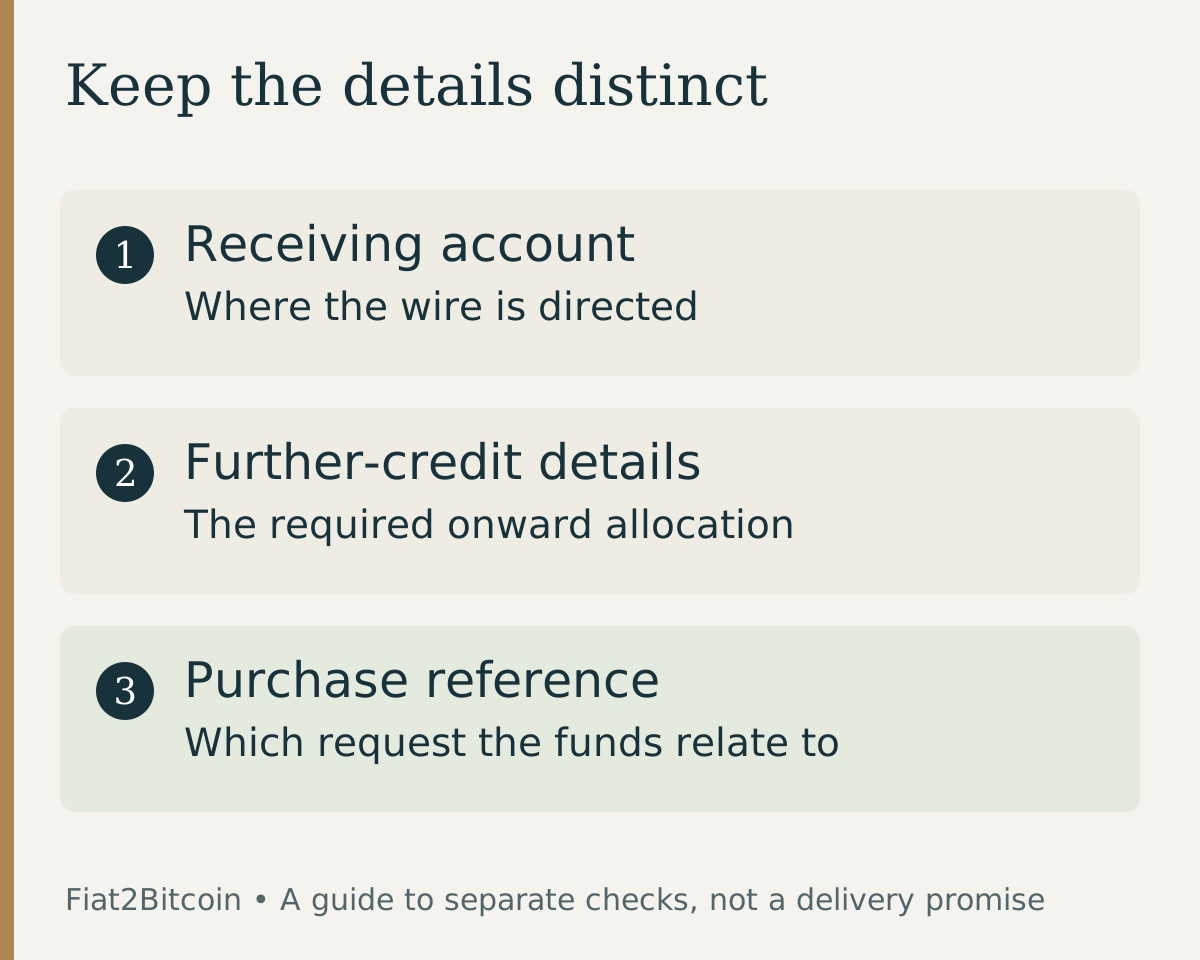
The phrase adds a final allocation instruction. The wire first reaches the account specified in the receiving instructions, then the recipient uses the additional details to identify where the funds belong within that arrangement.
Charles Schwab's funding explanation provides a concrete institutional example: its wire instructions distinguish an institution-level receiving account from the client details used for further credit. That example explains the term; it is not a template for a Fiat2Bitcoin payment.
Do not copy the account setup, beneficiary name or banking details from another company's help page. The relevant instruction is the one verified for your own payment. Even an earlier request with the same provider may have different details.
FFC, beneficiary and memo are different fields
Scroll across the table to see all columns.
| Detail | Purpose | Mistake to avoid |
|---|---|---|
| Beneficiary / payee and account | The named receiving account in the instructions | Replacing it with a final customer reference |
| For further credit details | The required onward allocation within that receiving arrangement | Omitting it because the main account number looks complete |
| Purchase or order reference | The particular request being funded | Assuming it is always the same as an FFC account identifier |
| Memo or message field | Additional information as supported by that bank's form | Assuming a memo automatically satisfies a required FFC instruction |
| Intermediary bank | A bank involved in routing the payment | Confusing the bank's role with the final allocation |
The exact labels are institution-specific. Fidelity's wire-entry walkthrough includes a separate further-credit question and a memo option. It also tells customers to confirm instructions with their bank. Do not assume that another bank uses identical labels or transmits every free-text field in the same way.
If the instruction sheet also names a routing bank, the intermediary-bank guide explains that separate role.
A simple example: received does not mean allocated
Imagine a hypothetical $5,000 wire whose verified instructions require both a receiving account and a final customer identifier. The receiving account tells the banking system where to deliver the wire. The additional identifier tells the receiving organization which customer record should receive the allocation.
If that identifier is missing, a successful sending confirmation cannot establish that the recipient matched the money to the correct purchase request. The recipient must check its own records and explain what it needs to investigate.
This example does not supply account numbers or a payment format. It shows why the question Did my bank send it? differs from Did the recipient identify it for my request? Neither answer alone establishes a Bitcoin price, purchase approval or wallet delivery.
What if your bank has no “for further credit” field?
- Keep the verified instruction sheet open and stop before submitting the wire.
- Ask the sending bank whether its form supports all required further-credit details.
- Have the bank explain exactly which fields will carry those details and whether any character limits apply.
- Resolve any mismatch with the original instruction issuer through the established channel.
- Review the full confirmation screen against the verified instructions before authorizing the transfer.
Do not shorten an account identifier, drop a name, or move details into an unrelated field just to make the form submit. If the bank requires a branch-assisted process or cannot transmit the required information, clarify the supported process before payment.
A useful question is: My verified wire instructions require further-credit information, but this form has no matching field. How will you transmit the complete required details, and can I review them before sending? This asks the bank to explain its own system without guessing a field mapping.
What if the wire was already sent without further-credit details?
Contact the sending bank promptly with the actual wire reference and explain exactly what was omitted. Ask whether it can investigate or transmit a correction for that payment. Separately, contact the instruction issuer through the verified channel so it can look for the payment against your request.
Keep the original instruction sheet, bank confirmation, amount, sending date and purchase reference together. Use the wire-tracking guide to organize those records. Do not send a second wire merely because the first has not been allocated.
A correction, investigation or return request is not a confirmed outcome. The wire cancellation guide explains why recovery depends on the payment's actual stage. Wait for authoritative confirmation of what happened.
Before a future wire, use the instruction-verification checklist and compare every required field. An unexpected change in beneficiary or further-credit details needs verification through the established channel, even if it arrives in a familiar-looking message.
Sources & further reading
General payment information and purchase-specific details serve different purposes. Review the current offer and terms before proceeding.
- Charles Schwab: Receiving accounts and further-credit details
- Fidelity: Further-credit fields and wire instructions
Original Fiat2Bitcoin guide. Examples are illustrative; they are not live quotes or customer transactions. How we prepare our guides.