For a Bitcoin purchase by wire transfer, start with the instructions issued for the reviewed request. Fiat2Bitcoin remains prelaunch. This explanation does not establish international-wire eligibility or supply funding instructions; employees issue request-specific instructions after review.
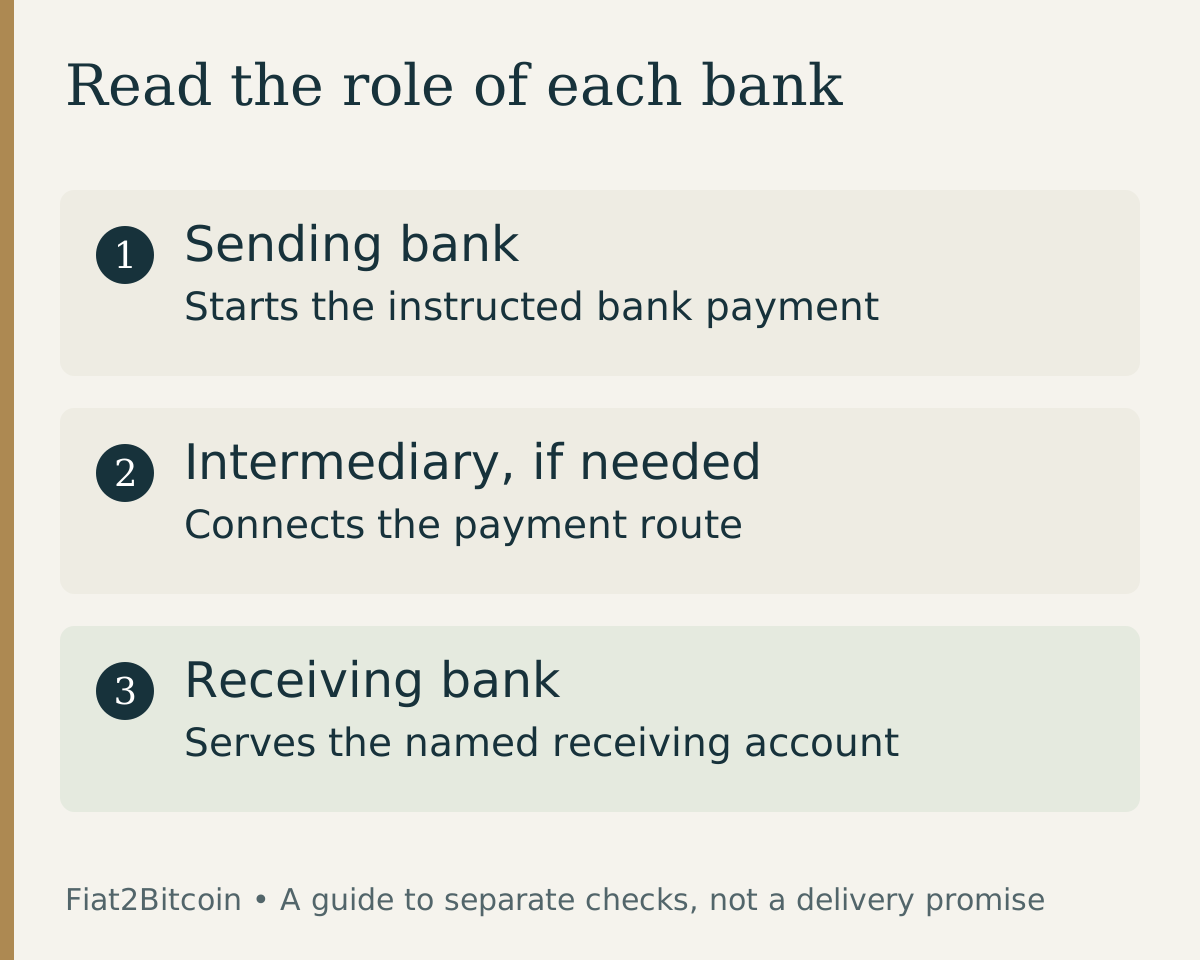
Intermediary bank vs. beneficiary bank: what is the difference?
Scroll across the table to see all columns.
| Term | Role in the instructions | What to clarify |
|---|---|---|
| Sending bank | Starts the wire on the sender's instruction | Can it send the exact instructed payment? |
| Intermediary bank | Provides a connection along the payment route | Are its details required, and where do they belong? |
| Beneficiary / receiving bank | Holds or services the named receiving account | Which bank identifier and account details apply? |
| Beneficiary / payee | The named recipient on the wire instructions | What exact name and account must be used? |
| Further-credit details, if required | Identify an additional final allocation | What exact final name or reference must travel with the wire? |
An intermediary bank and a beneficiary bank describe different roles. A bank can serve different roles in different transfers. The SoFi intermediary-bank explainer describes how a bank can bridge a gap when the sending and receiving institutions do not have a direct relationship.
A form's labels may differ from the instruction sheet. Do not decide where an account number belongs just because it appears beside a familiar bank name. Have the sending bank map the verified instructions to its own form.
Does every wire need an intermediary bank?
No. The route depends on the institutions, destination, currency and payment service. Intermediaries are common in cross-border explanations, but the presence of an intermediary field on a form does not mean you must fill it in.
Wells Fargo's wire FAQ explains that intermediary information may be needed in some cases and describes how its own international-wire process handles routing. That is guidance for that bank's service, not a universal form-filling rule.
If your verified instructions do not name an intermediary and the bank's form requires one, pause and ask the bank and the instruction issuer to resolve the mismatch. Do not search for a bank with a similar name or reuse information from an earlier purchase.
A routing explanation also does not prove that a particular Bitcoin provider accepts funds from your country, account type or bank. Establish purchase eligibility before arranging any wire.
An example: three banks, one purchase request
Imagine a hypothetical route from Sending Bank A, through Intermediary Bank B, to Receiving Bank C. Bank B's participation does not make it the seller of Bitcoin or the owner of the final receiving account. Each institution has a role in moving the bank payment.
Your instruction sheet may also identify a beneficiary account and a separate purchase reference. Those are not interchangeable with the intermediary bank's identifier. Retain the complete verified instructions so your bank can see the relationship between the fields.
If the sheet includes for further credit, read the further-credit explanation. That detail concerns allocation after funds reach the named receiving arrangement; it is not another name for every intermediary bank.
This example supplies no usable account details. It explains why replacing one field with another can produce a payment that is hard to identify or route correctly.
Five questions to ask before sending
- Does the sending bank support this exact payment route and currency?
- Are intermediary details required for these instructions, and which fields should contain them?
- Will every required beneficiary, further-credit and purchase-reference detail be transmitted?
- What sending or intermediary charges may apply, and could any reduce the amount received?
- What confirmation and payment reference will the bank provide if receipt needs investigation?
Stripe's intermediary-bank guide describes the routing role and possible charges. The useful number for your purchase is the amount expected to arrive under the actual instructions, not an assumed generic bank fee.
If a possible deduction could leave the request short, ask the instruction issuer how to handle it before sending. Do not increase the transfer amount or make a second payment on your own. The Bitcoin purchase-fee guide separates bank charges from the purchase quote and service fee.
Does passing through an intermediary mean the wire is complete?
No. A sending-bank confirmation, receipt at another bank, allocation to the correct request and approval for a Bitcoin purchase are separate records. An intermediary's involvement also does not establish a fixed additional delay.
Use the wire timing guide to separate bank processing from purchase review and delivery. If receipt is unclear, ask the sending bank to investigate using its payment reference, and ask the purchase provider about the matching request. The wire-tracking checklist explains what information to keep.
Before any transfer, follow the broader wire-instruction verification checklist. If instructions change unexpectedly, verify the change through an established channel before sending funds.
Sources & further reading
General payment information and purchase-specific details serve different purposes. Review the current offer and terms before proceeding.
- SoFi: What an intermediary bank does
- Wells Fargo: Wire instructions and intermediary information
- Stripe: Intermediary-bank routing and charges
Original Fiat2Bitcoin guide. Examples are illustrative; they are not live quotes or customer transactions. How we prepare our guides.