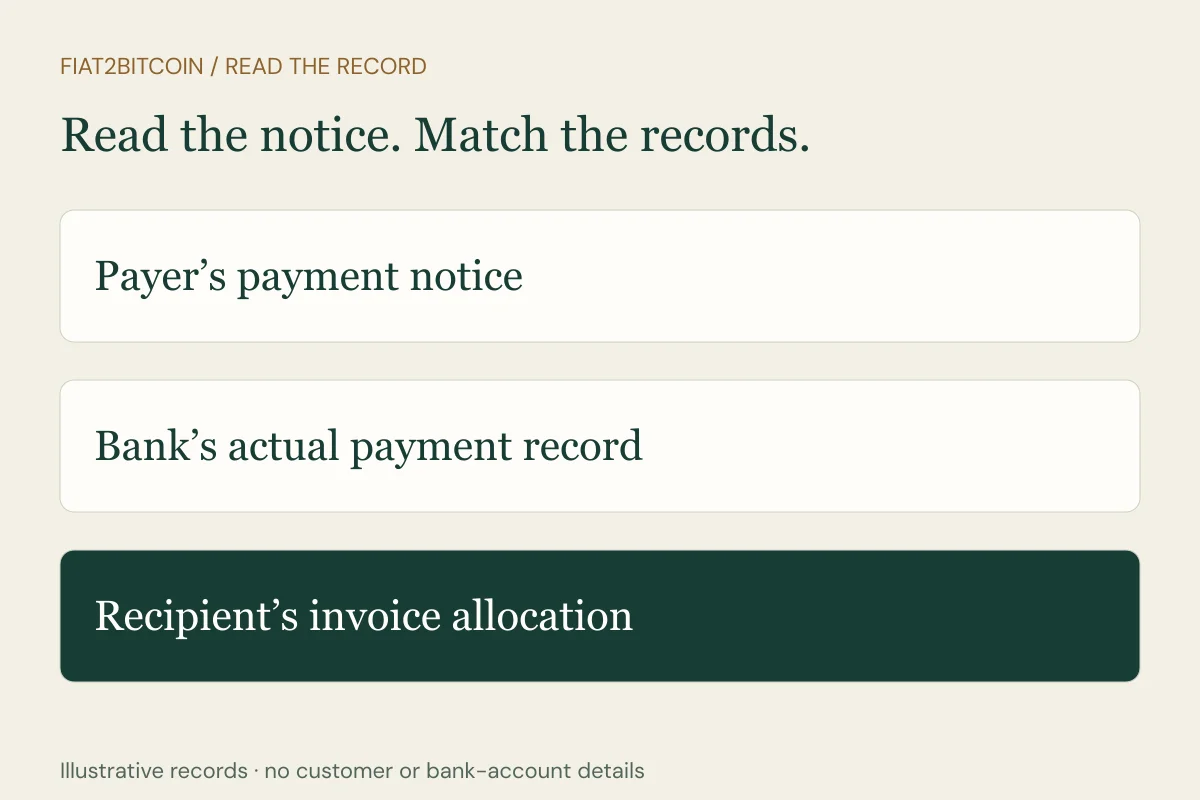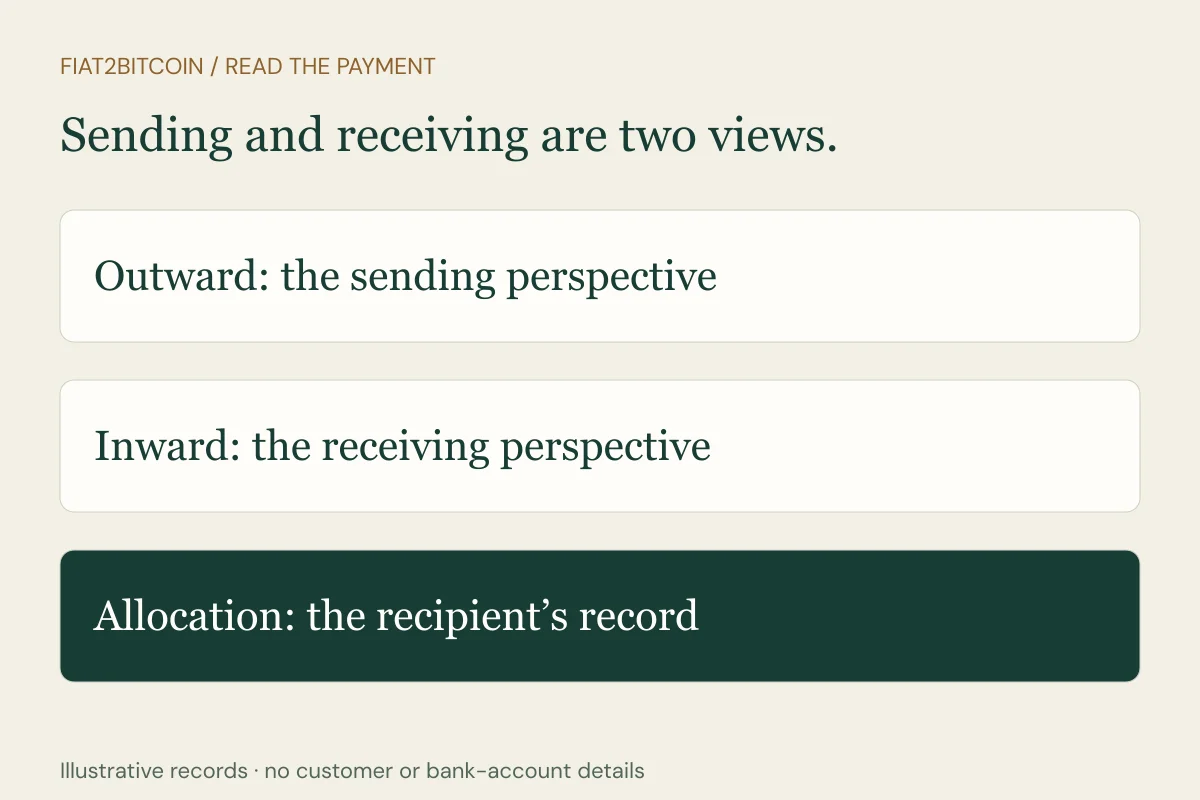
Your sender says an outward remittance was completed, while your bank is asking about an inward remittance. They may be describing opposite sides of the same transfer. Start by identifying the sending bank, receiving bank, amount, currency and references, then ask which event each institution has confirmed.
Which sender-side record should you compare with the incoming credit?
The outward-remittance guide separates a sending instruction, the sender’s account debit and the receiving credit. Its original USD 750 example shows how a fee added to the sender’s debit differs from a deduction from the amount reaching the recipient.
When a sender says “I sent the full amount,” ask which of those figures it means. Obtain the original instruction and the receiving credit, then identify the institution responsible for each actual fee. Do not infer the charge arrangement from the size of a shortfall alone.
What does inward remittance mean?
In cross-border banking, inward describes funds coming into the receiving market, institution or account. The service may cover a particular set of incoming transfers, so read the bank’s definition and status labels. Sending instructions and receiving-account credit belong to different records along the route.
HSBC India’s remittance explainer uses inward for money transferred into India from outside India and outward for money transferred from India elsewhere. That is a country-specific example of the directional distinction. Its currency conversion, documentation and regulatory requirements apply to that described service, rather than every incoming payment worldwide.
Find the named sender and receiving account in the original instructions. The remitter guide explains the sender’s role, while the beneficiary-bank guide identifies the institution serving the receiving account.
Inward versus outward: the same payment from two sides
Imagine Alex Example at Example Sending Bank pays Example Studio LLC at Example Receiving Bank. From the sending service’s perspective, the payment is outward. From the receiving service’s perspective, it is inward. The banks can have separate confirmation references and reporting times for that payment.
A sending-bank status and an incoming-bank entry should be reconciled using the actual references, amount, currency and parties. If the sender has only a scheduled instruction, ask when it was released. If the receiving bank has credited the account, ask the recipient’s payments team whether it matched the invoice or customer record.
Scroll across the table to see all columns.
| Perspective | Record to obtain | Question to answer |
|---|---|---|
| Sender: outward | Original sending confirmation | Was the payment actually released? |
| Banks in the route | Network and investigation references | Which payment and event are being traced? |
| Recipient: inward | Actual incoming-account entry | What amount and currency were credited? |
| Recipient’s invoice system | Allocation record | Which invoice or customer was matched? |
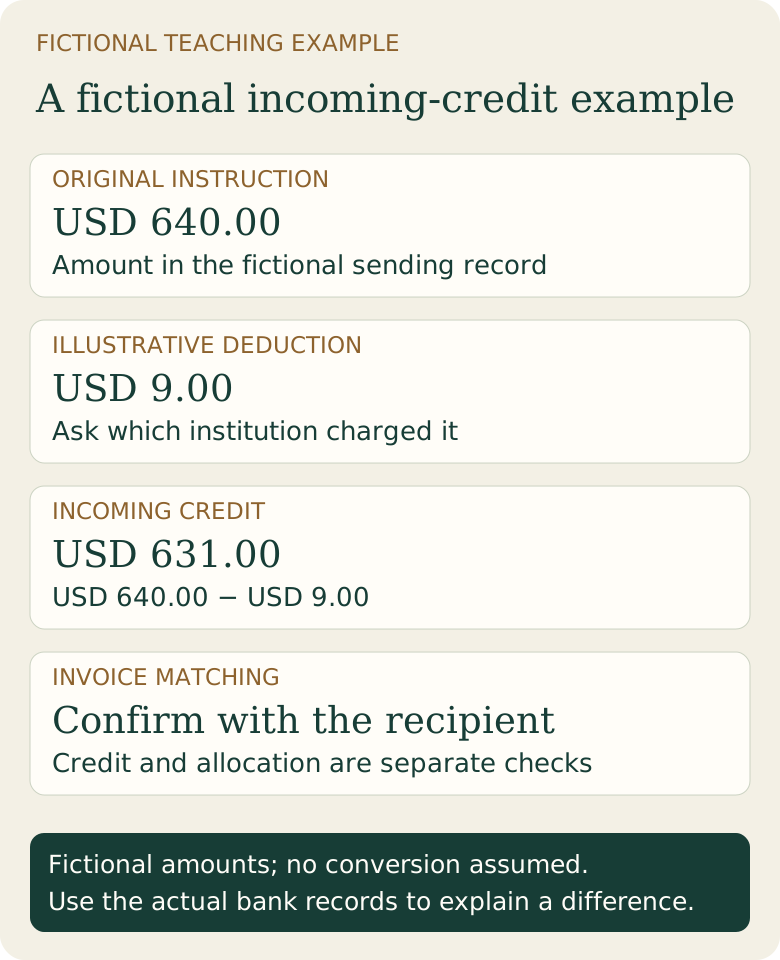
A fictional incoming amount after a charge
An invented instruction sends USD 640.00. In this example only, a USD 9.00 charge is deducted before the receiving credit, leaving USD 631.00. The arithmetic is USD 640.00 − USD 9.00 = USD 631.00. No currency conversion or other fee is assumed.
If the invoice requires USD 640.00, the recipient needs an explanation of the USD 9.00 difference. Ask the banks which institution charged it, how the selected charge arrangement was applied and whether the recipient booked the net credit to the correct invoice. A different real payment can have different fees, currencies and treatment.
Hang Seng’s inward-remittance FAQ notes that its credited amount can be net of charges. The same FAQ describes its own advice and notification process. This provides a concrete institution example without turning one bank’s fee or timing rules into a general promise.
What is an inward remittance advice?
It is a bank-issued notice about an incoming remittance under the issuing institution’s reporting process. Check its status, account, amount, currency, dates and reference. Identify the specific incoming-account entry it describes, especially if the sender has several payments or the recipient has multiple accounts.
The Hang Seng FAQ describes an inward-remittance advice for its listed business-banking services when funds are successfully credited or remitted to the account. A payer’s separate remittance advice can instead explain which invoices it intends to cover. Keep the issuer and reported event beside each document.
A value date can also describe a different event from the sending date or the recipient’s invoice allocation date. Ask the bank to explain the dates for the particular entry rather than calculating an arrival promise from the word inward.
What if the inward remittance is missing or under review?
Obtain the sender’s official transfer receipt, including the amount, currency, actual sending date and references. Ask the receiving bank whether it has the instruction, an unmatched incoming item, a credited entry or a request for further information. Provide requested documents through its verified secure process.
For a Swift route, ask the sending institution for the UETR and the latest reported event. Other networks use their own references. Keep the bank’s case number and next-update time, then ask the recipient’s payments team which customer or invoice field it still needs to match.
Country-specific purpose codes, foreign-exchange reporting and evidence requirements depend on the actual banks, location, payment and account. Describe the true purpose and obtain the receiving institution’s instructions. This guide does not supply a purpose code, tax treatment or regulatory eligibility decision.
How does incoming bank credit relate to a purchase?
Where a provider supports a bank-payment route, it can have separate stages for receiving funds, matching the order, review and delivery. If a payment requires further-credit details, confirm how those details were transmitted and how the recipient will identify the final customer.
Use the provider named in the actual checkout for purchase-specific questions. Fiat2Bitcoin does not receive customer wires, issue bank instructions or hold purchase funds or crypto. Current purchase options show the routes offered for your location and account. An incoming-bank entry and a Bitcoin wallet transaction answer different questions.
Sources & further reading
These sources explain the payment systems and rules discussed in this guide. For your purchase, check the provider’s current offer and terms.
- HSBC India: Country-specific inward/outward terminology
- Hang Seng: Incoming credits, advices and net-of-charge amounts
Published by Fiat2Bitcoin. Worked examples use fictional figures and records; they are not current prices or customer transactions. How we prepare our guides.