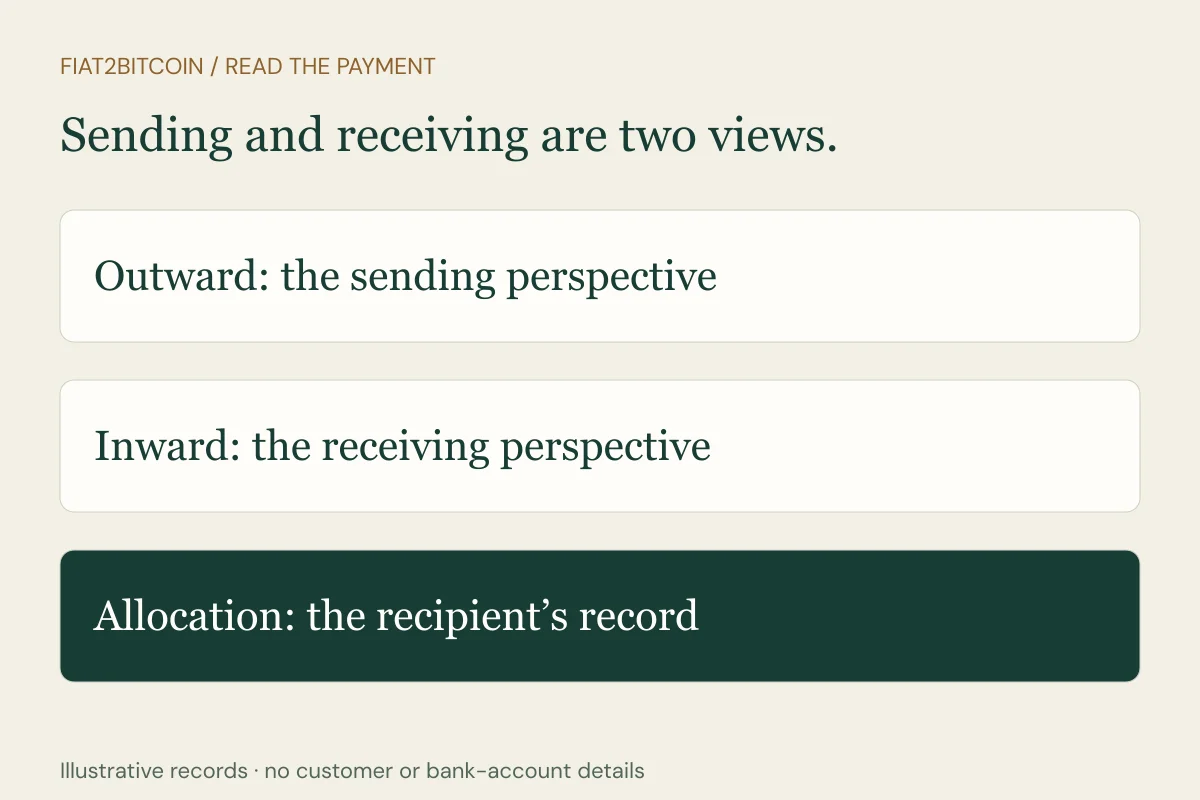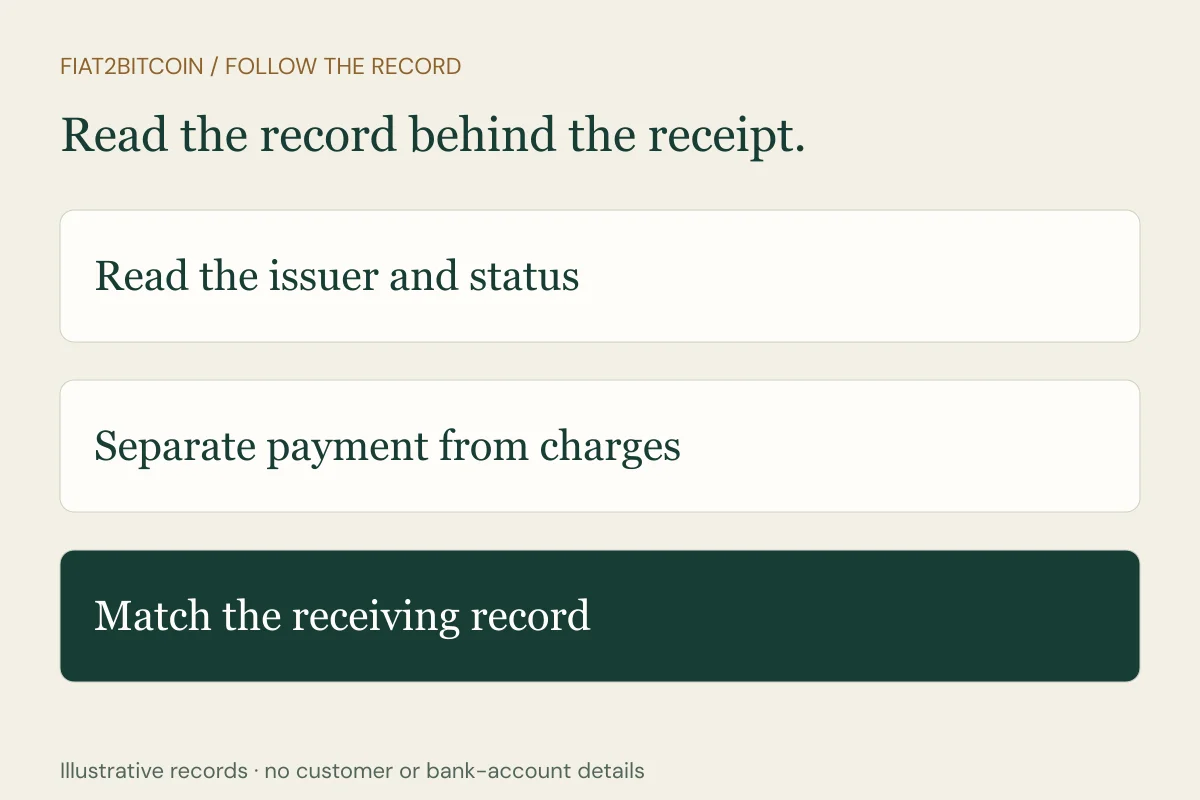
Your bank statement says “outward remittance,” but the recipient cannot identify the payment. Start with the sending record: was the instruction saved, scheduled, accepted, debited or actually sent? Then compare it with the receiving institution’s evidence, rather than treating the label as a delivery confirmation.
What does outward remittance mean?
The label usually describes money being sent from the institution or country whose process you are reading. HSBC India’s explanation uses outward for transfers from India to another country or region. Its Indian documentation and regulatory requirements describe that service; they are not universal rules for every sender.
The exact geographic scope can differ. Bank of China’s Lisbon branch description uses outward remittance for instructions to designated accounts that may be domestic or foreign. Read the bank’s definition and the destination together. The word outward alone does not establish that foreign exchange occurred.
The remitter is the sender. The receiving institution and named recipient are different roles. An inward remittance describes the receiving side; the two banks may use different references for the same payment.
Does an outward-remittance debit prove the recipient was paid?
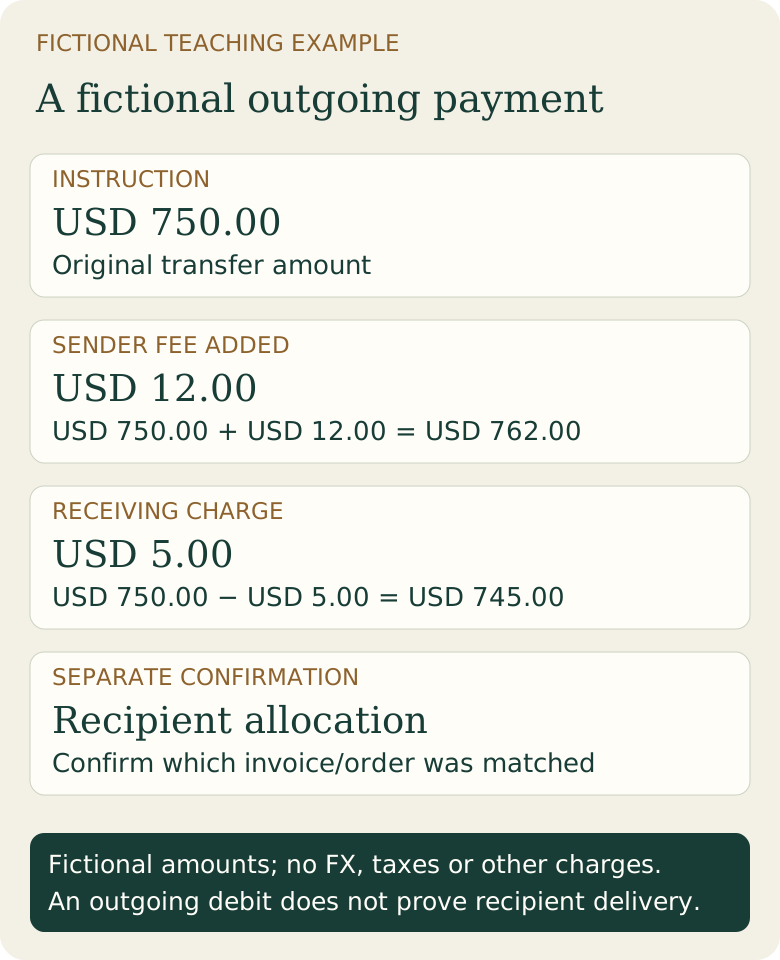
A debit shows an account entry under the bank’s reporting process. Keep the entry separate from confirmation that the instruction left the sending bank, that the receiving account was credited and that a business matched the funds to an invoice. Ask which event a status message actually confirms.
The following invented record chain shows why both sides may be giving accurate but incomplete answers. No dates, statuses or references below describe a real transaction.
Scroll across the table to see all columns.
| Record | What it can explain | What remains to confirm |
|---|---|---|
| DEMO-REQUEST-52: submitted | Sender created an instruction | Bank acceptance and release |
| DEMO-DEBIT-52: account debited | Sending account entry | Recipient credit |
| DEMO-CREDIT-52: recipient entry | Incoming-account credit | Invoice/customer allocation |
| DEMO-INVOICE-52: matched | Recipient allocated the payment | Any separate goods or crypto delivery |
Example: transfer amount, sender debit and recipient credit
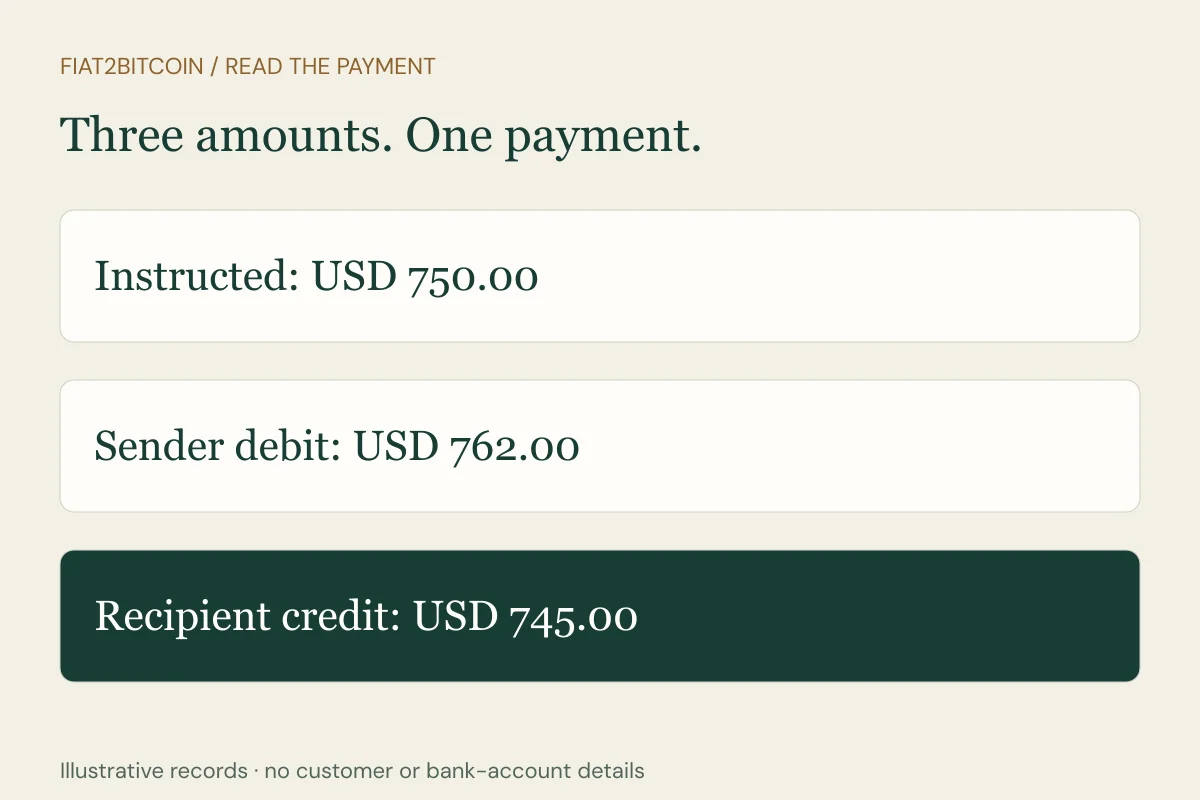
Assume an invented USD-only transfer instruction for USD 750.00. The sending institution adds a separate USD 12.00 fee. The sender’s total debit is USD 762.00. If a receiving institution then deducts an illustrative USD 5.00, the recipient’s credited amount is USD 745.00. These are three amounts: instructed, debited and credited.
The arithmetic is USD 750.00 + USD 12.00 = USD 762.00, and USD 750.00 − USD 5.00 = USD 745.00. The example assumes no exchange conversion, tax, additional charge or other entry. It is not a tariff, quote or claim about a particular provider. Check the actual charge option and records before explaining any difference.
For covered US consumer international transfers, the CFPB’s disclosure guide describes information about costs, exchange rates and expected recipient amounts. Receiving-side fees or taxes can still matter. A “zero transfer fee” label is not a calculation of every possible cost.
Which details should you check before an outward remittance?
Confirm the intended recipient’s name, account identifier, receiving bank, currency and required reference through the approved process. Where the bank asks for an intermediary or further-credit detail, have it identify the purpose of that field instead of moving values between boxes.
Keep the reason for payment accurate and obtain any country-specific evidence requirements from the institution. The word remittance does not choose an eligibility category, regulatory purpose code or tax treatment. If the service asks for a declaration you do not understand, clarify it before authorizing the payment.
Independently verify a change in bank details or payment procedures through an established contact. The FBI’s payment-fraud guidance recommends verifying such changes and warns about pressure to act quickly. A familiar-looking invoice or email thread is not sufficient confirmation.
What if the outward remittance has not arrived?
Open the official wire receipt or transfer confirmation. Collect the sending date, amount, currency, recipient and institution-issued reference. Ask the sending bank for the latest confirmed event, the reason for any hold, a case reference and when to expect the next update.
For a Swift payment, ask whether a UETR is available for the bank’s investigation. Ask the recipient to check the incoming entry and invoice matching separately. A local app reference or invoice number may help one team while another requires a network reference. Keep each identifier labeled.
For US transfers, the CFPB’s rights explanation describes protections for qualifying consumer remittances through covered providers. Coverage depends on the transaction and provider. Review the actual receipt and contact the institution promptly about errors or cancellation; no general reversal promise follows from the word outward.
What changes when the payment relates to a Bitcoin purchase?
Bank payment, order matching, provider review and wallet delivery are distinct. Resolve the existing transfer before considering another payment. An outgoing debit is not a Bitcoin transaction ID or confirmation that the provider delivered crypto.
Fiat2Bitcoin does not receive purchase funds or issue bank instructions. Use the provider named in your checkout for payment, verification, delivery and refund questions. Review current purchase options, and use the wire-transfer guides for terminology without assuming a bank-payment route is available to every account.
Sources & further reading
These sources explain the payment systems and rules discussed in this guide. For your purchase, check the provider’s current offer and terms.
- HSBC India: Country-specific inward and outward terminology
- Bank of China Lisbon: Its outward-remittance definition
- CFPB: Transfer disclosures and problems with sending money
- CFPB: Scope of US consumer-remittance protections
- FBI: Verify changed payment instructions
Published by Fiat2Bitcoin. Worked examples use fictional figures and records; they are not current prices or customer transactions. How we prepare our guides.