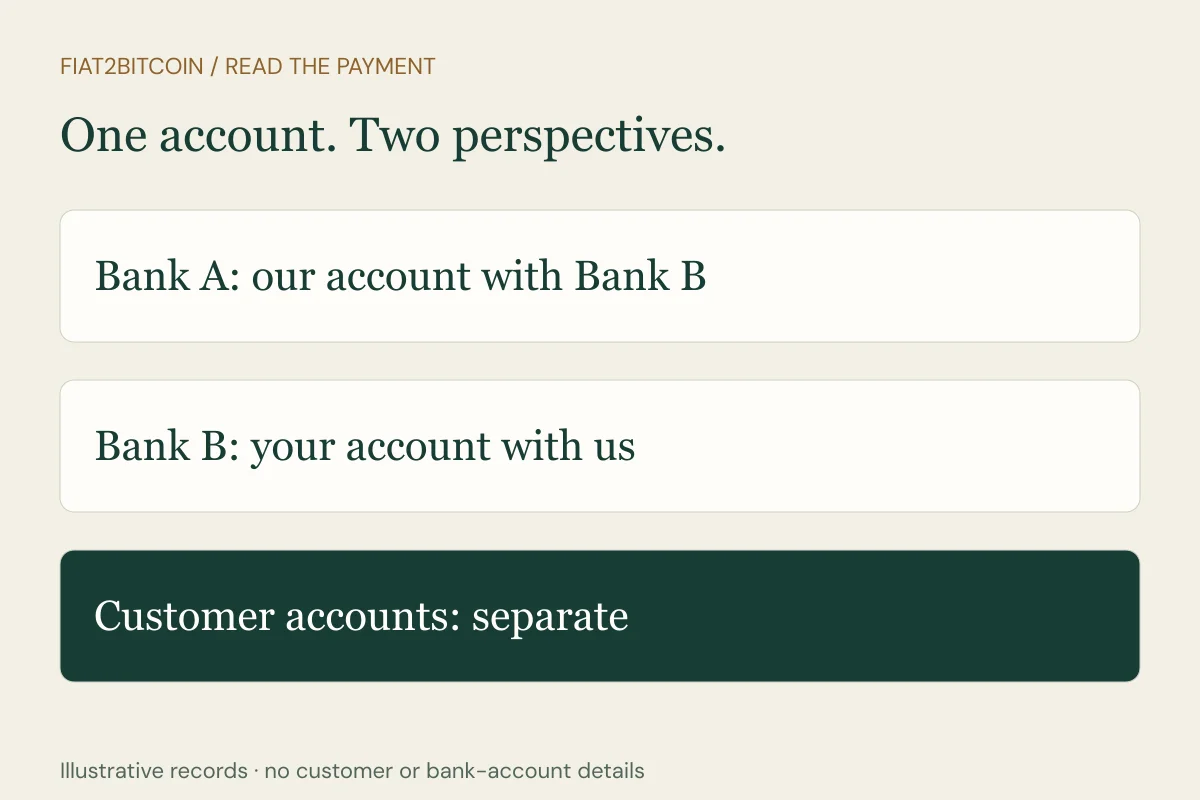
A wire explanation mentions a nostro account, while another bank document calls it vostro. The terms can describe the same bank-to-bank account, viewed from different sides. They help explain correspondent banking, but your payment still needs the recipient account and any required final-customer details in their assigned fields.
What is the difference between nostro and vostro?
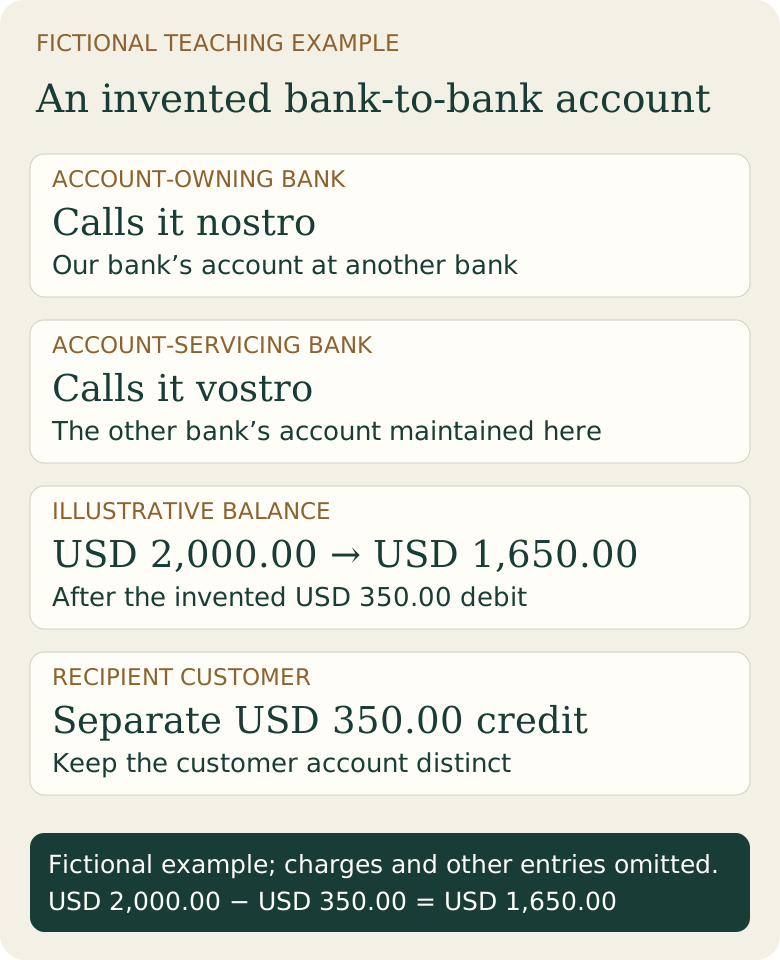
A nostro account is the account one bank holds with another bank, described from the account-owning bank’s side. Vostro describes the account from the bank maintaining it for the other bank. Start with two questions: who owns the account, and who services it?
The European Central Bank’s payments glossary defines a loro or vostro account as one bank’s account maintained on behalf of another bank. The account-owning bank regards that relationship as its nostro account. The terminology explains the viewpoint; this guide focuses on understanding payment roles.
For a fictional example, Example Sending Bank owns an account maintained by Example Correspondent Bank. The former uses nostro for that relationship; the latter uses vostro. The labels alone tell you neither the customer beneficiary nor the status of a particular transfer.
Nostro and vostro in one fictional account map
Keep the same invented bank-owned account in view as you change perspective. ACCOUNT-OMITTED below is a placeholder rather than a usable number. Alex Example’s personal account and Example Studio LLC’s receiving account remain separate records.
Scroll across the table to see all columns.
| Who is describing it? | Term | Account relationship |
|---|---|---|
| Example Sending Bank | Nostro | Our bank’s account at the correspondent |
| Example Correspondent Bank | Vostro | The sending bank’s account maintained here |
| Alex Example | Customer account | Sender’s separate account at its bank |
| Example Studio LLC | Beneficiary account | Recipient’s separate receiving account |
A fictional USD 350 payment using the relationship
Assume Example Sending Bank has USD 2,000.00 in its account at Example Correspondent Bank. In this simplified example, it instructs a USD 350.00 payment to Example Studio LLC, which also banks with the correspondent. The correspondent debits the bank-owned account by USD 350.00 and credits the recipient account by USD 350.00.
The bank-owned account’s resulting balance in the example is USD 2,000.00 − USD 350.00 = USD 1,650.00. It is still the sending bank’s nostro and the correspondent’s vostro. The customer receiving USD 350.00 has a separate account and credit entry. The illustration excludes charges, currency conversion, other entries and restrictions.
A BIS working paper published in April 2025 illustrates how a respondent bank’s account at a correspondent can support a payment between customers of different banks. Its authors’ model explains one arrangement. The figures here are original fictional teaching amounts, not a reproduction of a customer or bank record.
Are nostro and vostro the same as correspondent and intermediary?
A correspondent banking relationship concerns services one bank provides to another, which can include maintaining an account. An intermediary is an institution’s role in a particular payment route. Nostro and vostro describe an account relationship from the two sides, rather than naming every institution in a route.
The correspondent-versus-intermediary guide explains that distinction. In a more complex route, a correspondent can provide routing services while another institution serves the final beneficiary. Map the actual instructions instead of assuming the last bank named holds the customer’s account.
Likewise, the word nostro does not mean a sender should replace the beneficiary account number with a bank-owned account number found elsewhere. Have the sending bank identify each account’s holder and role using the verified payment instructions.
How are bank-to-bank statements different from customer confirmations?
The Payments Market Practice Group’s December 2024 interbank-statement paper, hosted by Swift discusses nostro/vostro reporting for reconciliation and liquidity purposes. It distinguishes bank-to-bank reporting from the broader customer-payment information that other records may contain.
A bank can use its own account statements and message references to reconcile a transfer while the customer sees a shorter wire receipt. Ask the sending institution which customer-facing reference or document it can provide for your payment, rather than requesting access to another bank’s account records.
If the payment travels over Swift, a UETR helps the banks identify the same payment. Keep its latest reported status alongside the reference. A bank-owned account balance is different from a finding about the recipient’s credit or invoice allocation.
How do these terms relate to further-credit instructions?
Bank-owned accounts, the named receiving beneficiary and a final customer can occupy different roles in a payment arrangement. Further-credit information can tell the recipient how to allocate funds after they reach a specified receiving account. Keep that final-customer identifier separate from the bank-owned account relationship.
Ask the sending bank: “Who owns each account listed in these instructions, which one is the receiving account for this transfer, and how will the required final-customer reference be carried?” If the answer is unclear, resolve the mapping before authorizing the payment.
For a purchase, use the payment provider and method offered in the actual checkout. Fiat2Bitcoin does not receive customer purchase wires or hold purchase funds or crypto. Review current purchase options and use the provider’s verified instructions for any supported route.
Sources & further reading
These sources explain the payment systems and rules discussed in this guide. For your purchase, check the provider’s current offer and terms.
- European Central Bank: Loro/vostro and nostro account perspectives
- BIS Working Paper 1259, April 2025: Correspondent payment model
- PMPG, December 2024: Interbank account-statement practice
Published by Fiat2Bitcoin. Worked examples use fictional figures and records; they are not current prices or customer transactions. How we prepare our guides.