A short answer names Satoshi Nakamoto. A useful explanation also separates three questions: who introduced Bitcoin, what can be verified about that introduction, and who makes decisions about software and purchases today.
This guide was checked October 19, 2026 and focuses on source documents rather than a list of identity theories. For the practical next step, use the Bitcoin buying-method pillar to compare payment routes. Fiat2Bitcoin purchases remain unavailable during launch preparation.
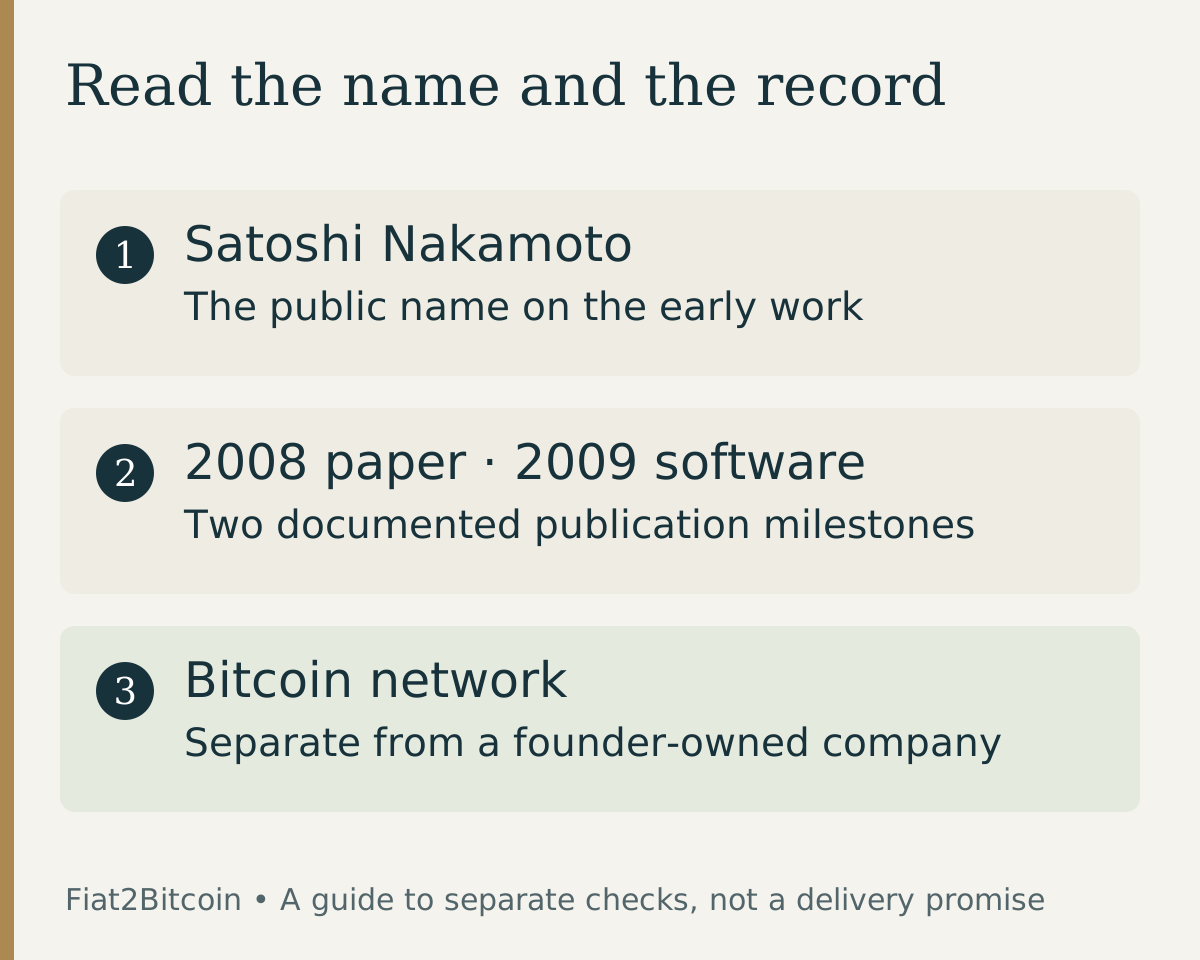
Who created Bitcoin, and what does the name establish?
Satoshi Nakamoto is the name attached to the earliest Bitcoin announcements discussed here. Bitcoin.org’s published educational source describes Satoshi as Bitcoin’s pseudonymous creator. A pseudonym is a public name used without establishing the person’s legal identity.
That distinction lets us credit the documented work without treating a photograph, biography or claimed identity as proven. A message signed with the name and an independently verified real-world identity are different kinds of evidence. The primary records below answer the origin question more directly than a list of people who have been suggested as candidates.
What do the original Bitcoin announcements show?
The cryptography mailing-list archive preserves an October 31, 2008 message under Satoshi Nakamoto’s name. It introduces the paper Bitcoin: A Peer-to-Peer Electronic Cash System and outlines a network-based approach to preventing double-spending.
A second archived message, Bitcoin v0.1 released, announces the first software release and says that open-source C++ code is included. These are two milestones: describing the design and announcing working software. They should not be collapsed into one publication date.
Scroll across the table to see all columns.
| Archived milestone | Date shown by the archive | What it documents |
|---|---|---|
| Paper announcement | October 31, 2008 | The paper and its stated peer-to-peer design |
| Bitcoin v0.1 release announcement | January 8, 2009 (EST) | The first software-release announcement with source code |
The second row uses the archive’s displayed Eastern Standard Time date. It is not a date for every event in Bitcoin’s launch. These old messages are historical evidence, not current software-installation or mining instructions.
Was Satoshi one person or a group?
The public name by itself does not resolve that question. This guide does not identify a particular individual or group as Satoshi. The cited announcements establish what was published under the name, not a verified personal identity.
When evaluating a new identity claim, ask what the evidence actually proves. A similar writing style, a repeated assertion or someone’s involvement in early digital-money work is not the same as a demonstrated connection to the original work. A confident headline can still be making a claim rather than reporting a settled fact.
The same caution applies to estimates of Satoshi’s holdings or wealth. This article does not assign addresses, coin balances or a net worth to an unidentified person. Knowing the name on an announcement does not establish ownership of every early Bitcoin transaction.
Is Bitcoin’s founder its owner or CEO?
Bitcoin does not have a company-wide CEO who can issue orders to the whole network. Bitcoin.org’s explanation distinguishes software development from control: users choose the software they run, and a developer’s proposed change does not automatically become everyone’s rule. That does not mean influence, disagreement or technical risk disappear.
Ownership of particular BTC is another question. Holding coins, maintaining software, operating a business and originating the design are separate roles. A company using Bitcoin in its name is not thereby the owner of Bitcoin, and a purchase provider’s founder is not Bitcoin’s creator.
For the asset itself, read the types-of-Bitcoin guide. It separates BTC from similarly named coins, wrapped tokens and wallet-address formats before you decide what you intend to receive.
Who works on Bitcoin software now?
Bitcoin Core has a public source repository and contribution process. Its README describes software that connects to the peer-to-peer network and validates blocks and transactions. The repository also publishes development and testing information; readers can inspect proposed changes and code history.
This is useful evidence of an ongoing software project. It is not a guarantee that every change is safe or that everyone uses identical software. The practical distinction is between contributing to an implementation and owning the network as a private company.
The Bitcoin supply guide and next-halving guide address the issuance schedule. Those rules are a separate subject from identifying the author of the original announcements.
Is a satoshi another type of Bitcoin?
A lowercase satoshi is a unit of BTC named after the creator: 100,000,000 satoshis equal one bitcoin. Bitcoin.org’s vocabulary source makes that distinction. It is not a separate coin issued by a person named Satoshi.
You can buy a fraction of a Bitcoin rather than a whole coin. For a fictional unit example, 25,000 satoshis is 0.00025 BTC. That is a unit conversion, not a dollar valuation, fee quote or minimum purchase amount.
What does Bitcoin’s origin tell a prospective buyer?
The origin record helps explain the project, but it does not approve a particular purchase. Imagine a fictional advertisement claiming a Bitcoin order is endorsed by its founder. The claim would not establish the seller’s identity, the asset being sold, a fee, a bank recipient or a confirmed delivery. Those facts need their own records.
Before funding, use the buying-readiness checklist, identify the intended BTC asset and network, compare the complete quote and confirm who will control the receiving wallet. Our seed-phrase guide explains the separate custody responsibility.
Then use the Bitcoin purchase-method pillar to compare debit card, credit card, ACH and wire routes. History does not select a payment method or promise a return. The current provider’s eligibility, costs and delivery terms determine the purchase you are actually considering.
Sources & further reading
General payment information and purchase-specific details serve different purposes. Review the current offer and terms before proceeding.
- Satoshi Nakamoto: Original paper announcement, October 31, 2008
- Satoshi Nakamoto: Bitcoin v0.1 release announcement, January 2009
- Bitcoin.org: Published FAQ and vocabulary source
- Bitcoin Core: Source code and development process
Original Fiat2Bitcoin guide. Examples are illustrative; they are not live quotes or customer transactions. How we prepare our guides.