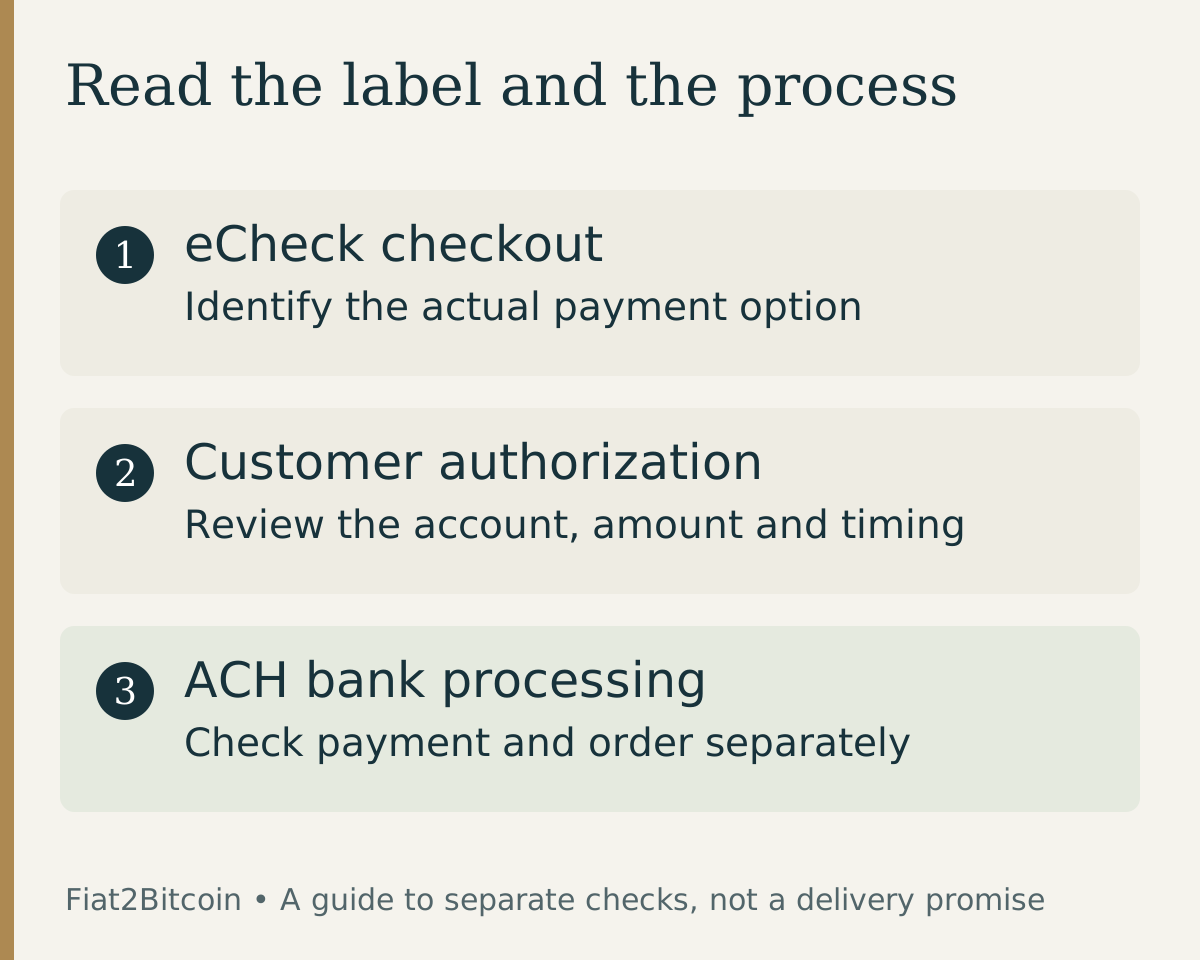
An online form may say “eCheck,” while the resulting bank entry mentions ACH. That can describe one payment rather than two charges. Match the company, amount and reference to the original authorization before deciding what the labels mean.
This guide explains terminology relevant to preparing an ACH Bitcoin purchase. It does not add an eCheck payment option at Fiat2Bitcoin or establish that a provider accepts one. Fiat2Bitcoin purchases remain unavailable during launch preparation.
What is the difference between ACH and an eCheck?
ACH stands for Automated Clearing House. The network supports electronic payments between U.S. bank accounts. An eCheck, short for electronic check, is a payment description used by processors and businesses; in a common online checkout, it describes an authorized debit processed through ACH.
For example, Authorize.net’s eCheck explanation describes collecting a customer’s approved bank payment over the ACH network. In that product, eCheck names the payment option and ACH describes how the funds move. This is a provider example, not a Fiat2Bitcoin integration.
Not every ACH payment is described as an eCheck. Nacha’s payment fact sheet includes payroll deposits, bill payments and other transfers, with both credit and debit payment types. Read the particular offer rather than infer its flow from one word.
ACH vs. eCheck at a glance
Scroll across the table to see all columns.
| Question | ACH | eCheck in a typical online bank-debit checkout |
|---|---|---|
| What does the term describe? | The Automated Clearing House payment network | An electronic-check payment option that commonly uses ACH |
| Who initiates the payment? | Depends on whether the entry is an ACH credit or debit | The collecting business or processor initiates the authorized debit |
| Is a paper check required? | Not inherently; ACH supports multiple kinds of electronic payments | Not for the online bank-debit example described here; follow the actual provider’s process |
| What determines timing and cost? | The actual bank-payment service and transaction conditions | The processor’s offer, its ACH processing and any additional conditions |
| Does the label establish a completed purchase? | No; match the payment to its order | No; an authorization or bank entry is separate from fulfillment |
If a form only says electronic funds transfer, start with the EFT-versus-ACH guide. EFT is a broader label. This article focuses on the relationship between an eCheck option and its underlying ACH payment.
How can an eCheck become an ACH bank entry?
Imagine a fictional business offering a $125 invoice with an eCheck option. The customer reviews the named collecting company, selected account, amount and debit date, then approves the stated payment. The processor submits the authorized bank debit. The bank may describe that entry using ACH terminology.
The customer should compare the $125 entry with the invoice and confirmation, not pay again simply because the statement uses a different label. A matching amount alone is not conclusive either: compare the date, company description and reference, and ask the business or bank to explain a discrepancy.
This illustration describes one invoice and one authorization. It contains no live payment instructions, Bitcoin price or delivery promise. If the invoice instead specified an ACH credit sent by the customer, the required action would differ. The ACH debit-versus-credit guide explains that distinction.
Is an eCheck the same as a scanned or paper check?
Do not treat those descriptions as interchangeable. An online ACH-debit checkout is different from depositing an image of a paper check through a bank’s app.
The OCC’s checking-account guide distinguishes electronic check conversion from processing an electronic image through the check system. A paper check can supply information for an authorized electronic payment, but that does not mean every check image becomes an ACH transaction.
Ask which process the business and bank actually use. Do not mail a check, upload its image or initiate a separate transfer unless the verified instructions for that payment require it. The word electronic alone does not answer the question.
Is an eCheck faster or cheaper than ACH?
When an eCheck uses ACH, comparing their speed as if they were independent networks can be misleading. Ask about the actual processor’s submission schedule, bank processing, any review and the event its completion estimate describes.
Nacha describes ACH processing in banking-day terms and distinguishes standard and Same Day processing. That does not set a deadline for every merchant’s order or establish when purchased Bitcoin can leave a provider.
Likewise, the label does not establish a universal fee. Compare the complete payment or purchase offer and separately charged costs. A processor’s advertised merchant rate is not a quote for a Bitcoin buyer. For purchase-specific milestones, read the ACH settlement and delivery guide.
What should a Bitcoin buyer check before paying?
- Confirm that the actual purchase provider offers the selected bank-payment method for your account and location.
- Follow its verified checkout and use the eligible account it identifies; do not convert another method’s instructions yourself.
- Read the debit authorization separately from the Bitcoin quote, including the total dollar cost, BTC quantity and expiry.
- Check the available funds and payments you have already authorized before accepting another debit.
- Keep the original order and payment references. Ask what remains before delivery instead of treating a bank entry as a receipt for Bitcoin.
The ACH pillar page explains Fiat2Bitcoin’s planned bank-payment route. An article about eCheck terminology is educational; it is not confirmation of a new supported payment method.
What if the payment is pending or returned?
Start with the existing payment and order. Ask the bank whether the debit is pending, posted or returned, and ask the business or provider what that means for the original order. Do not create a second payment merely to test a different label.
If the bank identifies an ACH return, request the exact code and use the ACH return-code guide. A return, a refund and cancellation of an order are different events. If an entry is unrecognized, contact the bank promptly through its official channel and describe the actual record.
Sources & further reading
General payment information and purchase-specific details serve different purposes. Review the current offer and terms before proceeding.
- Authorize.net: eCheck payments and ACH processing
- Nacha: ACH payment types and processing
- OCC: Electronic check conversion and check-image processing
Original Fiat2Bitcoin guide. Examples are illustrative; they are not live quotes or customer transactions. How we prepare our guides.