Start with the ACH Bitcoin purchase guide for the overall process. This article focuses on who initiates the dollar payment. Fiat2Bitcoin remains prelaunch, and no particular ACH push or pull option is promised for a future offer.
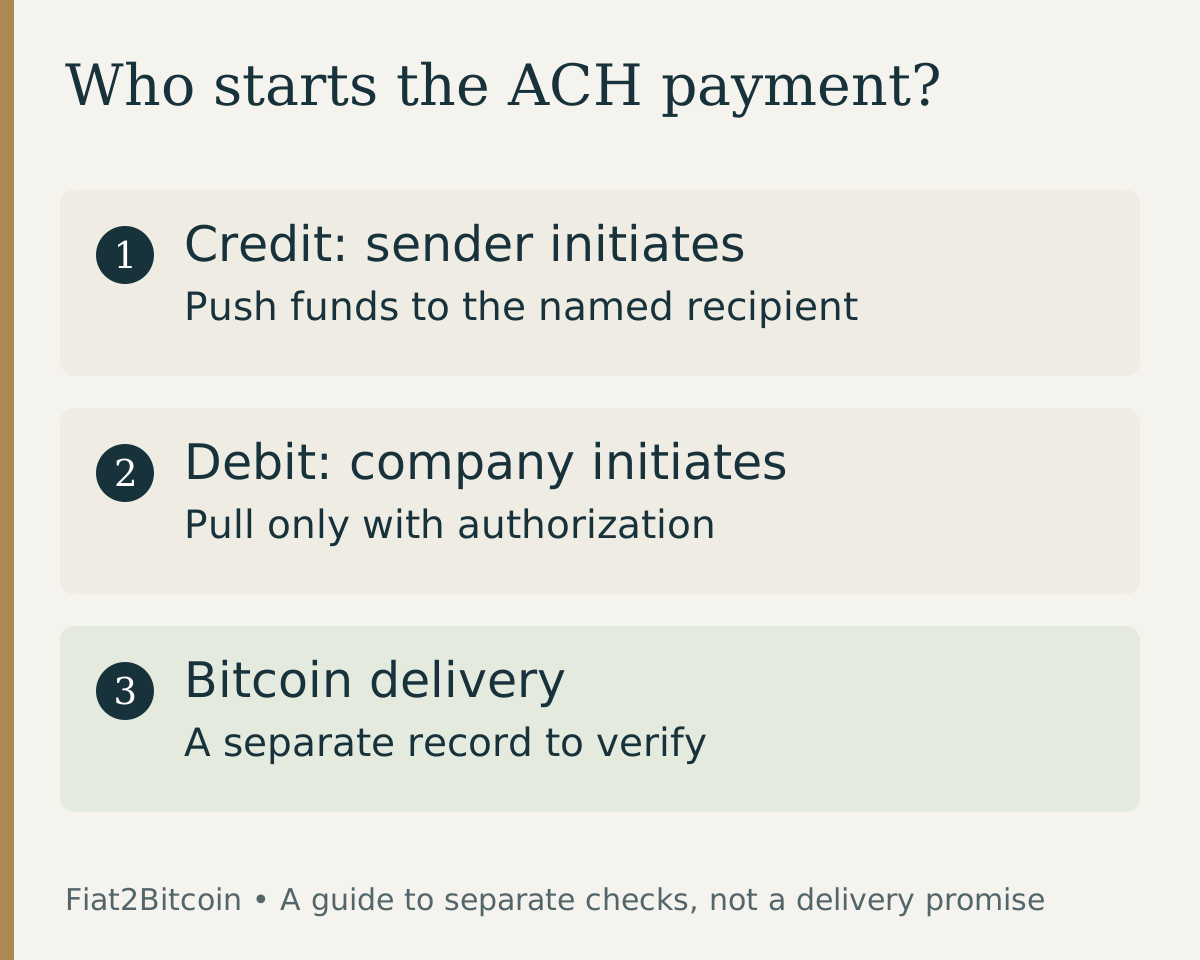
ACH debit versus credit at a glance
Scroll across the table to see all columns.
| Question | ACH credit / push | ACH debit / pull |
|---|---|---|
| Who starts the ACH instruction? | The party sending the money | The company collecting an authorized payment |
| Common example | An employer sends payroll | A utility collects an authorized bill payment |
| Possible purchase flow | You instruct your bank to send funds, if accepted | You authorize the provider to collect funds, if offered |
| What must match? | Verified recipient, account and required reference | Authorized account, amount and payment terms |
Nacha explains ACH credits and debits through payroll and bill-payment examples. The distinction describes how the network instruction starts. It does not mean an ACH credit is a credit-card purchase or a loan.
In either purchase scenario, money can leave your account. A debit on your bank statement alone therefore does not tell you whether the payment was initiated as an ACH debit or an ACH credit. Nacha's ACH developer guide explains the corresponding entries on both sides.
Two examples with the same dollar amount
Imagine a hypothetical $500 purchase flow that explicitly accepts an ACH credit. You receive verified instructions for that order, then ask your bank to send the permitted payment. Your task includes using the correct recipient details and any required order reference. Sending to an account used for some other purpose is not equivalent.
Now imagine a different $500 flow that offers an ACH debit. In the verified checkout, you authorize the provider to collect the stated amount from your eligible account. You retain that authorization and follow the existing order. Sending an additional $500 manually would be a separate payment, not a way to make the first one arrive faster.
These are illustrations, not Fiat2Bitcoin funding instructions. The dollar amount does not select the payment type. The eligible offer and authorization determine which action is required; if that is unclear, get clarification before moving money.
Does connecting a bank account authorize the purchase?
Read the actual consent and payment screens. An account check may establish ownership or validate details, while a separate instruction authorizes a specific payment. Some checkout flows collect multiple consents together, so do not assume either that linking always authorizes a debit or that it never does.
Our micro-deposit verification guide explains one possible account-validation step. Completing that step does not, by itself, prove a $500 purchase payment occurred. Look for an amount, date or schedule, payment reference and current order status.
Keep the authorization record in a secure place. Do not send account-login credentials or verification codes in an ordinary support message. Use the bank or provider's verified process for any sensitive account details it needs.
Does push or pull tell you when Bitcoin arrives?
Neither label is a delivery promise. The provider still has to identify the payment, apply the relevant review and release conditions, and complete the agreed purchase. Follow the ACH settlement and Bitcoin delivery guide to separate those milestones.
If a payment is missing, use the order reference with the provider and ask the relevant bank or initiating organization about the bank entry. Nacha's consumer FAQs explain that Nacha itself does not process individual payments or hold their records. The ACH trace-number guide helps you prepare a focused inquiry.
If you do not recognize a debit, contact your bank promptly through its verified channel. Describe whether you authorized it and what differs from your agreement. Do not initiate another payment to cancel out an unexplained entry. A cancellation, return or dispute needs its own confirmed outcome.
Sources & further reading
General payment information and purchase-specific details serve different purposes. Review the current offer and terms before proceeding.
- Nacha: How ACH credits and debits work
- Nacha: ACH push, pull and corresponding entries
- Nacha: Consumer payment questions and missing entries
Original Fiat2Bitcoin guide. Examples are illustrative; they are not live quotes or customer transactions. How we prepare our guides.