
Your bill increased, but the bank keeps sending the old amount. Or a company collected a different amount and you expected a fixed payment. The useful distinction is who instructs the transfer, which authorization applies and whether the amount is meant to track a bill. This guide uses UK banking terminology and keeps US ACH rules separate.
What is the difference between a standing order and a Direct Debit?
NatWest’s comparison describes a standing order as an instruction to send money regularly to a specified account, with amount, frequency, duration and reference selected by the customer. It describes a Direct Debit as permission for a business to collect payments, including amounts that can vary with the bill.
MoneyHelper’s UK guide also distinguishes these methods from recurring debit- or credit-card payments, which use a card payment authority. A transaction repeating each month does not, by itself, tell you which arrangement is in place.
Look at the bank’s actual payment type and the underlying agreement. A standing order can need an instruction change when the required amount changes. A Direct Debit collection must fit the agreed authorization and applicable scheme rules; it is not permission to collect any amount for any purpose.
Standing order, Direct Debit or recurring card payment?
Use the labels and records in your own account rather than identifying the method from a merchant’s display name. The comparison below describes the UK distinctions, not every country’s payment system.
Scroll across the table to see all columns.
| Arrangement | Instruction and amount | Record to check |
|---|---|---|
| Standing order | You instruct a scheduled bank payment | Amount, frequency, payee and reference |
| Direct Debit | Organization collects under your authorization | Mandate/agreement and collection notice |
| Recurring card payment | Organization uses a recurring card authority | Card agreement and merchant records |
Original example: fixed transfers do not automatically follow changing bills
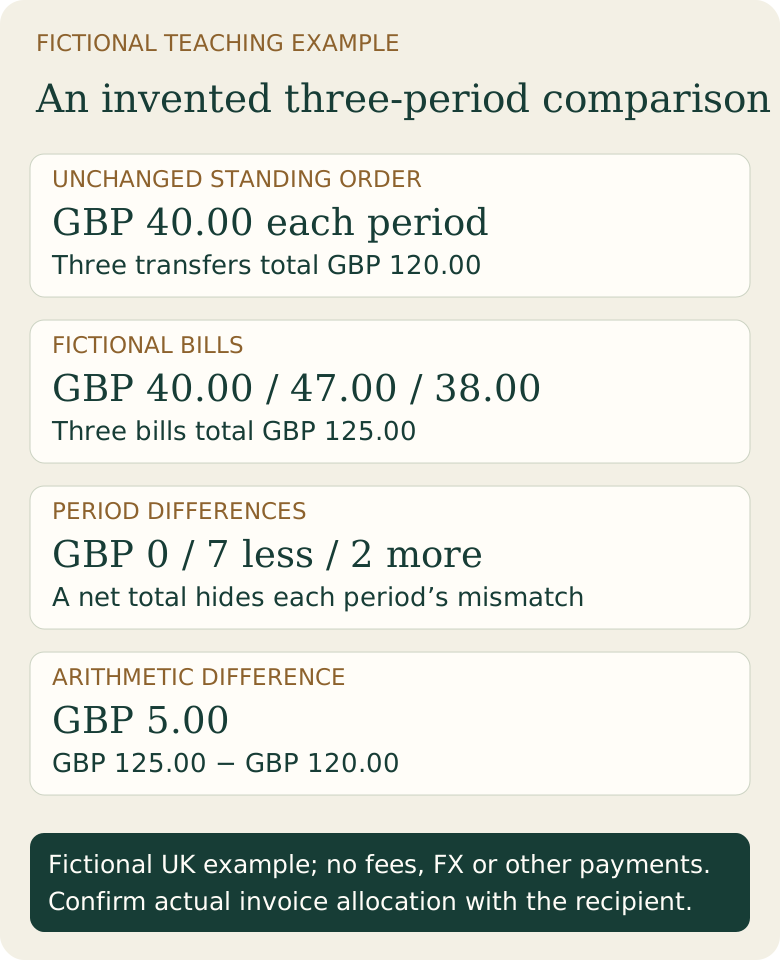
Assume a fictional standing order sends GBP 40.00 in each of three periods. The actual bills are GBP 40.00, GBP 47.00 and GBP 38.00. The standing order remains GBP 40.00 until its instruction is changed. This example excludes charges, interest, currency conversion and all other payments.
The three transfers total GBP 120.00, while the three bills total GBP 125.00: an arithmetic difference of GBP 5.00. That net figure hides a GBP 7.00 shortfall in the second period and GBP 2.00 more sent than billed in the third. It does not establish whether the recipient carries a credit, applies a fee or considers an invoice settled; confirm its actual allocation and agreement.
A variable Direct Debit may collect the amount due under its arrangement, but only the real mandate and notices establish what was authorized and scheduled. Do not replace an existing collection with an extra manual payment until the organization confirms how it will handle both.
Scroll across the table to see all columns.
| Period | Bill | Transfer | Difference for that period |
|---|---|---|---|
| 1 | GBP 40.00 | GBP 40.00 | GBP 0.00 |
| 2 | GBP 47.00 | GBP 40.00 | GBP 7.00 less sent |
| 3 | GBP 38.00 | GBP 40.00 | GBP 2.00 more sent |
What should you check before changing or canceling a payment?
Confirm the existing method, next date, amount, recipient and reference. Ask whether the current payment is only scheduled or already being processed. Check the recipient’s invoice record so a changed instruction does not leave an unpaid bill or create a duplicate payment.
MoneyHelper explains that stopping a standing order or Direct Debit does not, on its own, end the underlying contract. Ask the bank how to change the instruction and the organization what remains due. Exact cutoffs and obligations depend on the actual method, bank and agreement.
Keep the request confirmation and the original payment reference. If a collection is disputed, report it through the bank’s verified process and describe the actual facts. Do not assume a canceled instruction reverses an earlier completed payment.
Does the UK Direct Debit Guarantee cover standing orders?
The Direct Debit Guarantee concerns payments under the UK Direct Debit scheme, including payment errors described in its terms. It is not a standing-order guarantee, a recurring-card rule or a universal refund promise for a dispute about goods or services.
The scheme guidance also separates the payment remedy from the contract with the biller. Ask your bank whether the specific payment falls under that scheme and what process applies. This guide does not supply a dispute deadline, eligibility ruling or guaranteed recovery outcome.
Are these the same as ACH credits and debits in the US?
The direction concepts are related, but the names and rules are not interchangeable. A UK standing order is a customer’s scheduled instruction. A US bank’s recurring bill-pay feature can use different rails. A UK Direct Debit and a US ACH debit operate under different systems and protections.
Nacha’s ACH guide explains US employer-initiated credits and biller-initiated authorized debits. Use the ACH debit/credit guide and authorization guide for those US topics rather than applying UK scheme terms to an ACH entry.
Which recipient and reference should remain attached to a regular payment?
Keep the verified payee name, receiving account or other required method details, and the reference used to match the bill. A sort code identifies UK routing information; it does not identify the invoice. The payer/payee guide separates the people and organizations from their bank fields.
For a Bitcoin purchase, use only the methods and funding instructions actually shown by the provider in checkout. Do not set up repeat transfers to old instructions or infer that recurring purchases are available. Fiat2Bitcoin does not receive purchase funds or issue bank instructions. Review current methods and confirm the provider’s order-specific terms.
Sources & further reading
These sources explain the payment systems and rules discussed in this guide. For your purchase, check the provider’s current offer and terms.
- NatWest: Standing-order and Direct Debit control
- MoneyHelper: UK recurring bank and card arrangements
- Pay.UK Direct Debit: Guarantee scope and contract distinction
- Nacha: Separate US ACH credit/debit terminology
Published by Fiat2Bitcoin. Worked examples use fictional figures and records; they are not current prices or customer transactions. How we prepare our guides.