A form asks for the payee, a bank receipt names a remitter, and an ACH record calls someone the Receiver. Start with the payment you are investigating: who is paying, who is intended to receive the money, and which institution created each label? The answer can change between a purchase and its separate refund.
What is the difference between payer and payee?
The European Central Bank’s payer definition describes the party issuing a payment order or agreeing to the transfer to the payee. Its beneficiary glossary entry describes the recipient of funds, also called the payee. This is payment terminology; other products and legal documents can use additional roles.
For a straightforward invoice payment, the customer paying the invoice is the payer and the business receiving that payment is the payee. Their banks provide the payment services. A bank name in routing instructions is not automatically the name of the customer or business receiving the money.
The beneficiary-name guide explains the recipient field on bank instructions. The remitter guide explains sender identity. This comparison connects both sides rather than replacing those field-specific checks.
Original example: the roles change for a confirmed refund
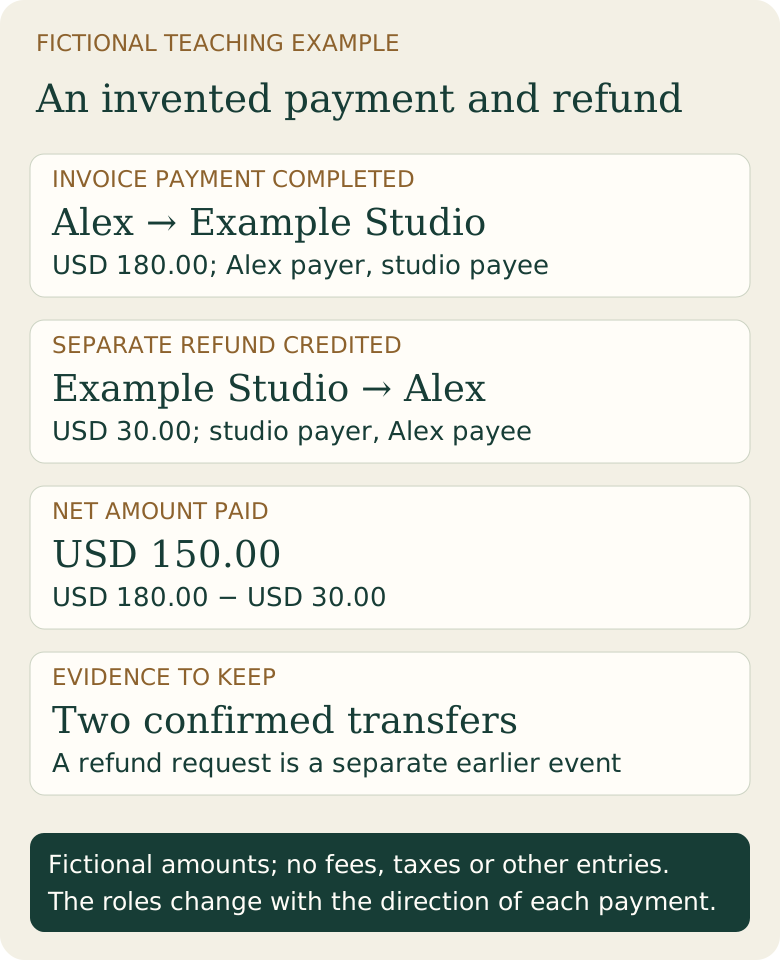
Assume Alex Example pays Example Studio LLC a fictional USD 180.00 invoice. Alex is payer and the studio is payee for that transfer. Later, a separate agreed USD 30.00 refund is actually sent by the studio and credited to Alex. For the refund payment, the studio is payer and Alex is payee.
If both transfers are completed and there are no fees, taxes, currency conversion or other adjustments, Alex’s net amount paid is USD 180.00 − USD 30.00 = USD 150.00. The refund request, the studio’s approval, its outgoing payment and Alex’s receiving credit are separate events. This illustration assumes the receiving credit has been confirmed.
Keep a reference for each transfer and link them in the invoice record. One person or business does not permanently occupy the payer or payee role merely because it was the customer or supplier in the first transaction.
Scroll across the table to see all columns.
| Payment and assumed event | Payer | Payee |
|---|---|---|
| USD 180.00 invoice paid | Alex Example | Example Studio LLC |
| Separate USD 30.00 refund credited | Example Studio LLC | Alex Example |
| Net paid after both completed | USD 150.00 arithmetic result | Not another transfer |
Why can the payer be called the ACH Receiver?
ACH network roles describe the payment instruction and the account it affects. Nacha’s ACH explanation calls the employer the Originator for payroll credits and the employee the Receiver. For an authorized utility debit, it calls the collecting utility the Originator and the consumer whose account is debited the Receiver.
In the utility-debit example, the consumer is economically paying the bill even though the ACH account role is Receiver. That label does not mean the consumer received money. Identify whether the entry is a credit or debit and whose account is credited or debited before interpreting the network role.
The ACH debit-versus-credit guide owns that direction-of-entry question. The ACH authorization guide covers the permission for an actual debit. A network role does not create authorization or approve a third-party payment.
Which name belongs in the payee field?
Use the name required by the recipient’s verified payment instructions and the sending service. A saved nickname can differ from the account-holder name. The account-holder guide explains that distinction; a business trading label or invoice contact is not a reason to guess a different legal account name.
If one account receives money for a final customer, confirm the named receiving account and any required further-credit details. The payee, receiving institution and final allocation can describe separate layers. Ask the bank how it transmits each required field.
Do not assume a payment provider accepts money from an account belonging to someone else. Confirm its payer/account-name rules before arranging payment. The terms payer, customer, account holder and beneficiary are useful labels, not permission to bypass ownership or eligibility requirements.
Does naming the payee prove that the payment arrived?
No. A saved payee record identifies a destination you entered. A submitted instruction, sender debit, recipient credit and invoice matching are different records. Use the official transfer receipt, then ask the responsible institution which event it confirms.
For an unrecognized or mismatched recipient, pause before payment and confirm the details through an established contact route. If money was sent, contact the sending institution promptly with the amount, currency, date and reference. Ask about the existing payment’s status before considering another.
Use the recipient’s secure process to resolve a missing order reference. A bank-generated transfer identifier and the recipient’s payment reference can both be needed, but they identify different records.
Who handles payer and payee details in a Bitcoin purchase?
Use the provider named in the actual checkout for account-name, verification, payment, delivery and refund questions. The bank payment and the later crypto-delivery record remain separate. A provider’s order status does not change what the bank receipt actually establishes.
Fiat2Bitcoin does not receive purchase funds, issue bank instructions or hold customer funds or crypto. Compare current purchase methods and follow the provider offer and terms shown for your account and location. The fictional refund above is not a Fiat2Bitcoin refund policy.
Sources & further reading
These sources explain the payment systems and rules discussed in this guide. For your purchase, check the provider’s current offer and terms.
- European Central Bank: Payer and payment-order definitions
- European Central Bank: Beneficiary/payee terminology
- Nacha: Originator and Receiver in ACH credits and debits
Published by Fiat2Bitcoin. Worked examples use fictional figures and records; they are not current prices or customer transactions. How we prepare our guides.