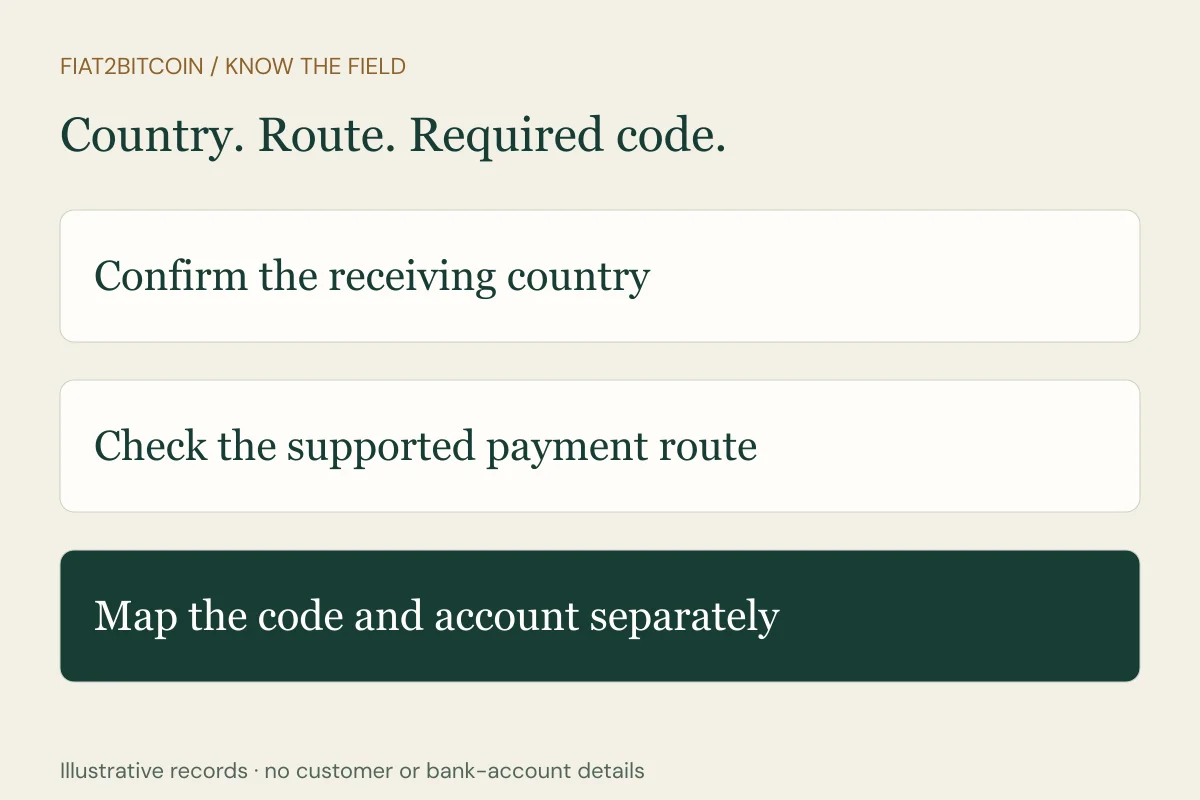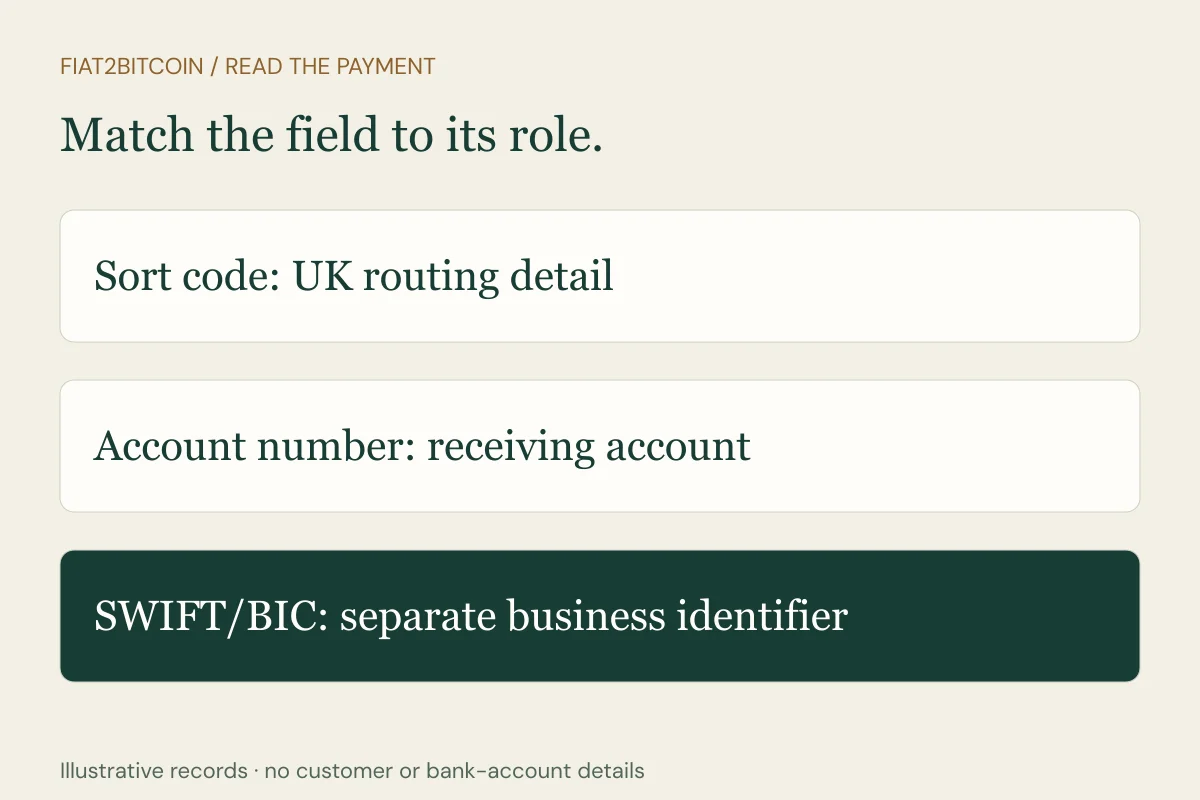
A recipient gives you a sort code and an account number, but your form asks for SWIFT or a routing number. These labels can point to different identifiers. Start with the receiving country and the payment route the sending service supports, then ask it which fields carry the verified details.
What is a sort code?
A UK sort code contains six digits, often grouped in pairs. Lloyds’ banking glossary explains that layout and says its customers can see their account’s sort code in online banking, the app and statements. Obtain the value for the actual receiving account rather than copying a code from an unrelated bank listing.
Pay.UK’s sort-code explanation describes sort codes as part of routing and settlement through UK systems. It also explains that allocation can be to payment service providers, including some that issue UK IBANs without participating in UK domestic systems. A sort code is therefore not a guarantee of a walk-in branch or every payment capability.
The bank-branch-name guide covers the institution’s written branch label. A branch name, branch address and numerical routing identifier answer different questions, even if a form displays them together.
Sort code vs SWIFT code, account number and IBAN
A sort code provides domestic routing information in the UK context. A receiving account number identifies the account at the institution. A SWIFT/BIC identifies a business party and may include an optional branch element. These are not alternative names for the same value.
An IBAN is an account identifier under a participating country’s registered format. Where the verified instructions give an IBAN, use the complete supplied value in the supported field; do not build one by concatenating a sort code and account number. The IBAN-versus-routing guide explains that distinction.
For a US destination, a nine-digit ABA routing number belongs to a different system. A form’s generic “bank code” label does not convert a UK sort code into a US routing number. Ask the sending institution how its selected route accepts the destination’s identifier.
Scroll across the table to see all columns.
| Field | What it identifies | Do not substitute |
|---|---|---|
| UK sort code | Domestic bank-payment routing | SWIFT/BIC or account number |
| Beneficiary account number | Receiving account | Sort code or invoice reference |
| SWIFT/BIC | Business party, with optional branch element | Domestic sort code |
| IBAN, when required | Account in its registered national format | An invented joined value |
A fictional example: the country setting creates the wrong field
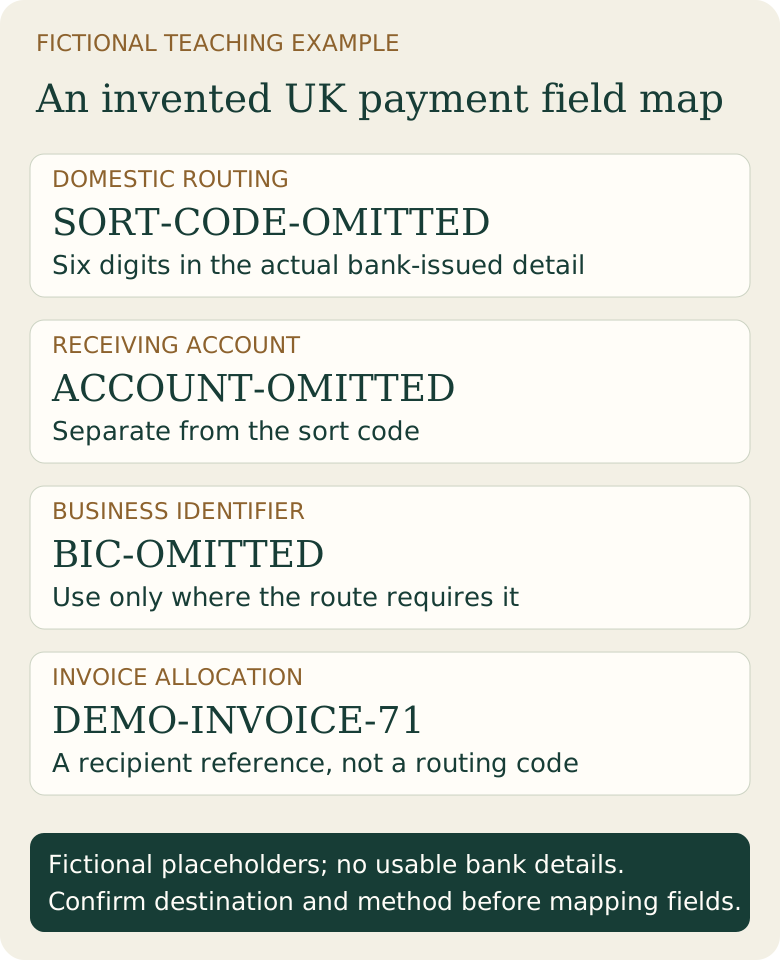
Alex Example is preparing a payment to a UK recipient. The verified details contain SORT-CODE-OMITTED, ACCOUNT-OMITTED and DEMO-INVOICE-71. Alex’s form is still set to a US receiving country and requires a nine-digit ABA number. These are non-usable teaching placeholders; no payment has been submitted.
The useful next step is to check the receiving-country selection and whether the service supports that destination, currency and method. If a supported UK setup is available, use its actual requested fields. If it still requests SWIFT, obtain the bank-issued BIC for that route instead of padding the sort code with zeros or putting the invoice reference in the bank-code box.
Keep the invoice reference separate from bank and account details. Ask which reference field is transmitted to the recipient. Where instructions require further credit, that final allocation may need another explicit field. Correct routing does not itself identify the customer or invoice.
Where should you find or check a sort code?
Use the receiving account’s authenticated banking details, an official statement or instructions the recipient has independently verified with its institution. For your own account, check its details screen. Preserve any leading zero and follow the sender form’s spacing and punctuation instructions.
Pay.UK’s official checker can help check whether a sort code supports listed UK payment types. Treat a routing-directory result as information about that code, not proof of who owns a particular receiving account or the legitimacy of an invoice. This page does not run a lookup or validate a customer account.
Lloyds’ payee-name guidance separately describes checking the name, account number, sort code and account type, with different possible match results. That is its process, not a promise that every bank checks all payments. If details do not match or cannot be checked, resolve the warning through the bank and intended recipient before paying.
What if the sort code is missing, rejected or recently changed?
Do not infer a code from a familiar bank name, branch address, card number or an old recipient record. Ask for current account-specific details and confirm them through an established contact route. If new details arrived by email, use a previously verified phone number or secure portal to verify the change.
A rejected field can mean the format, destination selection, selected route or underlying details need attention. Ask the sending service what it expects and report the exact label and warning without posting full bank details publicly. Do not remove digits, append zeros or override a warning just to make the form accept a value.
If a payment has already been sent, contact the sending institution promptly with its official confirmation reference. Use the receipt guide to distinguish the reported event from recipient credit. Confirm the existing payment’s status before considering a replacement.
Does knowing the sort code make a Bitcoin payment route available?
A bank identifier is not service eligibility or a checkout instruction. Your location, account, currency and the selected provider determine the methods actually offered. UK routing terminology on an invoice does not establish that a particular crypto checkout supports local UK transfers.
Fiat2Bitcoin does not receive purchase funds or issue bank instructions. Use the provider named in the actual checkout for payment, verification, delivery and refund questions. Compare current purchase methods and use the wire guide hub for help reading the terminology.
Sources & further reading
These sources explain the payment systems and rules discussed in this guide. For your purchase, check the provider’s current offer and terms.
- Pay.UK: Sort-code allocation and UK payment-system roles
- Lloyds: Six-digit format and account-specific location
- Pay.UK: Official sort-code checker and payment-type scope
- Swift: BIC structure and identifiers
- Lloyds: Account-name checks and mismatch messages
Published by Fiat2Bitcoin. Worked examples use fictional figures and records; they are not current prices or customer transactions. How we prepare our guides.