
Are you providing space or operating the Bitcoin ATM?
A placement arrangement can involve different jobs: the property owner grants space, the retail tenant manages access, an operator handles the kiosk and transactions, and an installer performs physical work. Identify each role in the agreement instead of assuming they are the same company.
CoinFlip’s current partner page says its host program handles installation, maintenance and customer service. That is the provider’s description of its program, not a Sacramento-specific quote or a contract accepted for your premises. Ask for the actual proposal, named legal entity and written responsibility schedule.
Do not promise customers exchange rates, accept their cash for the operator or take over refunds simply because a machine is in your store. Review your proposed duties with qualified advisers: California’s operator definition includes owning, operating or managing a kiosk, so “host” wording alone does not settle your legal role.
Scroll across the table to see all columns.
| Question | Put the responsible party in writing | Evidence to request |
|---|---|---|
| Who owns and runs the kiosk? | Named operator and any separate owner | Legal entity and current regulatory status |
| Who handles cash, customer checks and transactions? | Actual operator/provider | Operational and customer-support procedure |
| Who authorizes anchoring, power and signage? | Property owner, tenant and qualified installer as applicable | Written permissions and site-specific review |
| Who handles faults, incidents and removal? | Named service and contract parties | Response terms, insurance and removal obligations |
Which Sacramento site questions should come before installation?
Confirm the actual jurisdiction of the address. A Sacramento mailing address or a nearby-city label does not by itself tell you which city or county department handles the site. For a City of Sacramento location, use the City’s permitting and zoning channels for your proposed use and physical work.
The City’s permitting page describes building permits for new construction and many modifications, including electrical and signage work, and directs zoning questions to Community Development. That general guidance does not decide whether your particular indoor placement requires a specific permit. Ask about the exact installation plan, accessibility, electrical work, signs and any property restrictions.
Before signing, confirm landlord consent, where the machine will sit, safe customer access, power/connectivity, servicing access and what happens when the host business is closed. No permit fee, installation date or approval outcome is quoted in this guide.
What should you verify about the California operator?
Use DFPI’s current kiosk-operator guidance and FAQ to check the applicable requirements and the named operator’s status. A reported kiosk address is not the same as a license or an approval for a new site. A past letter about another regulatory scheme is not a substitute for the current requirements.
Ask the proposed operator which entity is responsible for customer verification, transaction limits, fee disclosures, receipts, complaints and refunds. The current FAQ describes a USD 1,000 daily customer limit for kiosk operators; a national marketing banner or projected store sales does not override applicable restrictions.
The Sacramento and Rancho Cordova consumer listing guide checks selected existing addresses. It is useful for understanding source verification, but it is not an installation service, an application outcome or evidence that a provider has accepted your business.
How can you test a placement offer without assuming revenue?
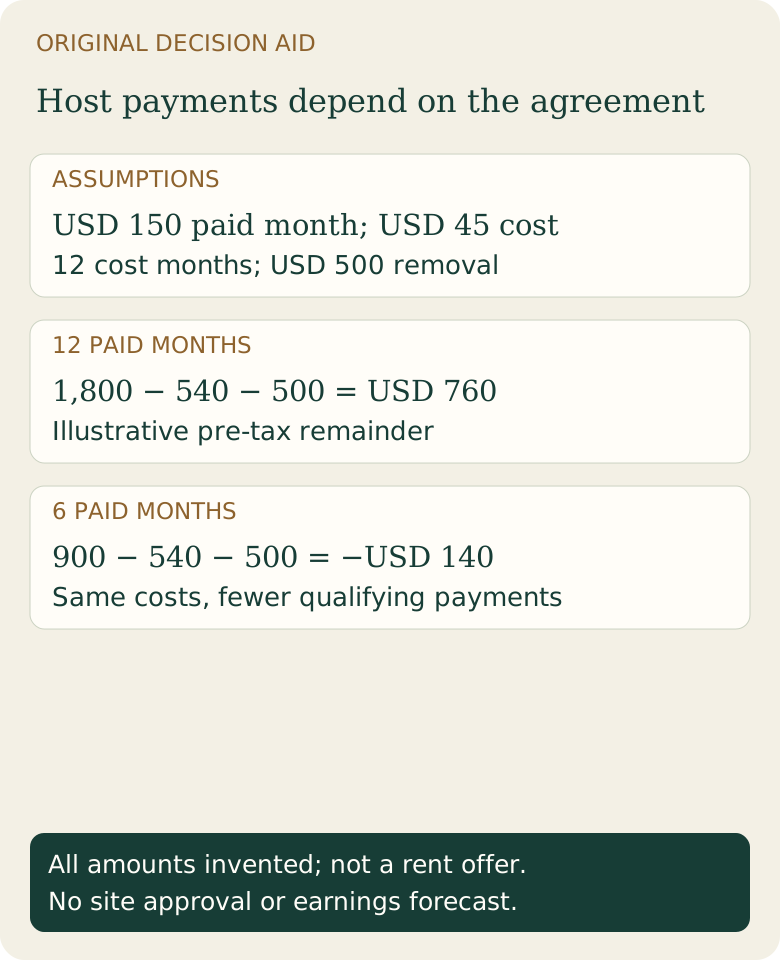
Use the actual proposed agreement for a real decision. To demonstrate the arithmetic only, invent a fixed payment of USD 150 for each qualifying paid month, ongoing host costs of USD 45 per month and a USD 500 removal charge. None of these numbers is a provider quote, market estimate or measured kiosk cost.
If all 12 months qualify for payment: 12 × USD 150 − 12 × USD 45 − USD 500 = USD 760. If only six months qualify but the assumed costs continue for 12: 6 × USD 150 − 12 × USD 45 − USD 500 = minus USD 140. The difference comes from the payment condition, not a prediction about Bitcoin demand.
These are hypothetical pre-tax cash-flow examples. They exclude unknown site work, taxes, legal costs, downtime effects and other agreement terms. They are not transaction revenue, earned commission, a profitability forecast or evidence that your store will receive any payment.
Scroll across the table to see all columns.
| Invented scenario | Annual host payments | Assumed ongoing + removal costs | Illustrated remainder |
|---|---|---|---|
| 12 qualifying paid months | USD 1,800 | USD 540 + USD 500 | USD 760 |
| 6 qualifying paid months; costs continue all year | USD 900 | USD 540 + USD 500 | −USD 140 |
What should the placement agreement settle?
Download the original Sacramento host contract worksheet. It records site, operator, payment-condition, service and exit questions and includes the exact hypothetical arithmetic. It collects no business application or customer payment information.
Ask what starts and stops host payments, whether rent depends on transactions or uptime, who pays electricity and connectivity, and whether exclusivity or an automatic renewal limits your choices. Check insurance, damage responsibility, relocation, termination and removal costs before accepting an attractive monthly figure.
Fiat2Bitcoin does not install or operate these kiosks, offer host contracts or certify local approvals. Contact the actual operator and relevant authorities for your premises. The ATM fee guide covers a different amount—the customer’s purchase cost—which must not be confused with any host payment.
Sources & further reading
These sources explain the payment systems and rules discussed in this guide. For your purchase, check the provider’s current offer and terms.
- CoinFlip: host-program description
- City of Sacramento: permitting and zoning
- DFPI: current kiosk-operator information
- DFPI: current digital-financial-assets FAQ
Published by Fiat2Bitcoin. Worked examples use fictional figures and records; they are not current prices or customer transactions. How we prepare our guides.