The differences at a glance
Scroll across the table to see all columns.
| Question | Debit-card payment | Bitcoin network transaction |
|---|---|---|
| What moves? | A payment in money such as U.S. dollars through the card system | Bitcoin between addresses on the network |
| What authorizes it? | The card-payment process, including the issuer's decision | A transaction signed using the keys controlling the bitcoin |
| Which record helps identify it? | The merchant order and card transaction reference | The Bitcoin transaction ID and destination address |
| What does a pending status mean? | Ask the issuer or merchant which card step is pending | Check whether the transaction has been broadcast and its confirmations |
| Who can explain a problem? | The card issuer and merchant or purchase provider | The sending provider or wallet service, with network evidence |
This comparison concerns an on-chain Bitcoin transfer. A balance shown inside a custodial platform may be an internal account record; it does not by itself show that a transfer to your own wallet has occurred.
What happens on the debit-card side?
A bank debit card usually accesses money in your bank account, as the CFPB's card comparison explains. During a purchase, a pending authorization can appear before the final card transaction is posted.
For a Bitcoin order, keep the merchant or provider name, dollar amount and order reference. These help the issuer identify its payment record and help the provider locate the purchase. A statement description may differ from the name of the website where you first compared offers; verify it through the original order.
Authentication, authorization and purchase completion answer different questions. A successful bank-app approval checks the cardholder. The issuer's authorization concerns the payment. Neither alone proves that Bitcoin reached the intended wallet.
What happens on the Bitcoin side?
An on-chain transfer identifies where the bitcoin is being sent and is processed by the Bitcoin network. A provider's order reference is not the same as its Bitcoin transaction ID. Ask for the transaction ID when the provider says it has sent an on-chain payment.
Bitcoin.org explains that confirmations build confidence in a Bitcoin payment. An unconfirmed transaction and a confirmed one are different states. The receiving wallet or service may have its own confirmation requirement; there is no single delivery time that applies to every purchase.
Check the address and network in the original order against the receiving wallet. A screenshot supplied by a stranger is not independent evidence. Do not enter a seed phrase or private key into a transaction lookup site. Public transaction details can reveal financial activity, so share only what is necessary through the provider's official support channel.
Buying Bitcoin with a debit card connects both systems
Imagine an illustrative order with a $200 card charge and a Bitcoin amount specified in the provider's quote. The bank may show a pending $200 transaction while the provider is still checking the order. Later, the provider may mark payment complete while the wallet transfer is still processing. Those statuses need not change together.
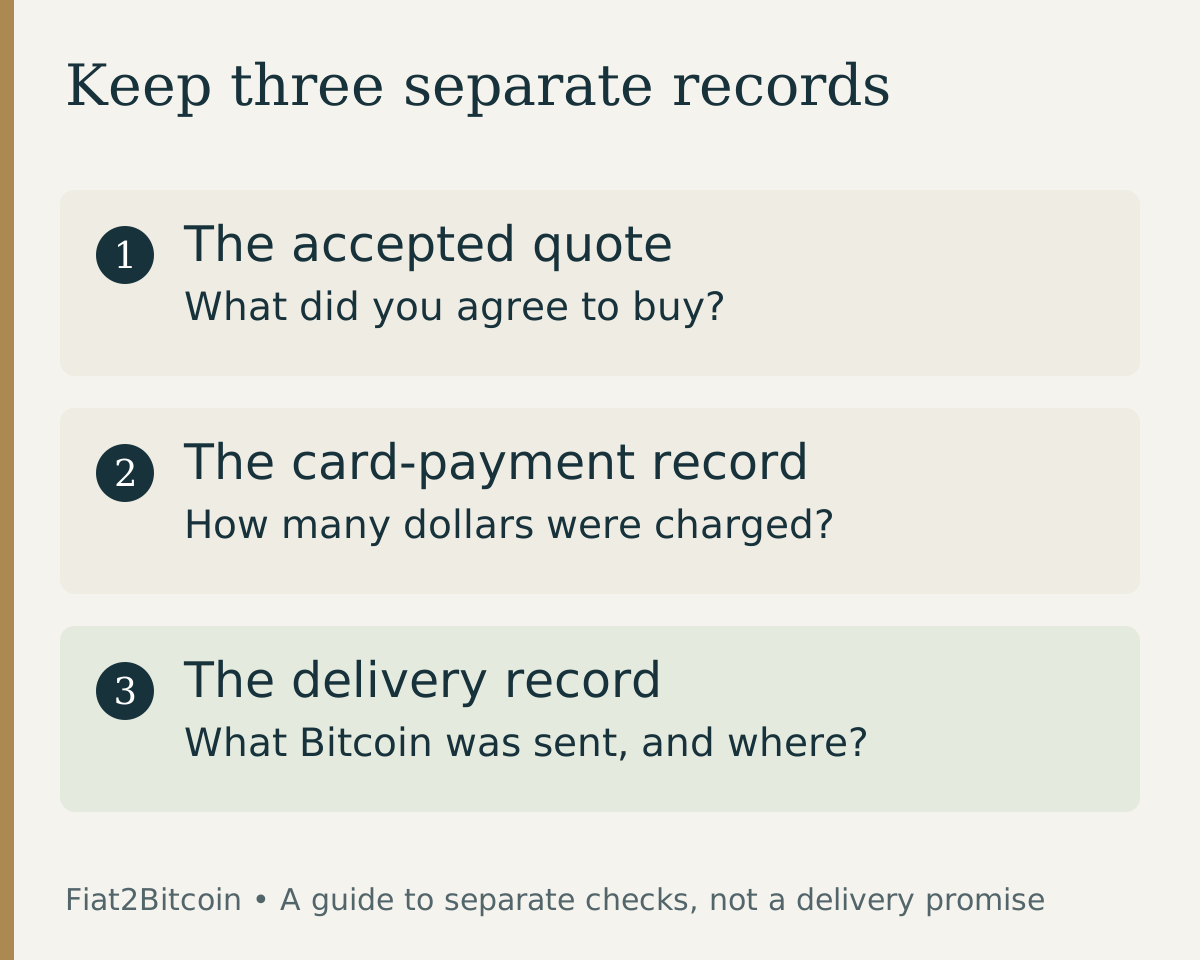
Keep three records: the accepted quote, the card-payment record and the Bitcoin-delivery record. The quote explains what you agreed to buy. The card record explains the money charged. The delivery record explains what was sent and where.
If the card was charged but the wallet is empty, return to the existing order. Ask whether payment is authorized or completed, whether any review is outstanding, and whether the Bitcoin transfer has been sent. Our pending Bitcoin payment checklist helps separate those questions before another attempt.
Fees and problem handling are different too
Compare the full provider quote with any separately collected bank or card charges. A Bitcoin network fee and a provider's service fee are not necessarily the same charge. Check what the quoted delivery amount already includes so you do not count a cost twice. Use our Bitcoin purchase-fee guide for a worked comparison.
For an unauthorized card transaction or billing problem, contact the issuer promptly and ask which procedures apply. Do not assume that a card dispute automatically reverses a Bitcoin transfer. The FTC explains that cryptocurrency payments are typically not reversible; recovery or a recipient's return payment cannot be assumed.
Is a crypto debit card the same thing?
No. A card marketed as a crypto debit card is a separate product with its own issuer and spending terms. Its branding does not prove that a merchant receives an on-chain Bitcoin transfer. Read that product's terms to understand how it funds and settles purchases.
This guide concerns using a payment card to buy Bitcoin and tracking the separate delivery. Fiat2Bitcoin does not offer a crypto spending card. Its debit-card purchase guide explains the planned buying process; its credit-card purchase guide covers the additional borrowing questions. Registration and payments remain unavailable while Fiat2Bitcoin is prelaunch.
Sources & further reading
General payment information and purchase-specific details serve different purposes. Review the current offer and terms before proceeding.
- CFPB: Prepaid, debit and credit cards compared
- Bitcoin.org: Transactions, confirmations and payment precautions
- FTC: Cryptocurrency and scams
- Bitcoin.org: Securing your wallet
Original Fiat2Bitcoin guide. Examples are illustrative; they are not live quotes or customer transactions. How we prepare our guides.