
Can an email-list vendor advertise Bitcoin payments?
Yes: the BitSMTP page we retrieved on November 18, 2026 advertises email leads with Bitcoin and other crypto payment options. That is a statement on its own sales page, not our verification of its checkout, delivered records, consent evidence, security or business practices. We did not register, buy, download a list or send a message.
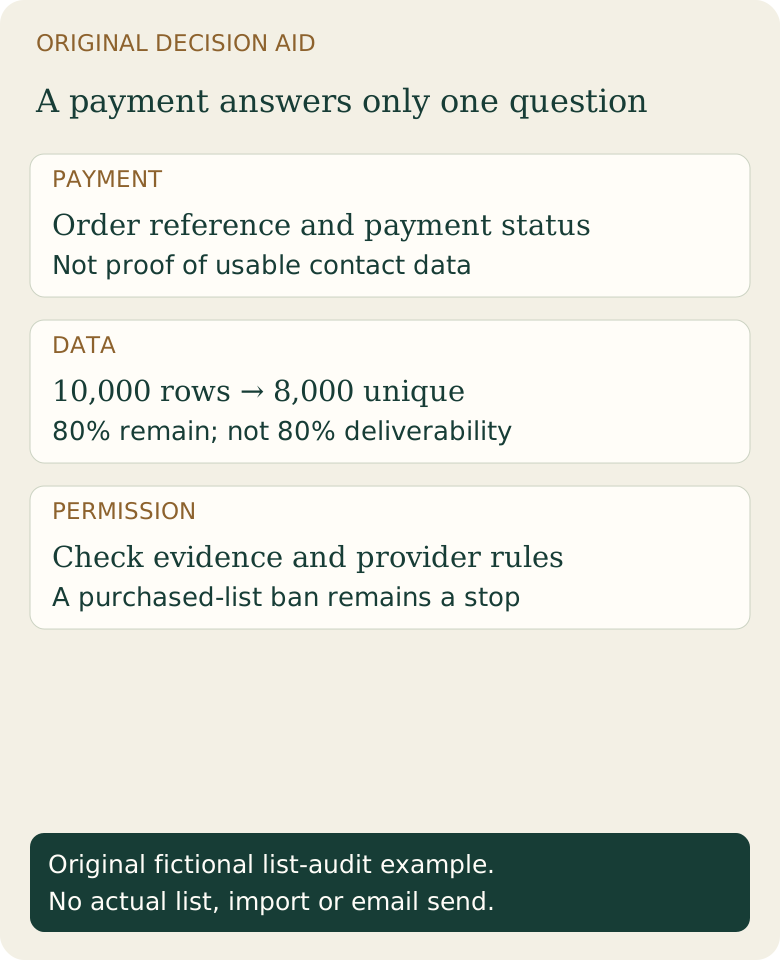
Before any purchase decision, identify exactly what is being sold: raw addresses, a database segment, research access or contacts who specifically requested communications from your business. A Bitcoin transaction can establish that a payment occurred; it cannot establish which of those products was delivered or which uses are permitted.
This guide evaluates the evidence questions, not the supplier’s reputation or an alleged success rate. It includes no affiliate tracking, supplier ranking, actual lead record or outreach template.
Which four evidence checks should stay separate?
A file arriving after payment is only one event. Use this original matrix to distinguish the contractual delivery question from the separate questions about the data and its use. If a vendor describes all four with one word such as “verified,” ask what was actually checked.
Scroll across the table to see all columns.
| Evidence layer | What would support it | What it does not prove |
|---|---|---|
| Payment and order | Actual invoice, agreed scope, order reference and payment status | That the delivered list is accurate or usable |
| Data provenance and quality | Collection source, date, deduplication method and defined validation result | That recipients permitted your communications |
| Permission and applicable rules | Relevant permission records, sender identity, purposes and withdrawal handling | That an email provider accepts purchased lists |
| Sending-provider permission | The provider’s current acceptable-use and list policies | A universal legal conclusion for every country |
What can a hypothetical 10,000-row list audit actually tell you?
Invent a delivery containing 10,000 rows. Removing 2,000 duplicate rows leaves 8,000 unique records: 8,000 ÷ 10,000 = 80% of the original row count. That is a deduplication result, not a deliverability rate or a consent percentage.
Now suppose 1,500 records include a vendor-supplied field labeled “opt-in.” The field still needs evidence: who the recipient agreed to hear from, what purpose was described, when agreement was recorded, and whether permission was withdrawn. A column label is not proof that your company was included.
Finally, apply the sending provider’s policy. If it prohibits purchased lists, neither the 8,000 unique records nor the 1,500 claimed opt-ins establish permission to import and send that purchased list. Stop rather than trying to rename, filter or re-upload it to bypass the restriction.
Scroll across the table to see all columns.
| Fictional count | Valid inference | Unsupported inference |
|---|---|---|
| 10,000 delivered rows | A row count in the imagined file | 10,000 reachable or permitted contacts |
| 8,000 after deduplication | 80% of raw rows remain under the assumed method | 80% deliverability or permission |
| 1,500 with a claimed opt-in field | 1,500 records need supporting evidence | 1,500 people consented to your brand |
| Provider bans purchased lists | The proposed import remains blocked by that policy | Filtering creates an exception |
How can provider rules differ from the legal question?
Resend’s acceptable-use policy, updated October 13, 2026 when retrieved, prohibits purchased lists, scraped contacts and unsolicited cold outreach. It separately requires recipients to have explicitly opted in to communications from the sender. Those are provider conditions; do not turn them into a statement that every jurisdiction has identical law.
For a jurisdiction-specific example, Canada’s Privacy Commissioner discusses address collection, purchased lists and consent withdrawal in its e-marketing guidance. A sender must assess the rules that apply to its circumstances and recipients. A vendor’s “compliant” badge is not a legal opinion about your campaign.
Ask qualified advisers about an actual cross-border or uncertain use. Confirm both applicable obligations and your provider’s contract before collecting, importing or sending. Changing the currency used to pay for data does not answer those questions.
What should you record before paying any data supplier?
Download the original lead-purchase evidence worksheet. It contains the four proof layers and fictional counts, not a list of addresses, a sending tool or permission to contact anyone.
Keep the product definition, allowed uses, provenance commitments, delivery terms, remedy process and actual payment instructions together. If an actual checkout offers Bitcoin, verify the asset, network, amount and expiry; use the payment-request guide before approving a wallet transfer.
A transaction ID can help identify a payment stage but is not evidence of audience permission or contractual delivery. Do not publish a recipient list or an unredacted customer record while asking for support.
Fiat2Bitcoin does not sell these lists, verify their contents, provide bulk-outreach services or handle their delivery and refunds. Permission-based signups and documented withdrawal handling are a different acquisition process from buying addresses.
Sources & further reading
These sources explain the payment systems and rules discussed in this guide. For your purchase, check the provider’s current offer and terms.
- BitSMTP: advertised email-list crypto payment claim; not endorsed
- Resend: current acceptable-use and mailing-list policy
- Privacy Commissioner of Canada: e-marketing and purchased-list guidance
Published by Fiat2Bitcoin. Worked examples use fictional figures and records; they are not current prices or customer transactions. How we prepare our guides.