
What are the steps before taking a Bitcoin-backed loan?
Identify the actual lending counterparty or protocol, read its current agreement and check eligibility for your location and account. Confirm whether you receive bank currency or a stablecoin, how collateral moves and who can release or liquidate it. Do not connect a wallet or transfer BTC merely because a webpage promises a low rate.
Coinbase’s current introduction describes an interface to Morpho lending on Base through which eligible customers can borrow USDC using crypto collateral. This is one documented structure, not a statement that every Bitcoin-backed loan uses the same protocol, terms or asset. Availability and product terms require a fresh check when you apply.
Next, compare principal, interest behavior, all fees, term or maturity, and the repayment process. Locate the exact collateral valuation method and liquidation threshold in the terms. Work through a price-decline example before choosing an amount. Approval, disbursement and release of collateral are separate events.
Calculate loan-to-value with the whole outstanding debt
LTV equals outstanding debt divided by the current value of pledged collateral. Coinbase’s loan-health explanation includes accrued unpaid interest in the debt side. A lower LTV does not remove counterparty, protocol, price or operational risks.
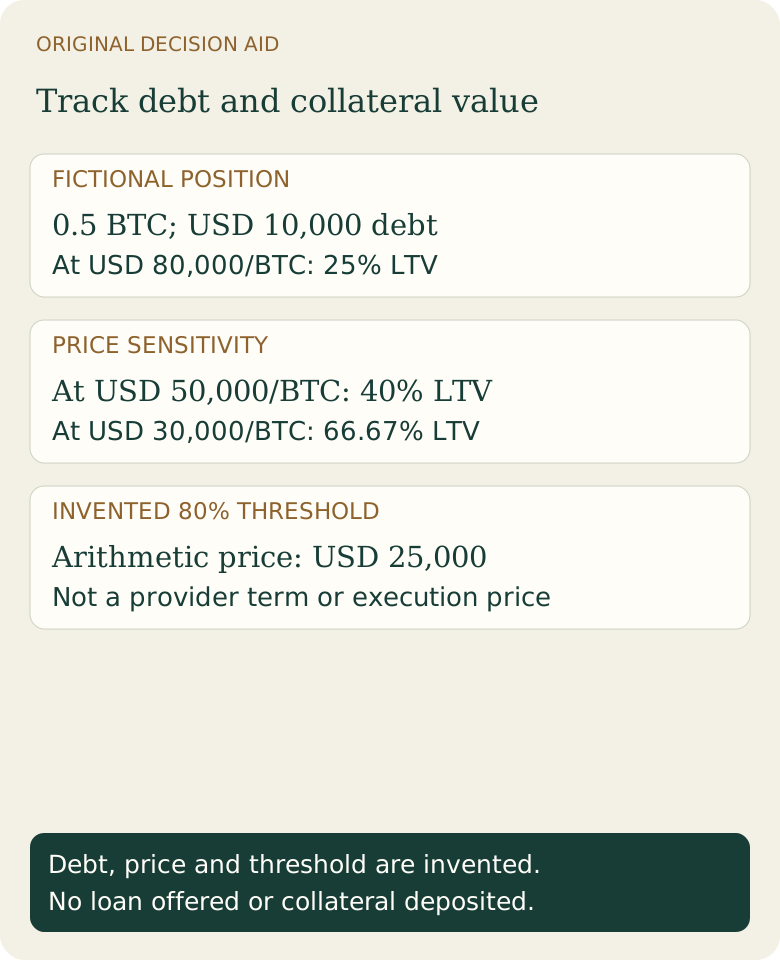
For this original fictional example, pledge 0.5 BTC valued at USD 80,000 per BTC and borrow USD 10,000. Collateral is worth USD 40,000, so LTV is 25%. The numbers are invented and do not describe an available loan, a current Bitcoin price or a suggested borrowing level.
If BTC falls to USD 50,000 and debt stays unchanged, collateral becomes USD 25,000 and LTV rises to 40%. At USD 30,000/BTC, collateral is USD 15,000 and LTV is about 66.67%. Interest or fees can make the debt larger even while the BTC price stays flat.
Scroll across the table to see all columns.
| BTC reference price | Value of 0.5 BTC | USD 10,000 debt / collateral |
|---|---|---|
| USD 80,000 | USD 40,000 | 25.00% LTV |
| USD 50,000 | USD 25,000 | 40.00% LTV |
| USD 30,000 | USD 15,000 | 66.67% LTV |
| USD 25,000 | USD 12,500 | 80.00% LTV |
What is the arithmetic liquidation price?
Assume, only for illustration, an 80% liquidation LTV, one collateral asset and USD 10,000 debt. The price at that ratio is debt / (BTC quantity × threshold): 10,000 / (0.5 × 0.80) = USD 25,000/BTC. The 80% input is invented, not a Coinbase or universal threshold.
If outstanding debt grows to USD 10,500 with the same collateral and illustrative threshold, the calculation becomes 10,500 / (0.5 × 0.80) = USD 26,250/BTC. The position reaches that ratio at a higher price because more debt is outstanding.
This simple model is not a promise about an actual execution price, liquidation size or remaining balance. Oracle prices, penalties, interest, contract rules, market liquidity and transaction timing may change the outcome. A warning or notification is not a guaranteed grace period.
What changes when you repay or add collateral?
At the fictional USD 50,000/BTC price, repaying USD 2,000 reduces debt to USD 8,000 against USD 25,000 collateral: 32% LTV. Instead, keeping USD 10,000 debt and adding 0.1 BTC makes collateral 0.6 BTC × USD 50,000 = USD 30,000: about 33.33% LTV. These compare arithmetic effects, not recommended actions.
Consider whether repayment funds are actually available in the accepted asset and network, and whether transfers can settle before liquidation. Adding more collateral also increases the amount exposed to that lending arrangement. A price calculation cannot establish that you will retain access to it.
Scroll across the table to see all columns.
| Question | Record from the actual agreement | Risk left if unclear |
|---|---|---|
| What is owed? | Principal, interest, fees and maturity | Debt may grow or become due |
| What is received? | Asset, network and withdrawal conditions | A stablecoin is not a bank deposit |
| Where does collateral go? | Custodian, wrapper, protocol and permissions | Custody and smart-contract exposure |
| When can it be liquidated? | Valuation, threshold and penalties | No reliable monitoring boundary |
| How is it released? | Repayment settlement and release process | A payment may not mean immediate return |
Decide whether the obligation fits your situation
A loan retains debt exposure alongside Bitcoin price exposure. Compare it with borrowing less, postponing the spending or other available ways to meet the expense; do not treat continued BTC ownership as proof that borrowing is economical. Tax treatment depends on facts and jurisdiction, and a loan or liquidation should not be described as automatically tax-free.
Download the original LTV worksheet to reproduce the hypothetical scenarios. Read custodial versus non-custodial wallets for the separate custody distinction. If your task is buying rather than borrowing, purchase methods and purchase costs describe that different process. A Fiat2Bitcoin purchase account does not create a borrowing facility.
Can I borrow without selling Bitcoin?
Some arrangements pledge Bitcoin or a representation of it as collateral. That can expose the collateral to transfer, lockup and liquidation. It does not guarantee you keep the BTC or avoid tax consequences.
Is the example’s 80% threshold available from a provider?
It is an invented teaching input. Read the actual provider or protocol terms; different assets and products can have different thresholds.
Does Fiat2Bitcoin provide Bitcoin-backed loans?
No. Fiat2Bitcoin does not lend, arrange these loans, evaluate your eligibility or hold loan collateral.
Sources & further reading
These sources explain the payment systems and rules discussed in this guide. For your purchase, check the provider’s current offer and terms.
- Coinbase: crypto-backed loan structure and eligibility
- Coinbase: LTV, interest and liquidation thresholds
Original fictional LTV and threshold calculations. No loan application, lender acceptance, collateral deposit or tax determination. How we prepare our guides.