
What does the Bitclassic investing page actually establish?
The page at bitclassic.org/investing-bitcoin-bitclassic/ describes account opening, funding, trading and withdrawal under the BitClassic name. We retrieved it, the website’s terms and its crew page on November 18, 2026. This review concerns those exact pages; another website, app or similarly named asset needs its own identification.
The investing page presents operational claims, while the terms page sets rules for using the website, content, comments and hyperlinks. A content-use agreement is a different document from a customer agreement identifying who executes a purchase or holds an account balance. The examined pages do not resolve that distinction for a reader.
This is a source comparison, not an exchange review or a conclusion that a particular person or service is fraudulent. We did not create an account, submit identification, search every possible register, place an order or test a withdrawal. We cannot turn the article’s descriptions into firsthand findings.
Which evidence belongs to each claim?
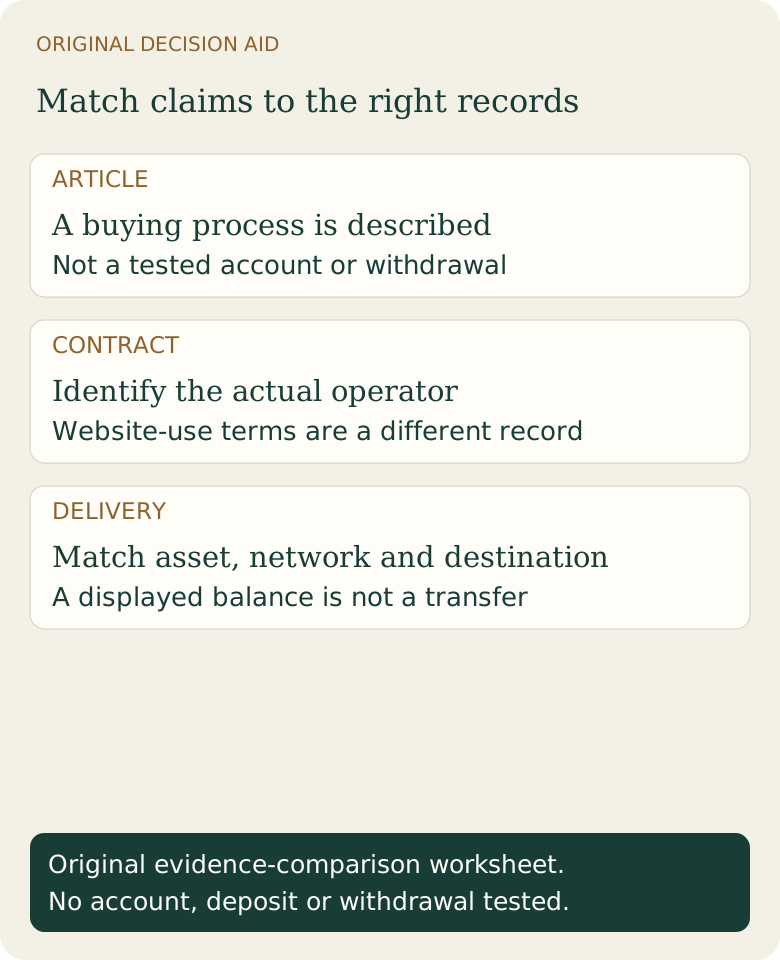
Separate what a webpage says from what an actual customer relationship would require. This original matrix identifies the next document or record to examine. It does not assert that an unseen document exists or that a missing link proves wrongdoing.
Scroll across the table to see all columns.
| Claim or record | What it can establish | Evidence still needed |
|---|---|---|
| A published buying guide | The publisher describes a process | Exact service URL and the entity offering it |
| Website-use terms | Rules for reading or using the site | Customer agreement for the actual financial service |
| A dashboard balance | An interface displays a number | Custody terms and authoritative transaction records |
| A withdrawal description | The article describes a feature | Actual supported asset/network, fees, conditions and a completed delivery record |
| A familiar brand or logo | A displayed name or image | Matching domain, legal entity and independently checked permissions where applicable |
How can you identify the actual purchase operator?
Start with the exact domain reached from the page, rather than assuming a name identifies a single company. Read the customer agreement before any funding step. Record the legal entity, country, permitted service, applicable customer location, dispute route and the terms version. A blog author, website owner, payment processor and custodian may have different roles.
The CFTC’s digital-asset fraud guidance recommends checking people or firms before trading and checking claims about a site’s history and identity. A register search must match the exact entity and activity in the relevant jurisdiction. A search result, registration of a different company, or a logo copied onto a page is not a universal approval of every crypto service.
We have not made a regulatory-status determination for Bitclassic. An unresolved operator question should remain unresolved in your notes, rather than being silently replaced by the name of a similarly spelled exchange. Do not send identification or money merely to discover who the counterparty is.
Why are custody and Bitcoin delivery separate checks?
Bitcoin is an asset on its network; an article title is not an asset identifier. Before comparing any offer, identify whether you would receive native BTC at an address, a custodial account claim, an investment product or a different token. A balance labeled Bitcoin does not by itself answer that question.
Custody describes who controls the keys and what claim the customer has. Delivery describes what was actually sent, where, on which network and with what status. Read our custodial versus non-custodial wallet guide for the general distinction and our Bitcoin transaction-ID guide for the record used to examine an on-chain transfer.
A transaction ID alone does not prove an entire advertised platform is reliable. It can support a specific network-transfer check when the asset, destination and amount match. Conversely, a page describing withdrawals is not evidence that a withdrawal happened.
What would an incomplete evidence file look like?
Imagine a reader saves three things: an investing article, website-use terms and a screenshot displaying a hypothetical 0.001 BTC balance. The file establishes that the documents and display were seen. It does not identify a signed customer agreement, prove custody rights or establish that 0.001 BTC was delivered to the reader.
Now imagine a fourth item: a customer agreement for a separately named operator. That creates a new task—matching the agreement to the exact service, legal entity and offer—not permission to merge the two names. No amount of arithmetic on the screenshot can fill that identity gap.
The useful outcome is a list of resolved and unresolved questions. If the operator, payment recipient or delivery terms remain unclear, pause the transaction. A small payment would still expose money and would not replace understanding the contract.
Scroll across the table to see all columns.
| Item in the imagined file | Supported conclusion | Question left open |
|---|---|---|
| Article and website terms | A process is described and site-use rules exist | Who contracts with the customer? |
| Screenshot: 0.001 BTC | A number appears in a fictional interface | Is there an authoritative balance or delivery record? |
| Agreement naming another operator | Another entity is named in a document | Does it actually govern this exact offer? |
What should you record before comparing an alternative?
Use the downloadable claim-to-evidence worksheet to record the exact page, operator, agreement, asset, network, custody arrangement and unresolved items. It contains no account credentials, wallet keys, customer information or recommendation to fund a service.
Once the actual service is identified, compare delivered Bitcoin, total costs and conditions using our Bitcoin purchase-fee guide. An identified provider can still have eligibility restrictions and changing offers. A content review does not establish availability or a guaranteed execution time.
Sources & further reading
These sources explain the payment systems and rules discussed in this guide. For your purchase, check the provider’s current offer and terms.
- Bitclassic: examined investing article
- Bitclassic: website terms
- Bitclassic: About the Crew
- CFTC: digital-asset fraud guidance
Published by Fiat2Bitcoin. Worked examples use fictional figures and records; they are not current prices or customer transactions. How we prepare our guides.