This guide supports reviewing debit-card Bitcoin purchases and credit-card Bitcoin purchases. Knowing the issuer helps you ask the right questions; it does not guarantee card acceptance, a particular fee or purchase approval.
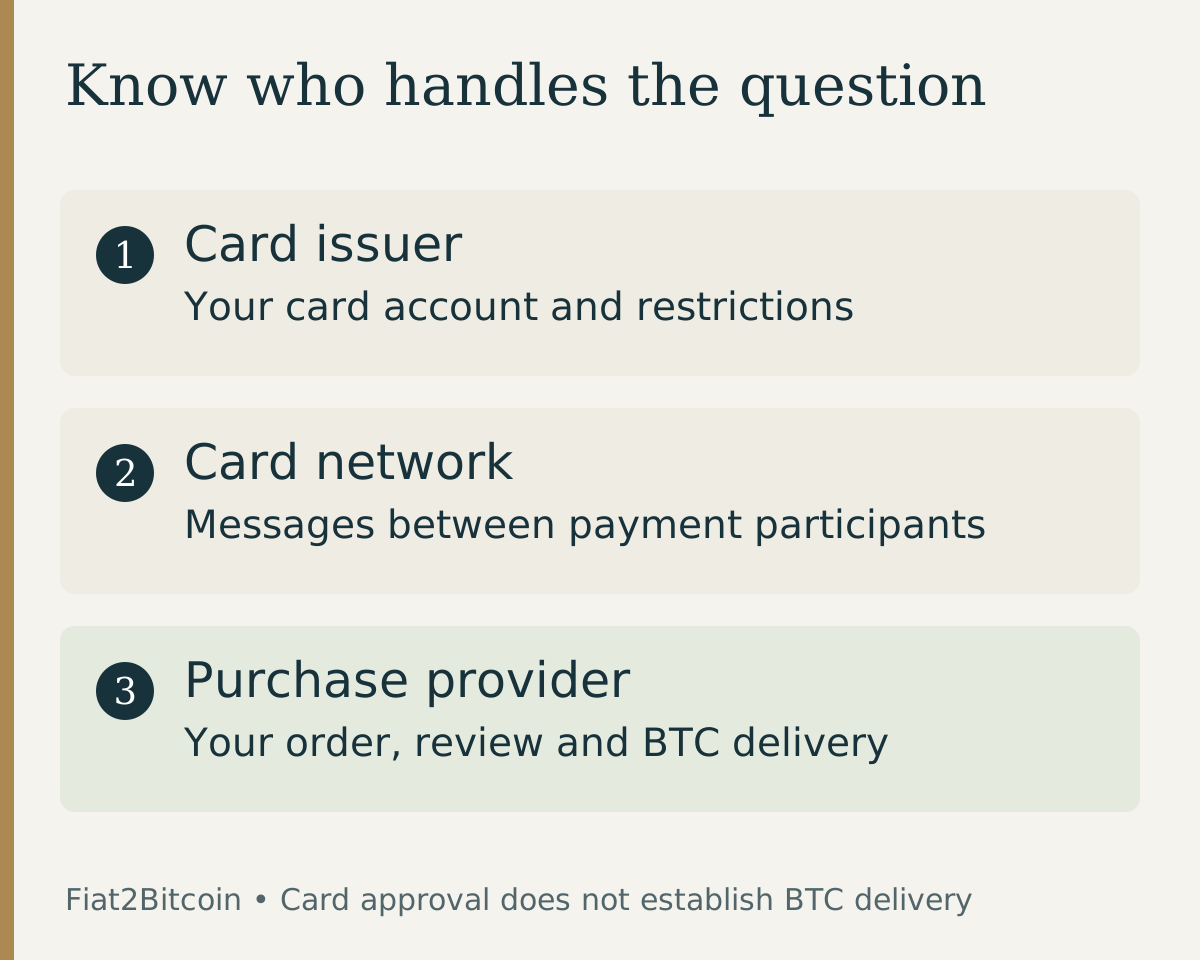
What is an issuing bank?
An issuer is the financial institution that provides the card and manages the associated card account. Stripe’s issuer explainer distinguishes this role from the acquiring bank on the merchant’s side and the network used to communicate card transactions. Banks and credit unions can issue cards.
On a debit card, the card account connects to the relevant bank funds. On a credit card, it connects to a credit account. The institution you use for another bank account is not necessarily the issuer of the specific card you selected.
The prominent brand on a card is not always enough to identify every organization behind it. A store or financial app may market a card issued by another institution. Read the card agreement or issuer disclosure for the specific card rather than guessing from its design.
Issuer, network, acquirer and Bitcoin provider: what is the difference?
Scroll across the table to see all columns.
| Role | Main function | Useful question |
|---|---|---|
| Card issuer | Issues the card and manages its account | Is this payment blocked on my card account? |
| Card network | Carries payment messages under its network rules | Which network is shown on the selected card? |
| Acquirer or merchant-side payment services | Helps the merchant accept and process payments | The purchase provider coordinates this side |
| Bitcoin purchase provider | Handles the order under its purchase terms | What is my order status and what remains before delivery? |
These are roles, and arrangements can vary. Visa and Mastercard are card networks; a network logo does not identify the particular bank account or establish that a Bitcoin provider accepts your card.
For a fictional example, a card bearing a network logo is issued by Bank A and used with Provider B. Bank A can explain the card account. Provider B can explain its order. Neither a familiar logo nor a bank notification proves that Bitcoin reached your wallet.
How do you find your card issuer?
Start with the card’s official account app, statement, agreement or the support details printed on the card. Visa directs cardholders with questions about a posted transaction to their issuer using the number on the statement or back of the card.
Mastercard’s consumer FAQ likewise directs account-specific card questions to the issuing institution. Use verified contact information rather than a phone number from an unsolicited message or an advertisement claiming to fix a declined purchase.
For an app-branded card, check the issuer disclosure and that card’s official support process. Do not assume the app brand, the network and the issuing institution are interchangeable. You should not need to paste your full card number into an unknown issuer-lookup website to find routine support.
Who should you contact about a Bitcoin payment problem?
Scroll across the table to see all columns.
| Question or problem | First contact | What to provide safely |
|---|---|---|
| Card account blocked, card expired or spending limit reached | Issuer through the official card support channel | The attempted amount, date and exact message |
| Provider verification or unsupported payment method | The purchase provider | Order reference and the displayed requirement |
| Bank shows a pending entry; order is unresolved | Provider for order status; issuer for the bank entry | Original order reference, date and amount |
| Order says Bitcoin was sent but wallet has not received it | Purchase provider and, if needed, wallet support | Order reference and BTC transaction ID if supplied |
| A charge you do not recognize | Issuer promptly through a verified channel | The statement entry and why you do not recognize it |
Keep full card numbers, CVV codes, PINs, account passwords and wallet recovery words out of ordinary support messages. Use the official secure process if additional verification is required.
The statement-descriptor guide explains why a displayed billing name can differ from the website name. An unfamiliar label deserves checking; do not assume it is legitimate merely because you recently tried to buy Bitcoin.
Does an issuer decline mean the Bitcoin provider rejected you?
Not necessarily. A payment can fail at different stages, and a generic checkout error may not identify which organization made the decision. Ask the provider whether it received an issuer response and what the supported next step is. Ask the issuer about the actual attempted payment rather than only asking whether the card works.
If the bank says it approved the attempt, still check the purchase provider’s order record. Payment approval is separate from identity review, order acceptance and Bitcoin delivery. Our card-authorization guide explains that distinction.
The debit-card decline guide covers common checks, and the 3D Secure guide covers a bank authentication challenge. Repeatedly resubmitting the same order can make it harder to understand which attempt produced a pending entry.
Do not change your identity or use someone else’s card to work around a restriction. Resolve the original order and ask about eligible payment options before starting another purchase.
What should you ask the issuer before a credit-card purchase?
Ask whether the specific transaction is permitted for your card, whether a limit applies, and how the issuer would classify and charge it. A general statement that the card supports online purchases does not answer all three questions.
The credit-card cash-advance guide explains the fee and interest questions to clarify. The issuer’s terms and the Bitcoin provider’s quote are separate parts of the cost; a quote may not include charges later added by the issuer.
Once the question is resolved, review the current purchase quote, selected card and destination again. A support conversation about the card account does not hold an earlier Bitcoin price or confirm the order is complete.
Sources & further reading
General payment information and purchase-specific details serve different purposes. Review the current offer and terms before proceeding.
- Stripe: Issuers, acquirers and card networks
- Visa: Cardholder transaction support
- Mastercard: Consumer card support
Original Fiat2Bitcoin guide. Examples are illustrative; they are not live quotes or customer transactions. How we prepare our guides.