This guide supports the credit-card Bitcoin purchase page. Card authorization also applies to debit-card purchases, where a hold can affect available bank funds rather than a credit line. Eligibility, fees and the final purchase status remain specific to the issuer and provider.
What does credit card authorization mean?
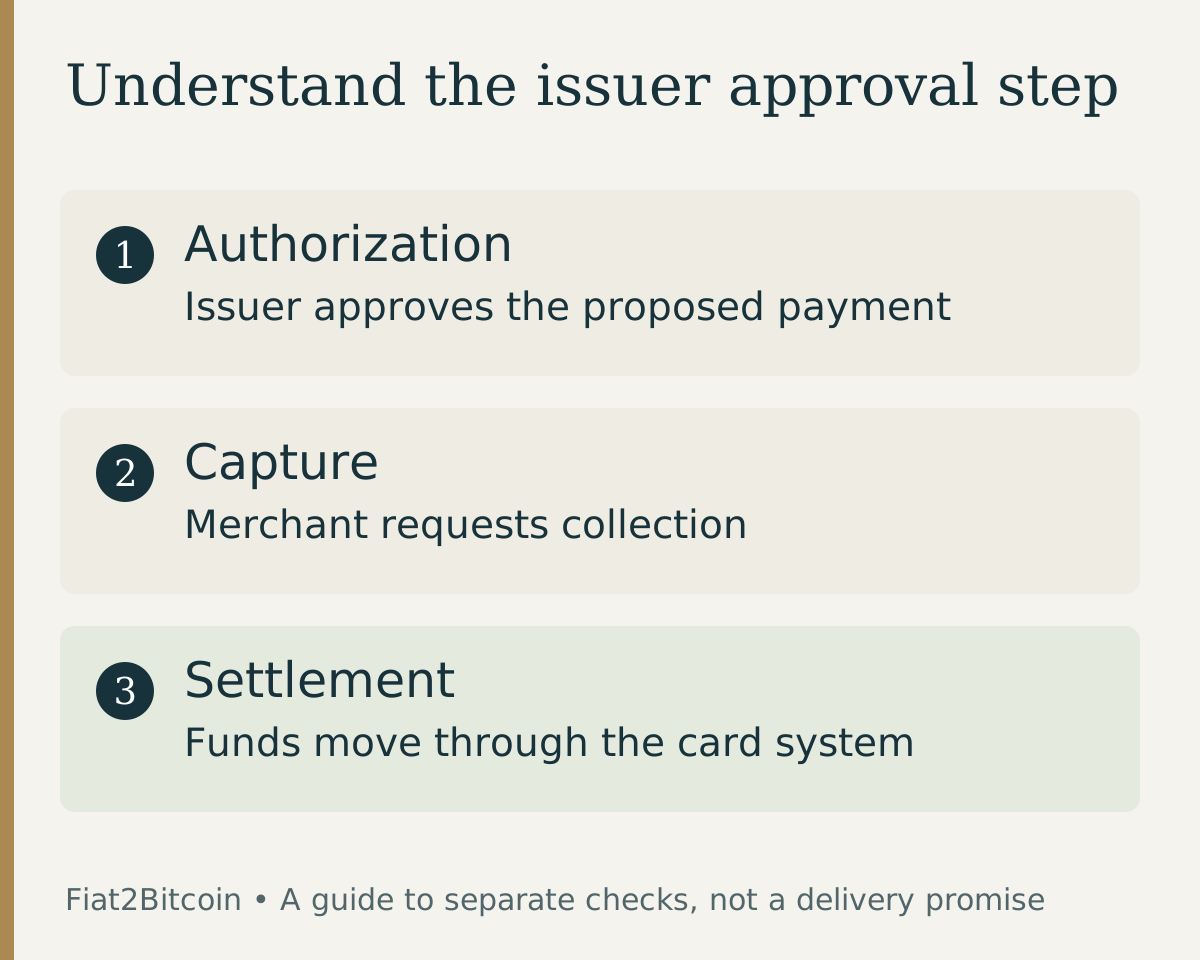
The merchant's payment process asks the card issuer whether it will approve a transaction. The issuer checks the proposed payment and returns its decision. Stripe's explanation of card authorization separates that approval from requesting the funds and moving them between banks.
An authorization code is part of the card-payment record. It is not a Bitcoin transaction ID, proof of wallet ownership or a promise that all purchase-provider checks passed.
The word also appears in ‘credit card authorization form,’ where it describes a customer's permission to charge a card. That permission and the issuer's approval are distinct. Signing a form does not make an issuer accept a payment or complete a Bitcoin order.
Authorization, capture and settlement: what changes?
Scroll across the table to see all columns.
| Stage | What it describes | What to confirm |
|---|---|---|
| Authorization | The issuer approves a proposed payment | Amount, card and whether a hold exists |
| Capture | The merchant submits the authorized payment for collection | Whether collection was requested for this order |
| Settlement | Funds move through the card-payment system | The provider's payment status |
| Bitcoin delivery | The provider sends or credits BTC under its terms | Asset, destination, amount and delivery reference |
The first three definitions follow Stripe's payment explanation. They are a guide to terminology, not a fixed timeline or a claim that Stripe processes Fiat2Bitcoin orders.
If the provider says BTC has been sent, move to the Bitcoin transfer-time guide. Waiting for network confirmations will not resolve a card payment that has not progressed to a purchase.
Why does an authorization reduce available credit?
Capital One's pending-transaction guide explains that an authorized but unfinished transaction can hold part of your available credit. Your issuer's actual display and processing rules determine how that appears on your account.
Hypothetical example: you have $1,000 of available credit and a $200 authorization is the only change. If the issuer reserves that full amount, available credit becomes $800. This does not mean you already received $200 of Bitcoin.
If you retry and a separate $200 hold appears, that same simplified example leaves $600 available. Two holds do not, by themselves, establish two completed charges. Check each attempt's status before deciding what happened.
These figures exclude fees, other activity and issuer-specific treatment. Use the issuer's current available-credit figure instead of treating the illustration as a personal limit calculation. For debit cards, also check the spending-limit guide.
Is a released hold the same as a refund?
No. A hold can be released when an authorization is canceled or expires without becoming a completed charge. A refund relates to returning money from a payment that succeeded. Stripe's cancellation and refund documentation illustrates why an uncaptured payment is canceled rather than refunded.
A disappeared pending entry does not independently prove the provider canceled your order. Ask whether the payment was captured, canceled, expired or replaced by a posted entry, and confirm the order outcome separately.
If the provider says it issued a refund, request the refund record and expected timing for the actual payment method. Do not expect a separate refund entry when the event was only a released authorization. Do not assume another provider's timing applies to your issuer.
Does passing 3-D Secure mean the purchase is approved?
Passing an authentication step and receiving issuer authorization answer different questions. A bank challenge helps authenticate a cardholder; it does not establish Bitcoin delivery. Our 3-D Secure troubleshooting guide explains the challenge step.
A provider can still require other checks. If the card issuer approved the payment but the order failed, ask the provider what happened to that authorization and whether the order can still complete.
Authorization also does not settle the borrowing cost. Check the issuer's treatment of cryptocurrency purchases, including possible cash-advance fees and interest, before approving a new attempt.
What should you ask before trying again?
- Provider: which order and payment attempt does the authorization belong to?
- Provider: was that payment captured, canceled or left uncaptured, and can the original order still finish?
- Issuer: is the entry a pending hold or a posted charge, and what affects its release?
- Provider: if a refund was issued, what reference and expected timing apply?
- Both records: are there multiple attempts that need to be reconciled separately?
Use the pending-purchase checklist when the bank, order and wallet records disagree. For a refusal at checkout, use the card-decline guide. This article explains the approval stage; it does not replace an investigation into an existing payment.
Use authenticated support and provide only the information needed to identify the attempt. If a charge is unfamiliar, contact your issuer promptly rather than repeatedly trying to complete an order you do not recognize.
Sources & further reading
General payment information and purchase-specific details serve different purposes. Review the current offer and terms before proceeding.
- Stripe: Card authorization, capture and settlement
- Capital One: Pending card transactions and available credit
- Stripe: Canceling payments and issuing refunds
Original Fiat2Bitcoin guide. Examples are illustrative; they are not live quotes or customer transactions. How we prepare our guides.