A large enough account balance does not settle every question about a debit-card Bitcoin purchase. The bank and purchase provider make separate decisions. Fiat2Bitcoin remains prelaunch; this guide does not establish a live purchase limit or confirm any bank's cryptocurrency policy.
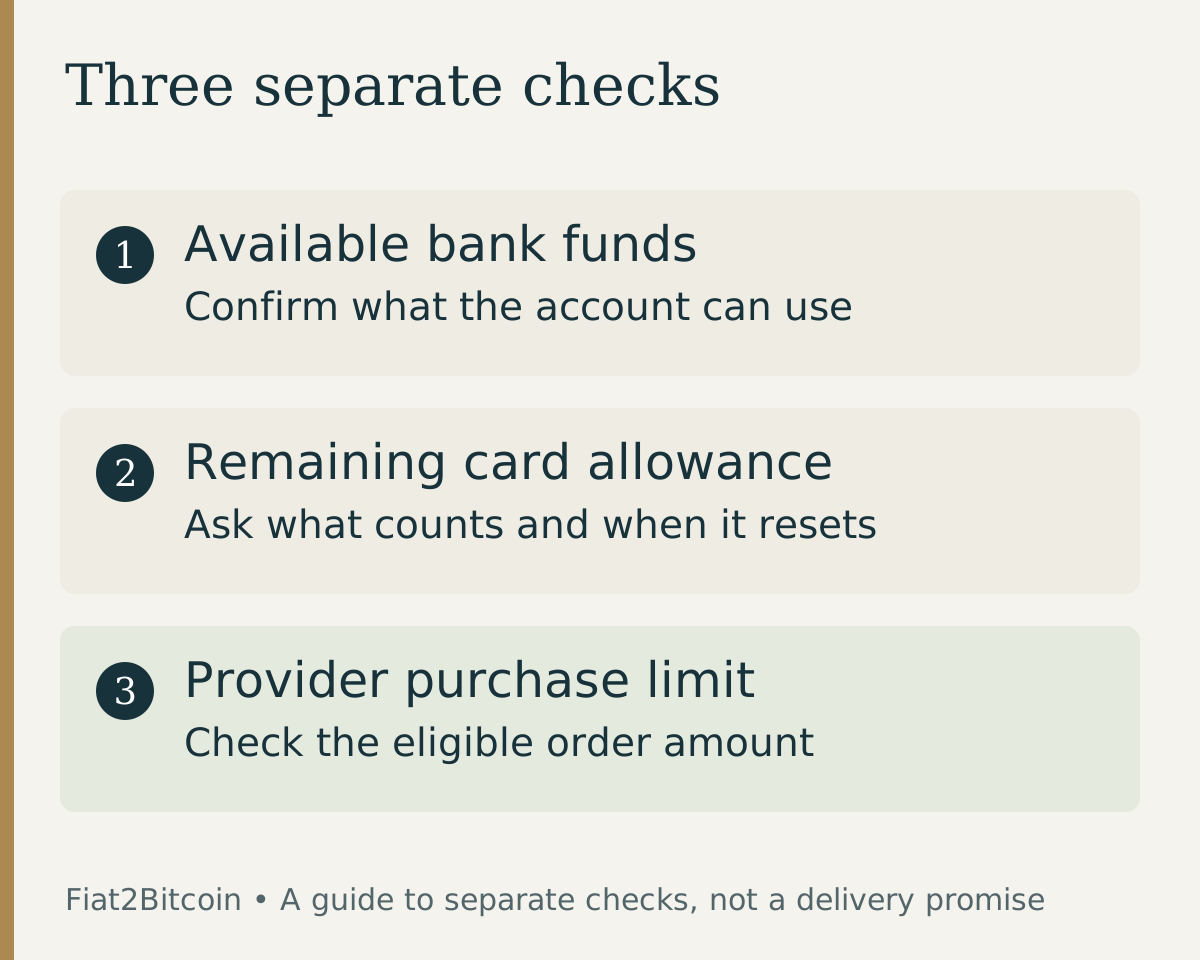
Which limit are you looking at?
Scroll across the table to see all columns.
| Check | What it tells you | Who can confirm it |
|---|---|---|
| Available funds | What the bank currently makes available in the account | Your bank |
| Card spending limit | The allowed card-purchase amount for the applicable period | Your card issuer |
| Remaining card allowance | What remains after activity the issuer counts toward that limit | Your card issuer |
| Provider purchase limit | The eligible order size under the provider's own conditions | The selected purchase provider |
An ATM cash-withdrawal limit answers a different question from an online purchase limit. Wells Fargo's debit-card FAQ distinguishes purchase and withdrawal limits and explains how its customers can check them. That bank's guidance does not establish your card's terms or its acceptance of Bitcoin purchases.
Do not use a credit-card cash-advance limit to estimate what a debit card permits. If you are comparing borrowing with spending bank funds, start with the credit-card purchase guide and the issuer's separate terms.
An example: enough funds, but too little card allowance
Suppose a bank confirms a hypothetical $2,000 daily purchase limit and says $650 of earlier card activity counts toward it. The remaining allowance would be $1,350. An available account balance of $4,000 would not increase that allowance.
If the next Bitcoin order would charge the card $1,400 in total, it exceeds that illustrative remaining amount by $50. Compare the full card charge with the allowance, not just the dollars being converted to Bitcoin. If the offer lists fees separately, establish whether they are included in that charge.
These figures are teaching examples, not Fiat2Bitcoin or bank limits. Other restrictions could still prevent a smaller payment. Pending authorizations and the issuer's counting rules can affect the real calculation, so ask the issuer for the remaining amount rather than reconstructing it from a few visible transactions.
How can you find your debit-card spending limit?
- Open your bank's official app or website directly and look for the card's purchase-limit information.
- Confirm whether the displayed figure is the total limit or what remains for the current period.
- Ask which transactions and pending authorizations count, and when the allowance resets, including the time zone.
- Ask whether the issuer permits this cryptocurrency purchase and whether any separate per-transaction restriction applies.
- Compare the answer with the provider's current eligibility and full dollar charge.
A useful message is: I am checking a proposed card purchase with a total charge of [amount]. What purchase allowance remains, when does it reset, and are there separate restrictions for this type of transaction? Use a verified bank support channel and provide only the details it needs.
There is no universal midnight reset or universal daily dollar limit to apply to every issuer. The answer should identify your particular card and the applicable period.
Can you request a higher limit?
Ask your issuer whether an adjustment is available and appropriate for your account. North Shore Bank's FAQ describes temporary-increase requests for some of its cards. That is an example of a bank process, not a promise that your issuer will approve a change.
If a change is approved, confirm the amount, when it takes effect, when it expires and whether it applies to the intended purchase. Keep your own budget unchanged unless you independently decide otherwise; extra card capacity is not a reason to spend more on Bitcoin.
Do not split a purchase or use another person's card to get around issuer or provider restrictions. A higher bank limit also cannot override the provider's identity checks, order limits or eligibility decision.
What if the purchase is still declined?
Check the original order and your bank's entry before another attempt. If there is a pending charge, clarify its status even if the checkout showed an error. The debit-card decline checklist covers other causes; a limit is only one possibility.
If the original attempt is resolved and another method is eligible, compare ACH purchases or a reviewed wire purchase on their own terms. They have separate checks, costs and funding instructions. Changing the method does not create an exception to an eligibility restriction.
Keep the bank's answer, accepted quote and provider order reference together. Payment authorization and Bitcoin delivery remain separate milestones, even when the amount fits every applicable limit.
Sources & further reading
General payment information and purchase-specific details serve different purposes. Review the current offer and terms before proceeding.
- Wells Fargo: Debit-card purchase and withdrawal limits
- North Shore Bank: Spending limits and increase requests
Original Fiat2Bitcoin guide. Examples are illustrative; they are not live quotes or customer transactions. How we prepare our guides.