Use this guide with the debit-card Bitcoin purchase page or credit-card Bitcoin purchase page. Fiat2Bitcoin remains prelaunch. We do not publish an active Fiat2Bitcoin card descriptor or ask readers to treat an example label as a legitimate charge.
What is a statement descriptor?
A statement descriptor, also called a billing descriptor, is the text that helps identify a charge or payment in account activity. It is a label on the payment record, not the purchase receipt itself.
Stripe's documentation explains that card descriptors can combine a fixed business prefix with a transaction-specific suffix. It also notes that some banks display the information inconsistently. These are examples of payment-processing behavior, not a statement that Fiat2Bitcoin uses Stripe.
For a Bitcoin purchase, keep the receipt identifying the actual purchase provider. Compare that record with the statement entry rather than expecting the Bitcoin ticker, a wallet address or the exact website title to appear. If you cannot connect the label to the receipt, ask the provider and card issuer to identify it.
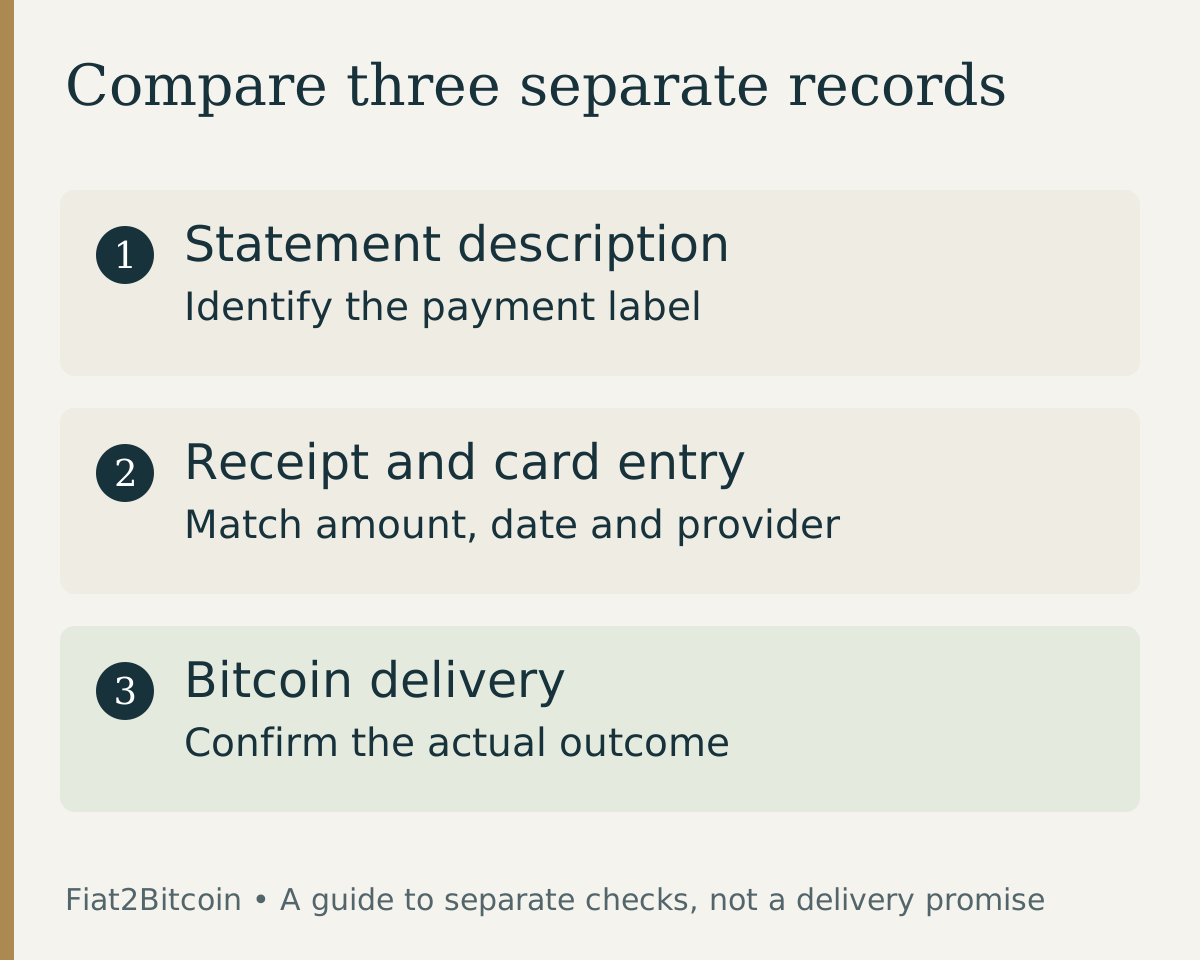
Which record tells you what?
Scroll across the table to see all columns.
| Record | Useful for | Not enough to prove |
|---|---|---|
| Statement descriptor | Recognizing the business or payment label | That you authorized this specific charge |
| Amount, date and card entry | Matching a bank record to a possible purchase | The purchase provider's final order outcome |
| Provider receipt or order | Checking the selected offer and purchase status | That Bitcoin is already in the receiving wallet |
| Bitcoin transaction record | Checking a claimed on-chain delivery | The meaning of a separate card fee or bank label |
A statement description is also different from your billing ZIP code and from an ACH company ID. The billing ZIP guide covers checkout address information; the ACH company ID guide covers bank-payment originators.
Can the description change between pending and posted?
Yes, a pending label can differ from the final statement description. Stripe's explanation of billing descriptors distinguishes the initial description associated with authorization from the later description after settlement. That general distinction does not establish a deadline for your card issuer.
Save the original entry and check its current status. A changed name alone is not evidence of a second purchase. Equally, two separate posted charges should not be dismissed as a harmless label change without checking them.
If the main problem is an unresolved payment, follow the pending Bitcoin payment guide. Identify the bank entry and provider order before trying again. The statement label does not tell you whether a new attempt would duplicate the purchase.
A five-step checklist for matching a charge
- Open the card issuer's official account view. Record the exact descriptor, amount, currency, date and whether the entry is pending or posted.
- Open the purchase provider's verified account portal or your saved receipt. Find the order reference and payment details.
- Compare the records together. An amount or date by itself may not uniquely identify an order, especially if you made several attempts.
- Ask the provider to confirm the expected statement description for that order. Ask the issuer to identify any separate entry you still cannot explain.
- Keep the explanation and references with the order record. Check Bitcoin delivery separately if the provider says it has sent the purchase.
For example, suppose a hypothetical receipt shows a $100 card purchase and the bank shows a $100 merchant entry plus a separate fee. Matching the $100 amount helps the investigation, but it does not explain the fee. Ask the issuer what the fee represents and compare the answer with the provider's quote.
For credit cards, the cash-advance fee guide explains why issuer charges can sit outside the checkout quote. Do not assume that a descriptor proves a particular transaction classification or rewards treatment.
What if the charge is unfamiliar or unauthorized?
If you suspect an unauthorized debit or card charge, contact the bank or card provider immediately through a trusted channel. The CFPB's card-data guidance recommends prompt reporting. You do not need to complete a public web search before raising a suspected unauthorized payment.
For a recognized purchase with a billing error, explain the exact mismatch and retain the receipt. The CFPB's credit-card billing-error guide describes contacting the issuer and following its dispute process, including written notice to protect applicable rights. Debit-card and credit-card procedures can differ; ask about the process and deadlines for your account.
Use the issuer's official app, the number on your card or a trusted statement. Do not send a card security code, bank password or wallet recovery phrase to someone offering to identify a charge. Share only the records needed through the bank's or provider's verified channel.
A refund, a dispute and a Bitcoin transfer are separate events. Get the outcome of the original order and payment confirmed before treating any label change as a refund or placing a replacement order.
Sources & further reading
General payment information and purchase-specific details serve different purposes. Review the current offer and terms before proceeding.
- Stripe: How statement descriptors work
- Stripe: Pending and settled billing descriptions
- CFPB: Reporting suspected unauthorized card activity
- CFPB: Correcting credit-card billing errors
Original Fiat2Bitcoin guide. Examples are illustrative; they are not live quotes or customer transactions. How we prepare our guides.