For an ACH Bitcoin purchase, read your bank record alongside the provider's order. This guide focuses on the bank's hold label and available funds. The ACH settlement and delivery guide covers the wider purchase timeline.
What does ACH hold mean on your bank account?
ACH stands for Automated Clearing House, the U.S. bank-payment network. SoFi's bank-hold explanation describes funds being made unavailable in anticipation of an electronic transfer. A pending debit may therefore reduce what you can spend before the bank shows the payment as posted.
Bank labels and display rules differ. First establish whether the entry concerns money leaving your account or an incoming deposit that is not yet available. Neither direction should be inferred solely from the word ‘hold.’
Nacha's consumer FAQ notes that a pending direct deposit can reflect notice of money expected on a future date, before the bank has received it. Your own bank is the right place to confirm what its label means.
Separate the bank hold from the purchase provider's hold
Scroll across the table to see all columns.
| Where you see it | What may be restricted | Who can explain it |
|---|---|---|
| Bank account: pending outgoing ACH | Funds available to spend from the bank account | Your bank or credit union |
| Bank account: pending incoming credit | Access to an expected deposit | Your bank and the sender where needed |
| Purchase provider: withdrawal hold | Ability to send some balance out of the provider | The provider under its stated release terms |
| Bitcoin wallet: unconfirmed transaction | The receiving wallet's treatment of an on-chain transaction | The wallet or receiving service |
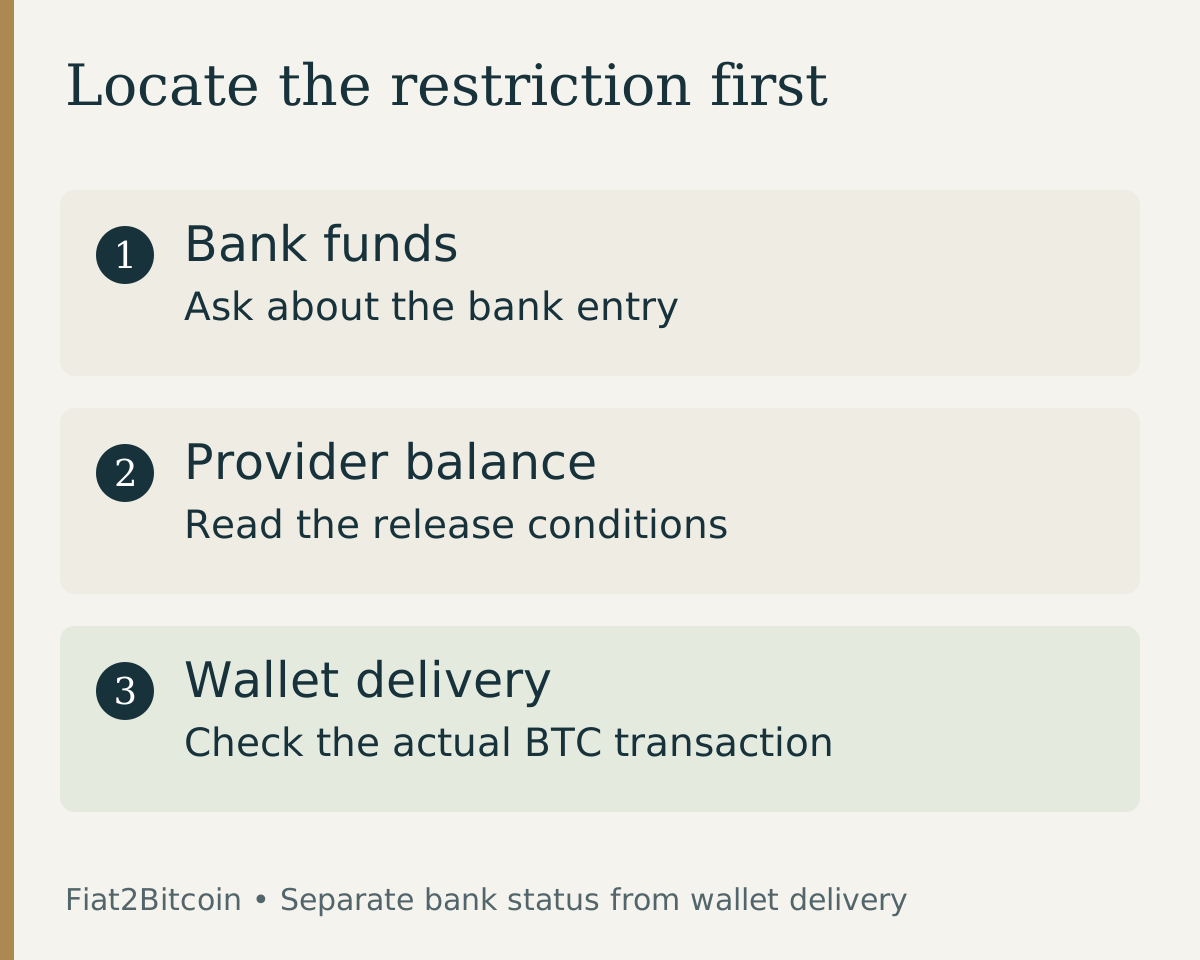
One label cannot answer all four questions. A bank hold ending does not automatically end a provider restriction, and a provider balance does not prove that BTC reached an external wallet. Use the Bitcoin transfer-time guide only once there is a network transaction to examine.
A simple available-balance example
Suppose your bank shows $1,200 before a hypothetical $300 outgoing ACH payment. Assume there are no other payments, deposits, fees or holds, and that this bank subtracts the pending debit from available funds.
Scroll across the table to see all columns.
| Stage | Current balance | Available funds |
|---|---|---|
| Before this payment | $1,200 | $1,200 |
| $300 reserved as a pending debit | $1,200 | $900 |
| $300 debit posts and its hold is removed | $900 | $900 |
In this simplified example the final step is not another $300 deduction from available funds. The pending reservation becomes the posted debit. Your bank may display the stages differently, so reconcile the records instead of treating every row as a new charge.
The example gives no BTC quantity and says nothing about an accepted exchange rate or delivery. Other scheduled debits can still affect your real available balance. Keep enough funds for all payments you have authorized.
How long does an ACH hold last?
There is no single duration you can safely apply to every bank label and provider policy. SoFi describes common bank-processing holds in terms of business days, while also noting that there is no fixed hold time. Ask your bank for the expected posting or release date for the actual entry.
Record when the hold appeared, the date the bank expects the next event and what could change that estimate. Then ask the purchase provider separately whether its order has a withdrawal or delivery restriction. Do not copy one company's advertised waiting period onto another company's order.
If the bank's stated date passes, follow up with the same payment details and case reference. A missing label might mean a display update, posting, rejection or release; look for the underlying transaction outcome before assuming cancellation or a refund.
What should you ask the bank or provider?
Start with the party that displays the restriction. Nacha explains that banks and payment originators are generally best placed to help with an individual payment; the association does not hold individual transaction records.
- Match the amount, date and company description to the order you intended to fund.
- Ask the bank whether the entry is incoming or outgoing, what balance it affects, and whether it has posted.
- Ask what event ends the hold and whether any action is required from you.
- Ask the provider whether the existing order is still active and whether it has received or matched the payment.
- Save the answer and next follow-up date before considering another payment attempt.
If tracing is needed, use the ACH trace-number guide. If the bank identifies a return, use the return-code guide. A hold by itself is not a return code.
What if you did not authorize the payment?
Compare the entry with your own records and, where appropriate, other authorized account users. A familiar amount alone does not prove that a debit belongs to your Bitcoin order. The ACH company-ID guide explains another detail the bank can use to investigate the originator.
If an entry remains unrecognized, contact your bank promptly through its official channel. The CFPB's unauthorized-transaction guidance explains that reporting deadlines can affect protections. Do not wait for a generic hold estimate before reporting suspected unauthorized activity.
For a payment you did authorize, review the ACH authorization terms before requesting a change. A request to cancel, a bank hold release, a return of dollars and a completed Bitcoin transaction are different events. None should be promised from the label alone.
Sources & further reading
General payment information and purchase-specific details serve different purposes. Review the current offer and terms before proceeding.
- SoFi: ACH holds and available funds
- Nacha: Consumer ACH payment questions
- CFPB: Reporting unauthorized bank transactions
Original Fiat2Bitcoin guide. Examples are illustrative; they are not live quotes or customer transactions. How we prepare our guides.