An explorer is useful when you know which record you are checking. It can be misleading when a page labels lifetime receipts, an unconfirmed projection or a single address as “your Bitcoin.” Define the scope before trusting the number.
This page is an explanation with an annotated fictional result, not a hosted live lookup. It does not ask you for an address, extended public key, recovery phrase or private key, and it makes no network request for your wallet.
Watch the short explanation
A 70-second educational walkthrough. Distinguish receipts, balance and pending. Match the network and scope. Never enter recovery words or private keys. Narration is synthetic.
Read the video transcript
What a checker can show
A Bitcoin balance checker can show public address records, but one address is not necessarily a whole wallet. It cannot prove that a visitor owns the keys, reverse a payment or recover a forgotten private key. This page is an explanatory guide, not a hosted live lookup.
Read confirmed amounts
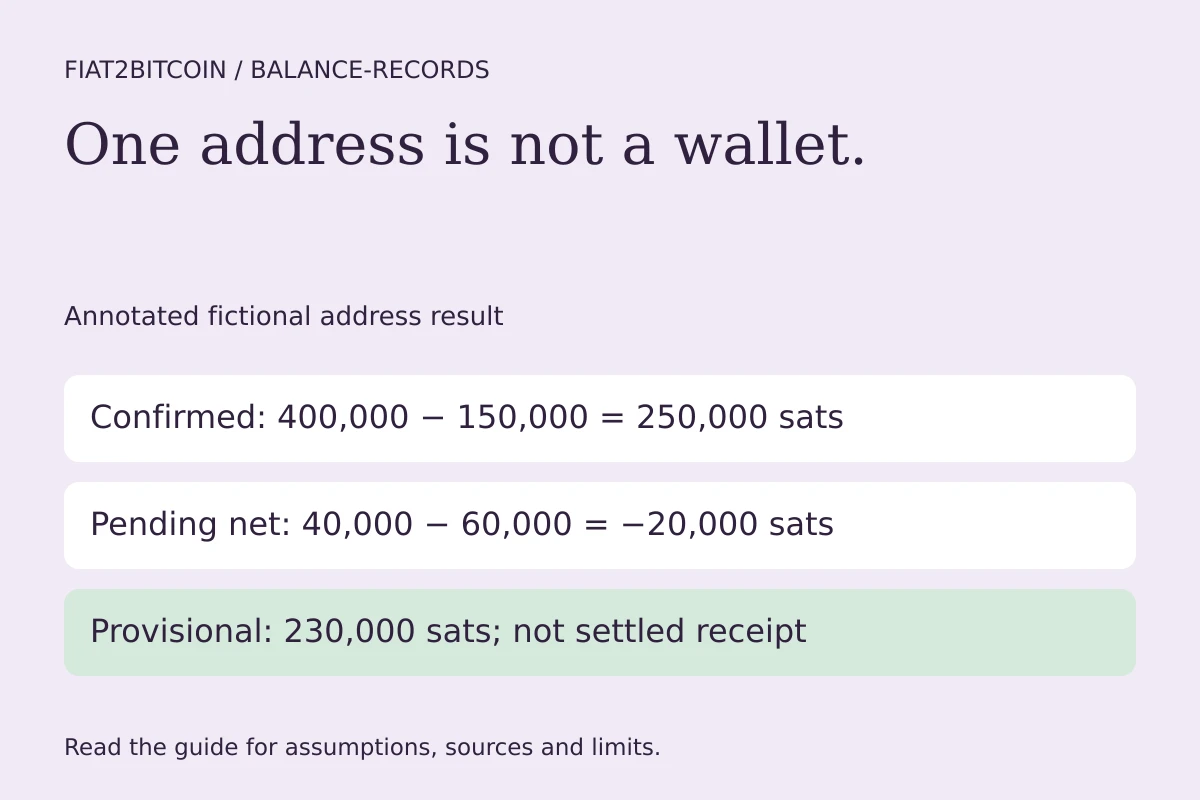
In the invented address example, four hundred thousand confirmed received satoshis minus one hundred fifty thousand spent satoshis leaves two hundred fifty thousand. Total received is not the same as the current confirmed balance.
Pending is separate
The fictional pending received amount is forty thousand satoshis, while pending spent is sixty thousand. The pending net change is minus twenty thousand. Adding it gives a provisional two hundred thirty thousand, subject to unconfirmed outcomes.
Check the whole scope
A wallet can manage many receiving and change addresses. A custodial account balance differs from the public balance of its deposit address. A single on chain result does not reveal a Lightning balance. Compare the correct scope and chain context.
Protect the lookup
A read only public lookup needs no recovery words or private key. An explorer can learn which address you query and connection information. A failed lookup is unknown, not zero. Use the guide’s fictional result to learn the fields without sharing your own wallet data.
How to check a public address

Use your wallet’s own receiving/account information to identify the intended network and address. For a public explorer, independently open a known service such as Blockstream’s Bitcoin explorer and inspect the address result. Testnet, Signet and mainnet are different networks.
An explorer can learn the queried address and connection information. For stronger privacy and independent verification, a wallet connected to your own appropriately synchronized node is a different arrangement. Do not paste an extended public key into a public tool merely to avoid checking multiple addresses.
Read confirmed and pending amounts separately
Esplora’s documented address API reports confirmed chain statistics and mempool statistics in satoshis. For this fictional result, confirmed received outputs total 400,000 sats and spent outputs total 150,000: confirmed balance is 250,000 sats, or 0.00250000 BTC.
The fictional pending received total is 40,000 sats and pending spent total is 60,000. The pending net change is −20,000 sats; confirmed plus that change is a provisional 230,000 sats. Pending transactions can change or conflict, so the projection is not settled receipt.
Scroll across the table to see all columns.
| Field / calculation | Satoshis | Meaning |
|---|---|---|
| Confirmed funded outputs | 400,000 | Historical confirmed receipts |
| Confirmed spent outputs | 150,000 | Historical confirmed spends |
| Confirmed difference | 250,000 | 0.00250000 BTC in this example |
| Pending funded minus spent | 40,000 − 60,000 = −20,000 | Unconfirmed net change |
| Provisional combined result | 230,000 | 0.00230000 BTC, subject to pending outcomes |
Why your wallet can show more than that address
A wallet can manage multiple receiving/change addresses, accounts, scripts and networks. An exchange may show an internal custodial balance that is not the public balance of the deposit address it assigned you. Lightning balances are not directly obtained by reading a single on-chain address.
In an invented two-address wallet, A has 250,000 confirmed sats and B has 750,000. The total across those two distinct addresses at the same confirmed chain state is 1,000,000 sats, or 0.01000000 BTC. A’s result alone accounts for only one quarter of that example total.
A balance is not proof of spending authority
Anyone can look up public addresses. A displayed amount does not show that a visitor has the private keys or that the sender of a screenshot owns the funds. Watch-only software can show records while being unable to sign a spend.
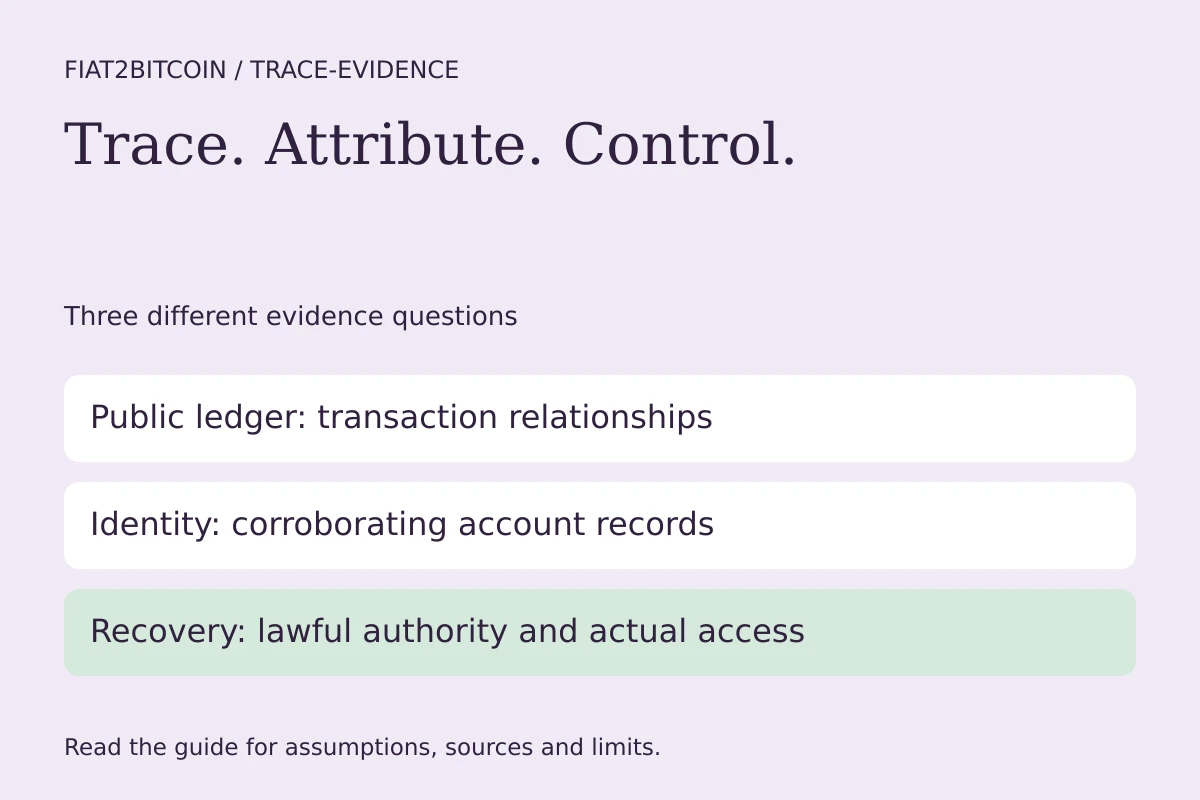
Be suspicious of a website claiming it found a wallet you can unlock by paying a fee or submitting recovery words. Checking public data cannot reconstruct a private key. The traceability guide separates public trails, identity and control.
Record enough context to compare two results
Download the fictional annotated result. Its symbolic labels are not real addresses, and no live funds or ownership are represented.
- Match the network and complete intended address.
- Record the source, observation time and confirmed block context.
- Distinguish current confirmed balance, total received and pending net change.
- Check whether the result covers one address, selected accounts or the whole wallet.
- Treat an unavailable or failed lookup as unknown, not zero.
- Compare against your wallet/node records without exposing secret recovery material.
Balance-checker questions
Why does an address show zero when my wallet has BTC?
It may be a different address, network, account, chain state or custodial record. Zero at one address does not settle the wallet-wide question.
Does total received equal spendable balance?
No. Previously spent outputs remain part of lifetime received totals.
Can an explorer recover a forgotten private key?
No. Public transaction lookup provides no such capability.
Should I upload a seed phrase to synchronize a checker?
No. Read-only checking does not require it. Use only your wallet’s supported recovery process if recovery is actually needed.
Sources & further reading
These primary sources support the explanations and examples above. Check each record’s date and context when following a claim.
- Blockstream Esplora API: Address statistics and satoshi units
- Bitcoin.org: Public transaction history and privacy
- FTC: Cryptocurrency payments and scams
Sources checked November 24, 2026. This is a guide, not a live balance-checking service. Failed or missing observations are unknown; no wallet data is collected. How we prepare our guides.
Check the scope before judging the balance.
Learn why wallets generate new receiving and change addresses while older addresses may remain part of the wallet.
Read why wallet addresses change