The claim that Bitcoin is completely anonymous is misleading. So is the claim that every public address immediately reveals a person’s identity. An investigation depends on the records available and what they actually establish.
This guide explains evidence and ordinary privacy, not methods to defeat an investigation. Its example uses symbolic labels instead of real wallet addresses and makes no allegation about any identifiable person.
Watch the short explanation
A 69-second educational walkthrough. Public trails and real names differ. Control and recovery need more evidence. Keep records without exposing secrets. Narration is synthetic.
Read the video transcript
Yes, but separate the questions
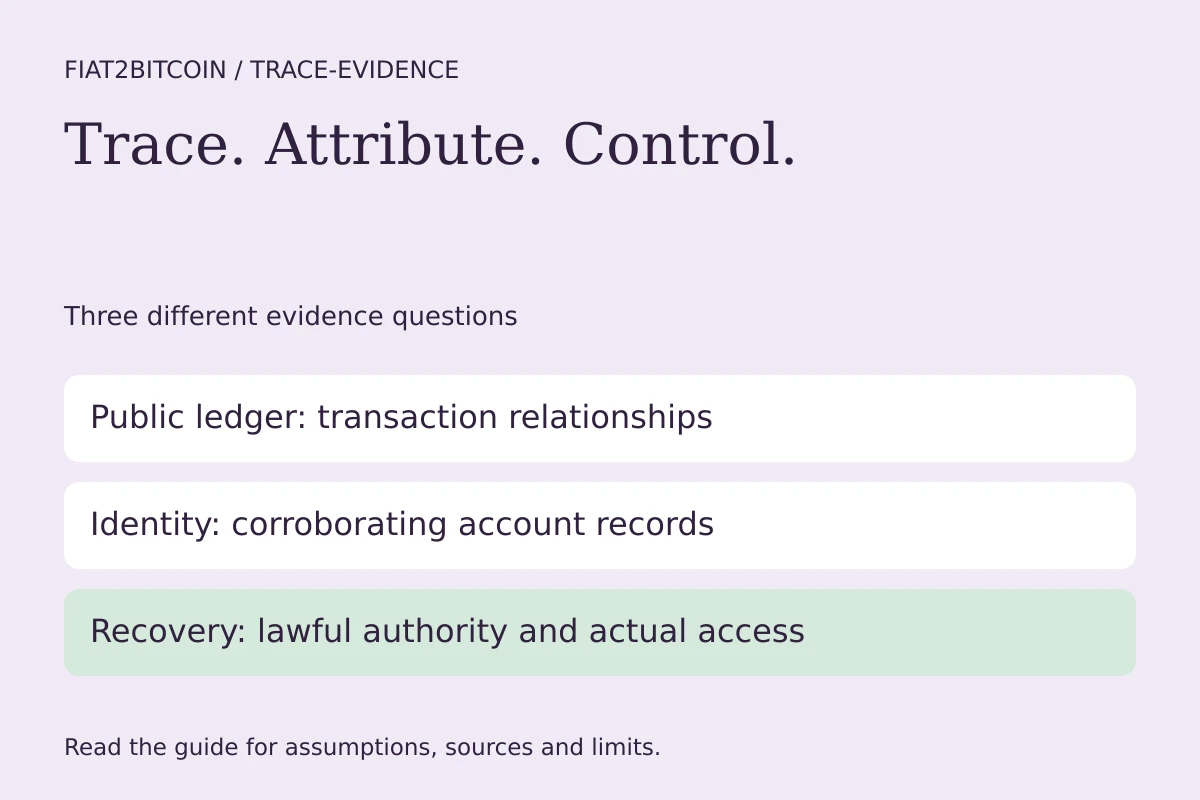
Police can inspect Bitcoin’s public transaction history and combine it with other evidence. The blockchain is not a reliable real name directory. Identifying a person, proving control and recovering funds are separate questions.
What the ledger can show
The public ledger shows transactions, outputs, amounts and spending relationships. A change output or custodial transfer may not create a new owner. Service labels and proposed clusters need supporting evidence.
A documented historical example
In June twenty twenty one, the Justice Department reported seizure of sixty three point seven Bitcoin allegedly linked to the Colonial Pipeline ransom. Its account describes following transfers and an address for which the FBI had the private key. Tracing alone does not reveal a private key.
Attribution requires corroboration
A receipt or communication can connect a known event with a transaction. A service’s records may identify an account under the applicable legal process. Public transaction links alone do not establish a person’s guilt or guarantee recovery.
Keep useful records
Preserve transaction hashes, order references and original communications when reporting suspected crime. Use official channels. Do not share private keys or recovery words with someone claiming to verify ownership, and be wary of paid recovery guarantees.
What investigators can see on the public ledger

Public on-chain data includes transactions, outputs, amounts, spending relationships and block inclusion. Explorer labels and proposed address clusters add interpretations; they are not names written into Bitcoin’s consensus rules.
Transaction time also needs care: a block timestamp or an explorer’s first-seen record is not necessarily the exact time a person authorized a transfer. Custodial services can move coins for many users, and a transaction can contain change or multiple recipients.
What connects a transaction to a person?
A complainant’s receipt, communications, an exchange account record or other independently obtained evidence can connect a known event to a transaction. The legal process for obtaining private records depends on the jurisdiction and facts. This article makes no determination about the authority required in a particular case.
A receiving address alone does not prove who controlled the keys, why a transfer occurred or whether someone committed an offense. An exchange deposit address may be controlled by the exchange while its internal account ledger identifies a customer.
Scroll across the table to see all columns.
| Observation | Possible supporting record | What remains unresolved |
|---|---|---|
| Victim receipt points to transaction A | Receipt, order and transaction record | Whether every output belongs to the same recipient |
| A spends into transaction B | Public spending relationship | Identity, purpose and change ownership |
| B reaches a labeled service | Verified service attribution | Which account and beneficial owner, if any |
| Service records identify an account | Records obtained under applicable authority | Who actually used it and what other evidence supports the case |
What the DOJ’s 2021 DarkSide announcement demonstrates
On June 7, 2021, DOJ reported seizure of 63.7 BTC allegedly traceable to the Colonial Pipeline ransom payment. Its account of the supporting affidavit describes following multiple public-ledger transfers and identifying an address for which the FBI had the private key.
The important distinction is that following transfers and having the means to spend seized funds were separate elements. The announcement does not show that looking at any address automatically gives investigators its private key, and its historical dollar valuation is not today’s value.
Tracing, freezing and recovery are different outcomes
A report can identify a likely destination without producing a return of funds. A custodial provider’s ability to freeze an account differs from control of a self-custody key. Cooperation, location, legal authority, attribution and available assets all affect outcomes.
Be wary of recovery agents who guarantee success or demand more cryptocurrency to release a balance. Preserve real records and use official reporting channels. A blockchain screenshot is not a court order, seizure receipt or promise of reimbursement.
Protect ordinary privacy and preserve useful records
Bitcoin.org explains address reuse and the privacy cost of publishing addresses. Sharing an extended public key can expose more of a wallet’s history than a single address. Never give a recovery phrase or private key to someone claiming to investigate or verify a balance.
- Keep the original transaction hash, amount, network and order reference.
- Preserve communications and the source of any destination instructions.
- Distinguish what you observed from a label or analyst inference.
- Report suspected crime through the appropriate official channel.
- Redact private identity information before asking for public technical help.
Bitcoin tracing questions
Can police identify everyone instantly?
No. Public transaction data and reliable real-world attribution are different evidence.
Does moving Bitcoin create a new owner?
Not necessarily. A wallet reorganization, change output or custodial transfer can occur without a new beneficial owner.
Can a balance checker recover stolen Bitcoin?
No. A read-only balance lookup neither controls the keys nor reverses a transaction.
Does deleting a wallet app delete the blockchain history?
No. Local app deletion does not remove already published Bitcoin transactions.
Sources & further reading
These primary sources support the explanations and examples above. Check each record’s date and context when following a claim.
- Bitcoin.org: Public transaction history and privacy
- DOJ: June 2021 DarkSide ransom seizure and affidavit account
- FTC: Cryptocurrency payments and scams
Sources checked November 24, 2026. The case account is attributed to DOJ and dated 2021. Public labels and transaction links are not presented as conclusive identity or guilt. How we prepare our guides.
Keep the evidence; do not pay a recovery promise.
For a suspected scam, preserve transaction records and use official reporting channels.
Read the scam and reporting guide