
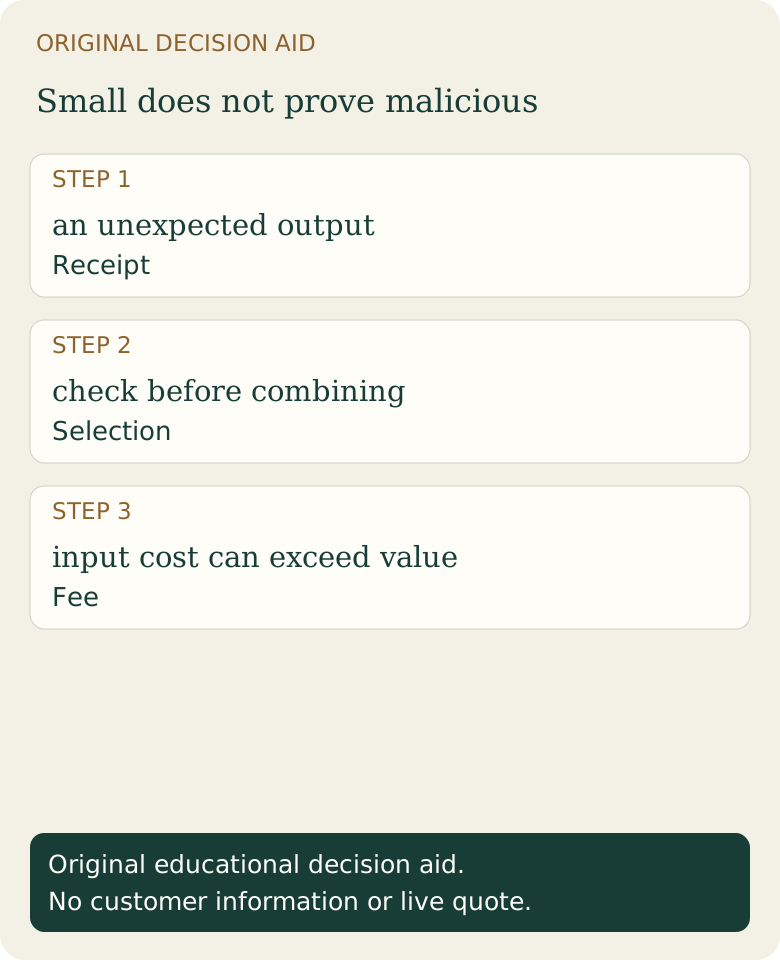
Is every small Bitcoin receipt a dust attack?
Bitcoin Optech distinguishes uneconomical outputs from policy dust. A small output can be costly to spend, while dust policy thresholds depend on script and relay-policy assumptions. There is no single universal BTC amount that establishes malicious intent.
An ordinary small payment, an unsolicited output and a confirmed phishing attempt are different observations. Do not label a sender a criminal solely because the amount is small. Check whether you expected the payment and keep any suspicious message separate from the blockchain facts.
How can output linking affect privacy?
Optech’s output-linking explanation describes the privacy issue. Spending multiple outputs together can provide evidence linking their control. An unwanted output may be intended to encourage that linkage. Address reuse and information shared with services can add context; public transaction history is not the same as proven personal identity.
Opening a wallet to view a receipt is different from approving a spend. The output does not grant the sender your signing secret. Avoid websites that ask you to connect a wallet, enter recovery words or make an extra payment to remove supposed contamination.
Original calculation: when a tiny output is uneconomical
Assume a hypothetical output of 1,000 satoshis, a marginal input size of 68 virtual bytes and a fictional fee rate of 20 sat/vB. Its illustrative additional input cost is 68 × 20 = 1,360 satoshis, exceeding the output value by 360 satoshis. This simplified marginal-input comparison is not the fee of the entire transaction.
At an invented 2 sat/vB the same input assumption costs 136 satoshis, leaving 864 satoshis before other transaction costs. Script type, transaction structure, policy and actual feerate matter. Neither result proves an attack or tells you when to spend. Use the fee-rate guide for whole-transaction sizing.
Original response checklist
Use your wallet’s official instructions for output labeling, coin control or freezing when supported. These features vary and should not be assumed available in every wallet.
Scroll across the table to see all columns.
| Situation | Reasonable next check | Avoid |
|---|---|---|
| Unexpected tiny receipt, no message | Record it locally; examine official coin-control options | Spending it automatically with unrelated outputs |
| Message asks you to claim or clean funds | Treat the message as untrusted; verify independently | Recovery words, unknown links or cleanup payments |
| Exchange balance rather than self-custody output | Ask the exchange through its official support route | Assuming you can select its underlying UTXOs |
| Funds already moved | Preserve references and review what was actually authorized | Promises that a recovery fee guarantees reversal |
Should you consolidate small outputs?
Consolidation can reduce future input count but also link outputs and incur a present fee. An unknown small output should not be swept together with everything solely to clear the wallet display. Decide based on ownership, privacy, the wallet’s actual controls and the fee environment.
Learn how UTXOs work and protect your recovery backup. This guide does not collect addresses, scan balances or provide a cleaning service. Fiat2Bitcoin cannot approve or reverse a wallet transaction.
Should you consolidate an unexpected tiny receipt?
Do not automatically combine an unknown receipt with recognized outputs to make the list look tidy. Combining inputs can connect their histories, and spending a small output can cost more than its value under some fee assumptions. A universal fixed “dust amount” does not answer every wallet-policy or economic question.
The coin-control guide includes a fictional three-output selection matrix and a consolidation cost comparison. It distinguishes a relay-policy threshold from an output that is simply expensive to spend. Receiving an unsolicited output does not itself disclose recovery words.
Sources & further reading
These sources explain the payment systems and rules discussed in this guide. For your purchase, check the provider’s current offer and terms.
- Bitcoin Optech: uneconomical outputs and dust
- Bitcoin Optech: output linking
- BitBox: Coin control and its trade-offs
- Blockstream: UTXOs
Published by Fiat2Bitcoin. Worked examples use fictional figures and records; they are not current prices or customer transactions. How we prepare our guides.