
What are you actually selecting?
A Bitcoin balance can contain several unspent transaction outputs, or UTXOs. Coin control works with those pieces, not simply the displayed account balance. Depending on the wallet, selecting coins may restrict eligible inputs or spend the selected set; read its current instructions.
One address can contain several UTXOs. Choosing “this address” and choosing a particular output therefore need not be the same instruction. The UTXO explainer shows how a payment consumes an output and creates change.
An original input-selection worksheet
Scroll across the table to see all columns.
| Invented output | Your note | Decision before signing |
|---|---|---|
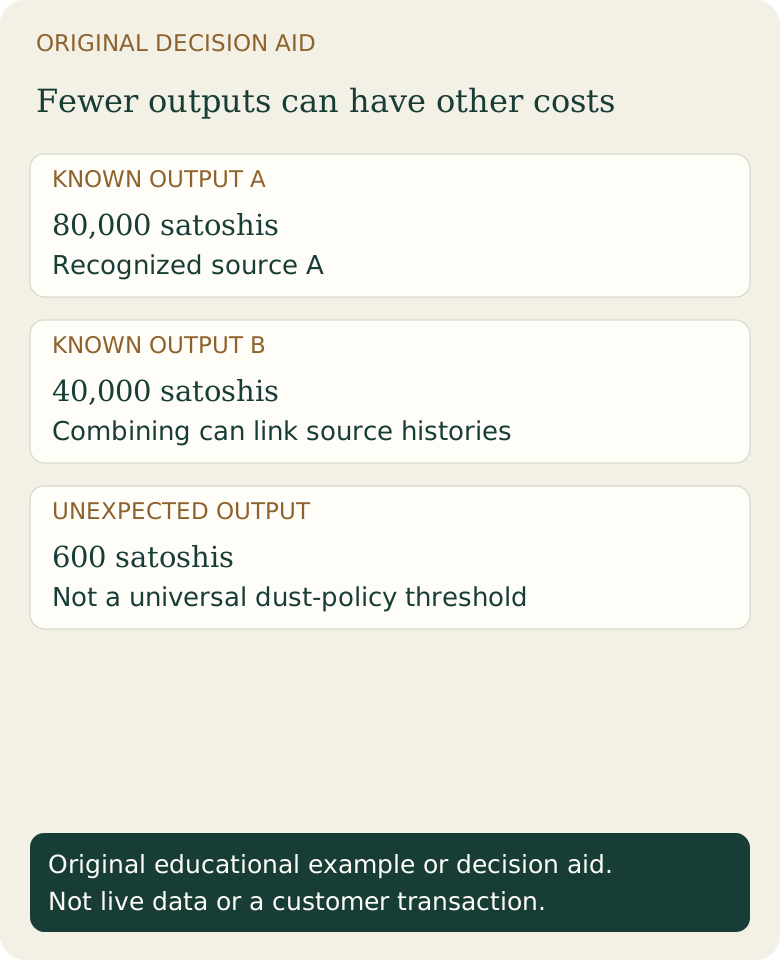
| A: 80,000 sat | Recognized receipt; source A | Could cover a 50,000-sat payment if the actual fee fits |
| B: 40,000 sat | Recognized receipt; source B | Combining with A can link their histories |
| C: 600 sat | Unexpected small output | Investigate and label; do not combine just to tidy the balance |
Check the whole transaction, including change
Suppose a wallet spends the fictional 80,000-satoshi output, sends 50,000 and charges a 1,200-satoshi fee. Its change is 28,800 satoshis: 80,000 − 50,000 − 1,200. Those are new outputs; the original 80,000-satoshi output is spent.
Check the receiver, change and total fee in the actual wallet preview. More selected inputs can increase size, and a wallet may handle a very small remainder differently. Never copy a change destination from an unsolicited message. This guide does not construct or sign transactions.
When can consolidation reduce future fees?
Consolidation combines existing outputs into fewer outputs you control. Use two scenarios rather than assuming fewer outputs always means savings. Invented case: consolidation costs 1,000 satoshis now and reduces a later payment by 300 vB. At a later rate of 2 sat/vB, the saved fee is 600 satoshis, less than the consolidation cost. At 10 sat/vB, the modeled saving is 3,000 satoshis before subtracting that cost.
The simplified break-even future rate is 1,000 ÷ 300, approximately 3.34 sat/vB when rounded up to hundredths. Future size and rate are assumptions, not forecasts. A future transaction can differ from the model. Privacy costs, an additional transaction and any other charges remain even when the arithmetic looks favorable.
Is every small output dust?
No single amount defines every small-output problem. Bitcoin relay dust policy depends on transaction-output and spending assumptions; an output can also be uneconomic to spend at a particular fee rate without being invalid. Our 600-satoshi example is not a universal cutoff.
Unknown tiny receipts can also raise tracking concerns. The dust-attack guide explains why receiving one does not itself reveal your recovery phrase. Avoid merging unrelated histories merely to make a list shorter. Before changing settings, make sure your own wallet’s current documentation and recovery plan are understood.
Sources & further reading
These sources explain the payment systems and rules discussed in this guide. For your purchase, check the provider’s current offer and terms.
Published by Fiat2Bitcoin. Worked examples use fictional figures and records; they are not current prices or customer transactions. How we prepare our guides.