You choose a small Bitcoin test transfer, then notice that the exchange receiving it has a minimum deposit. The useful number is the amount the recipient will get. Start with the sender’s final withdrawal preview and the receiving service’s current deposit screen.
This guide’s amounts are invented for the arithmetic. They are neither live provider quotes nor instructions to fund a particular service. For the surrounding address, network and delivery checks, start with the wallet and delivery pillar.
Which minimum applies to this step?
A purchase service, a sending exchange and a receiving exchange can set separate requirements. Record each amount in its stated unit; a USD purchase budget and a BTC deposit threshold need different comparisons.
Scroll across the table to see all columns.
| Requirement | Where to read it | Number to compare |
|---|---|---|
| Purchase minimum | The provider’s eligible checkout | The purchase amount in the required currency. |
| Withdrawal minimum | The sending service’s withdrawal preview | The amount that service allows you to withdraw under its stated fee treatment. |
| Deposit minimum | The receiving account’s exact asset/network deposit screen | The amount expected to arrive, using the recipient’s stated rules. |
A self-custody wallet and a hosted exchange account have different receiving arrangements. In Trezor Suite, you select the account for the sender’s network and verify its address on the device. For a hosted account, read that service’s crediting and minimum-deposit rules as well.
Example 1: a deducted fee takes a test below the minimum
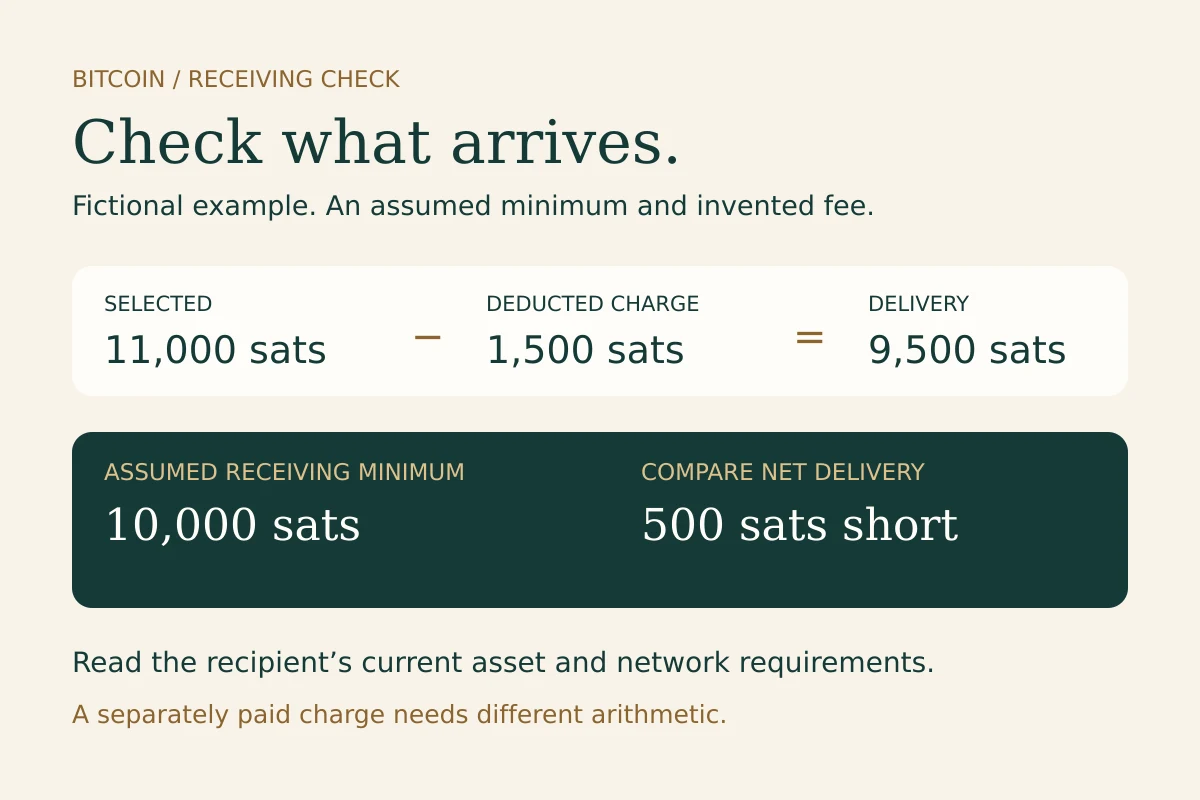
Suppose an invented receiving service requires 10,000 sats per deposit. The sender’s preview says it will deduct a 1,500-sat charge from the 11,000 sats you select. Every figure in this example is fictional.
Scroll across the table to see all columns.
| Preview field | Satoshis | BTC |
|---|---|---|
| Selected withdrawal amount | 11,000 | 0.00011000 |
| Charge deducted from that amount | 1,500 | 0.00001500 |
| Expected delivery | 9,500 | 0.00009500 |
| Recipient’s assumed deposit minimum | 10,000 | 0.00010000 |
| Shortfall | 500 | 0.00000500 |
The calculation is 11,000 − 1,500 = 9,500 sats. Under these assumptions, the delivery is 500 sats short. Revisit the preview before authorizing the transfer. If any charge or net amount remains unknown, resolve it before treating the comparison as complete.
Example 2: the sender charges the fee separately
Now suppose the fictional preview says the recipient gets 11,000 sats and the sender charges a separate 1,500 sats. The total balance used is 12,500 sats, while delivery remains 11,000 sats. Against the same invented 10,000-sat threshold, that is 1,000 sats above the minimum.
Use the preview’s fee treatment. Subtracting a separately paid charge from the stated net delivery would count it twice. The network-fee and withdrawal-fee guide explains the distinction. The deposit comparison still needs the right network, destination and the receiving account’s other conditions.
Already sent below the minimum? Check the receiver’s policy
Keep the original withdrawal reference, transaction ID, exact network, receiving address and amount paid to that address. Look at the receiving account’s deposit history and current help page before deciding what to do next.
As a service-specific example checked November 17, 2026, Kraken’s deposit guidance warns that deposits below its minimum are lost and that a later qualifying deposit will not credit the earlier one. It directs customers to their signed-in deposit page for current amounts. Apply the policy of your actual receiving service; do not assume a top-up combines separate deposits.
Send the original record through verified support and ask: “How is this transfer recorded, which minimum applied when it arrived, and what options does your policy allow?” Sending more before that answer creates another transfer to investigate.
Before a small test transfer, save these five details
A small test can help check a receiving setup when its amount and route meet the relevant conditions. Use this checklist alongside the test-transaction guide.
- Exact asset and network: read both sending and receiving screens.
- Full receiving address: compare the pasted value with the intended wallet or account, and the hardware screen where applicable.
- Current receiving minimum: keep its unit, network and date together.
- Final delivery and fee treatment: identify whether the charge is deducted or paid separately.
- Original transfer record: after submission, retain the reference and transaction ID rather than creating a duplicate to fix a display delay.
Do more confirmations fix a below-minimum deposit?
Confirmations track block inclusion. A hosted service separately applies its crediting rules, including its supported asset, network and minimum. If the transaction already meets its confirmation requirement, investigate the deposit record and account conditions instead of estimating another block interval. The Bitcoin transfer-time guide walks through that check.
For purchase planning, the buying pillar connects the final quote to the receiving requirements. Fiat2Bitcoin’s current eligible purchase options and the selected provider’s checkout determine which routes are available; this guide describes receiving checks rather than a new deposit service.
Sources & further reading
These sources explain the payment systems and rules discussed in this guide. For your purchase, check the provider’s current offer and terms.
- Kraken — Deposit minimums, fee treatment and below-minimum policy (checked November 17, 2026)
- Trezor — Receive crypto in the correct network account and verify the address
- Bitcoin.org — Transactions and confirmations
Published by Fiat2Bitcoin. Worked examples use fictional figures and records; they are not current prices or customer transactions. How we prepare our guides.