
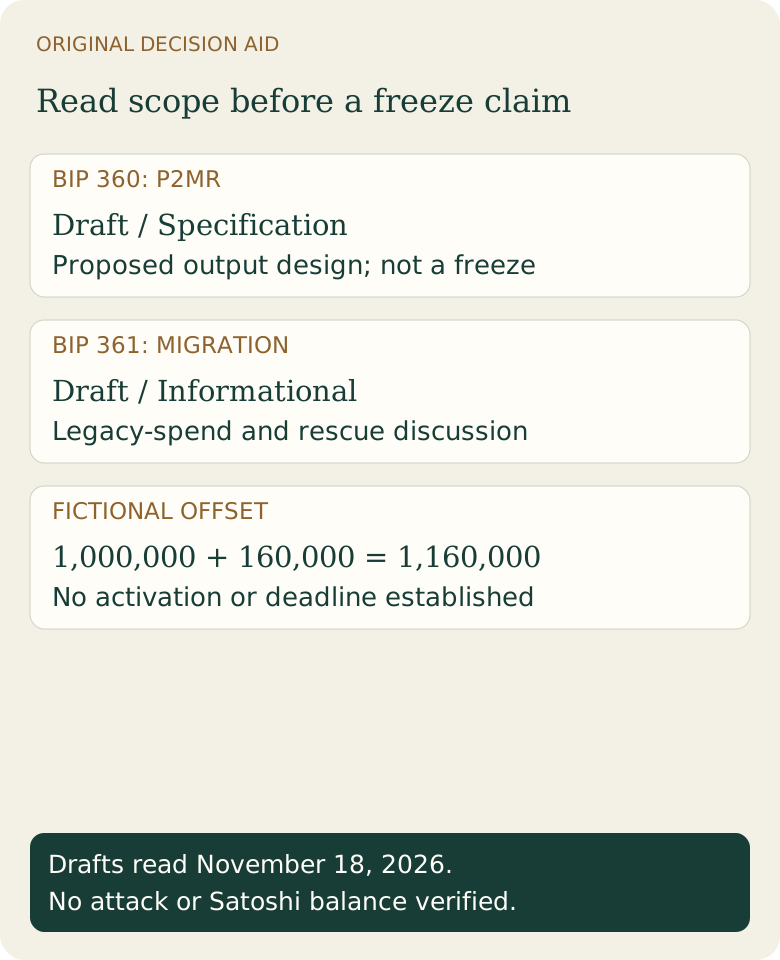
What does “freezing Satoshi’s coins” leave unspecified?
A Bitcoin output has spending conditions. A headline about “Satoshi’s coins” adds a separate identity attribution, and a claim that those keys are lost adds another inference. This review has not authenticated an inventory of Satoshi-controlled outputs, a balance, current key possession or abandoned ownership.
First ask which outputs a proposal would affect, under what rule and from what activation point. Then ask what evidence connects an output to a person. The term “tokens” does not identify a special class of Satoshi-issued Bitcoin assets that a single company can freeze.
This guide is an analysis of the identified public drafts, not a poll of experts or an implementation audit. It does not claim that a quantum attack is occurring, that one will arrive on a particular date or that any named person supports every part of a proposal.
BIP 360 and BIP 361 are different proposals
The examined BIP 360 text is titled Pay-to-Merkle-Root (P2MR), version 0.12.1. It proposes an output design without Taproot’s key-path spend, addressing long public-key exposure. It explicitly separates that goal from protection against short-exposure attacks and from decisions about burning or freezing existing coins.
The examined BIP 361 text describes post-quantum migration and a legacy-signature sunset. Its header depends on a post-quantum signature BIP still identified as TBD. It discusses tighter legacy-spend verification and rescue mechanisms rather than supplying an already activated network rule.
Scroll across the table to see all columns.
| Document | Displayed status and type | Question it addresses | Do not infer |
|---|---|---|---|
| BIP 360: P2MR | Draft / Specification | A proposed output format and long-exposure risk | All quantum attacks solved or old coins frozen |
| BIP 361: migration and sunset | Draft / Informational | Migration incentives and future legacy-spend restrictions | A deployed rule, fixed current deadline or complete rescue implementation |
Why is there a real policy disagreement?
The protective objective is to prevent an attacker from taking value using a cryptographic capability that earlier owners did not face. The access concern is that changing spending requirements can burden a legitimate holder who cannot migrate or satisfy a new rescue process. Both questions need to be evaluated at the level of a specified rule, not a slogan.
A promise to protect ownership still needs a workable account of who can prove the required knowledge and under which conditions. Conversely, leaving an output spendable under existing conditions does not demonstrate that a future signature was made by the historical owner rather than by an attacker. Those are consequences to analyze, not a finding that any particular output has been stolen.
BIP 361’s rescue discussion acknowledges unresolved coverage. This guide does not determine which holdings a future mechanism could protect. A wallet seed, xpriv or other secret must not be submitted to someone merely claiming to administer a quantum migration.
How should an activation-relative timeline be read?
BIP 361’s examined specification describes Phase A using an offset of 160,000 blocks after activation, with an approximate year description, and Phase B using a further time horizon. An offset is not evidence that activation has happened or that a calendar deadline is currently running.
For an original fictional example, assume an activation height of 1,000,000. Adding a 160,000-block offset gives height 1,160,000. At an invented constant ten minutes per block, the arithmetic duration is 1,111.11 days, approximately 3.04 years using 365.25 days/year. Neither the activation height nor the constant intervals are a forecast or an observation.
Keep block units, approximate year language, activation evidence and the exact draft version separate. Do not turn a proposal’s relative schedule into a dated instruction to move funds. Current implementation and activation evidence would require their own verification.
A practical way to read the next quantum headline
Use this original evidence ladder before drawing a conclusion about a particular wallet or about Bitcoin’s supply. The transaction-ID guide helps identify a transaction, while the escrow-policy guide illustrates why spending conditions and off-chain claims answer different questions.
Scroll across the table to see all columns.
| Claim | Evidence question | What remains separate |
|---|---|---|
| An output exposes a public key | Which output and script data establish exposure? | Identity and current control |
| The output belongs to Satoshi | What attribution method and uncertainty are documented? | Proof of present key possession |
| A rule is proposed | Which exact draft, version and scope? | Implementation and activation |
| A freeze is active | Which deployed rules and network evidence establish it? | A draft header or news forecast |
| A rescue is available | Which reviewed implementation and eligibility conditions? | A promise to recover every lost key |
Keep the source date and unresolved questions together
Download the original proposal-analysis worksheet for the scope matrix, source date and fictional offset calculation. The underlying drafts can change; compare their current text before relying on a later summary.
Fiat2Bitcoin does not operate a freeze or quantum-rescue service. This article provides no instruction to sign a migration transaction, disclose secrets or buy a purported quantum upgrade. For a separate purchase question, compare purchase methods and custody responsibilities. A buying service does not decide Bitcoin consensus rules.
Sources & further reading
These sources explain the payment systems and rules discussed in this guide. For your purchase, check the provider’s current offer and terms.
- BIP 360: current P2MR draft and scope
- BIP 361: current migration and signature-sunset draft
- Bitcoin developer guide: outputs and spending conditions
Original dated proposal-scope and evidence analysis plus a fictional block-offset calculation. No activation audit, quantum attack, Satoshi ownership authentication, key recovery or future hardware-date forecast is claimed. How we prepare our guides.