
What does a 2-of-3 escrow arrangement mean?
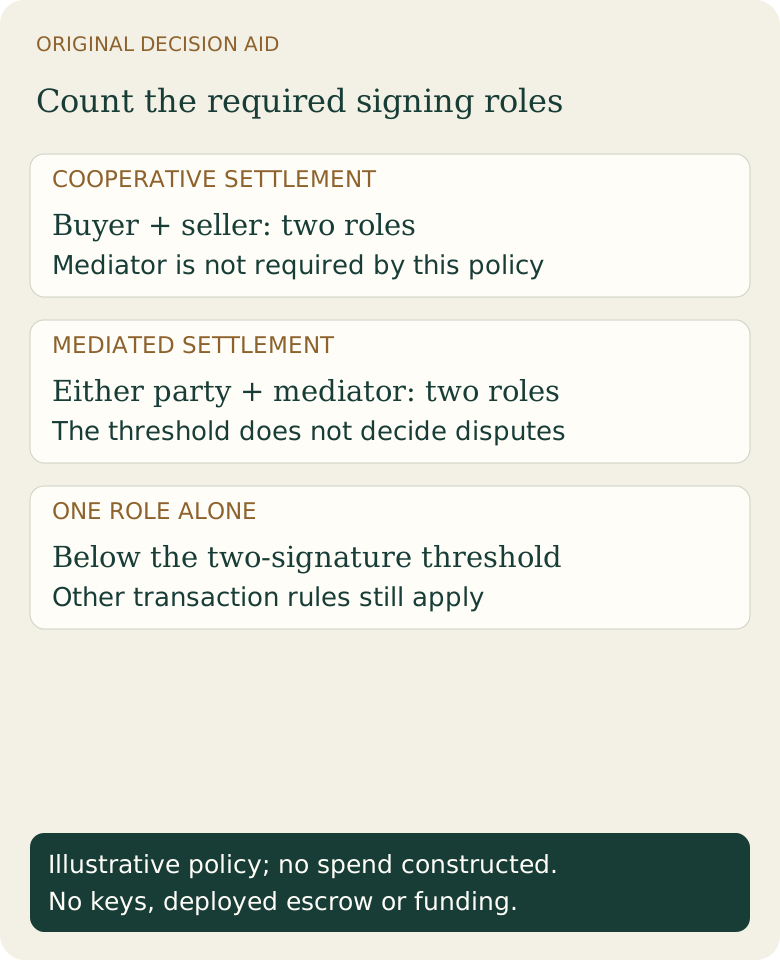
Assign three distinct public keys to buyer, seller and mediator and require two valid signatures. Buyer plus seller can settle cooperatively. Buyer plus mediator or seller plus mediator can also meet the same threshold. One key alone is insufficient under this policy.
BIP 11 describes M-of-N signature conditions. The Bitcoin developer guide explains how transaction outputs commit to spending conditions. These sources support the threshold mechanism, not the reputation, availability or legal authority of a particular escrow provider.
This guide owns the transaction-policy question. The multisig wallet recovery guide covers the different problem of retaining access to a wallet over time. Neither a public key nor a wallet interface establishes what a mediator has agreed to do.
An illustrative script policy, not a deployable contract
The traditional signature-policy shape is: OP_2 <buyerPubKey> <sellerPubKey> <mediatorPubKey> OP_3 OP_CHECKMULTISIG. The angle-bracket terms are placeholders for distinct public keys. This incomplete illustration contains no usable keys, address or funding transaction and must not be copied into a wallet as a complete escrow setup.
OP_2 establishes the required count; the three public-key placeholders identify the authorized keys; OP_3 supplies their count; OP_CHECKMULTISIG checks the threshold. The signature order and complete transaction context matter. In a P2WSH construction, BIP 141 defines the witness-script commitment and validation rules.
For a classic CHECKMULTISIG witness, an extra empty stack item is required in addition to the signatures and script. Mentioning that item does not make this a tested implementation. No keys, signatures or spend transactions were generated for this guide. Use a reviewed implementation and independently verified receiving policy rather than assembling a production script from this paragraph.
Which signature combinations satisfy the policy?
This original eight-case truth table enumerates every subset of the three roles and checks only whether at least two distinct authorized signers are present. “Allowed” means the signature-count condition is met, assuming valid signatures and all other transaction rules. It does not determine the correct recipient, transaction validity by itself or whether the payment complies with the agreement.
The critical implication is that buyer and seller can spend together without the mediator, and either party can spend with the mediator without the other. The threshold does not force the mediator to choose the rightful claimant or prevent two parties from cooperating against the third.
Scroll across the table to see all columns.
| Buyer signs | Seller signs | Mediator signs | Threshold result |
|---|---|---|---|
| No | No | No | Not enough signatures |
| No | No | Yes | Not enough signatures |
| No | Yes | No | Not enough signatures |
| No | Yes | Yes | Allowed by this signature threshold |
| Yes | No | No | Not enough signatures |
| Yes | No | Yes | Allowed by this signature threshold |
| Yes | Yes | No | Allowed by this signature threshold |
| Yes | Yes | Yes | Allowed by this signature threshold |
Does escrow include an automatic refund?
Not in the simple threshold policy above. A refund path, if wanted, must be explicitly designed, reviewed and coordinated with the transaction conditions. BIP 65 specifies an absolute timelock opcode; it does not add a refund branch to every multisig output.
A timelock can restrict when a particular spending path becomes available. It does not wake a wallet up, broadcast a transaction or ensure anyone still has the required signing material. A poorly specified timeout can also leave a party with a different outcome than the commercial agreement describes.
Do not describe an unbroadcast draft, an email promise or a screenshot as a confirmed refund. Check the actual transaction using the transaction-ID guide, keeping the distinction between construction, broadcast and confirmation visible.
What must be agreed before any funding?
Record the asset and network, amount, spending policy, role-to-key mapping, fee responsibility, dispute evidence, mediation response expectations and fallback process. Verify the intended recipient’s transaction outputs as well as the policy; valid threshold signatures can authorize an unwanted destination.
Download the original escrow-policy worksheet. It includes the full truth table and prompts for the off-chain agreement. It contains no private keys, customer data, deployed addresses or executable escrow service.
Fiat2Bitcoin does not provide escrow, hold a cosigning key, sign customer transactions or decide disputes. Its purchase methods describe a separate provider purchase process. Buying BTC does not establish an escrow agreement with a later seller; selected purchase providers handle their own verification, payment, delivery and refunds.
Does the mediator have to sign every spend?
No. Any two authorized keys satisfy this simple 2-of-3 threshold, including buyer plus seller.
Can this policy prove that goods were delivered?
No. It checks defined spending conditions. Evidence and dispute decisions are handled outside this illustrative signature threshold.
Is the illustrated script ready to fund?
No. It is an annotated policy shape with placeholders, not a tested wallet implementation, complete transaction or deployable escrow agreement.
Sources & further reading
These sources explain the payment systems and rules discussed in this guide. For your purchase, check the provider’s current offer and terms.
- Bitcoin developer guide: transactions and multisignature
- BIP 11: M-of-N signature policy
- BIP 141: P2WSH witness validation
- BIP 65: absolute timelock conditions
Original exhaustive eight-case signature-threshold analysis; policy illustration only. No script was deployed, funded or tested as a complete transaction. How we prepare our guides.