
What would actually be exchanged?
“Testnet” needs a version: Testnet 3 and Testnet 4 are different networks. Signet also needs an identity: the default public Signet and a custom Signet can differ. Record the node’s network and genesis block before treating an address, transaction ID or balance as relevant to a swap.
BIP 94 specifies Testnet 4; BIP 325 specifies Signet’s block-challenge mechanism. A Signet block requires the appropriate challenge solution, but that does not make its ledger the same as Testnet. A transaction confirmed on one network does not create an output on the other.
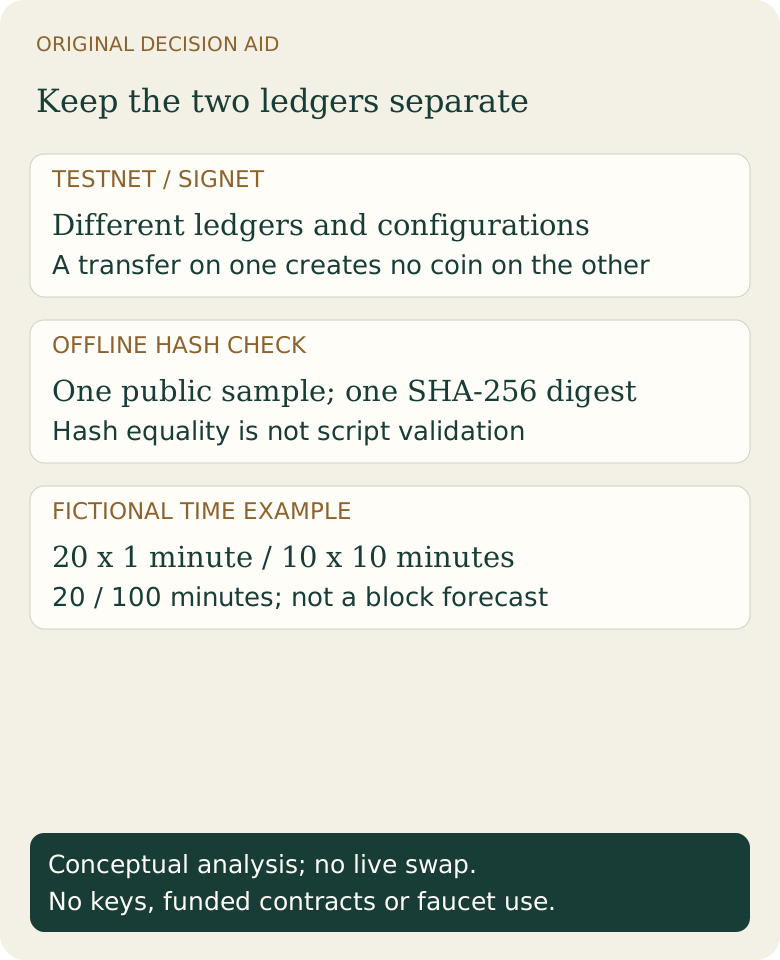
Imagine Alice already has test coins on Testnet 4 and Bob already has test coins on the chosen Signet. A swap exchanges their access to those separate outputs. It is not a bridge that manufactures Signet coins by destroying or moving Testnet coins, and it does not establish a mainnet BTC exchange rate.
How do linked contracts coordinate the exchange?
The HTLC pattern combines a hash condition with a refund condition. In a conceptual sequence, Alice funds the longer-timeout side and Bob verifies it before funding the shorter-timeout side. Alice’s successful redemption reveals the preimage, which Bob can then use for the other redemption before its refund path becomes available.
That ordering is a design requirement to test, not a guarantee produced by using the word “atomic.” Each party must verify the other output’s amount, script, receiver, hash, network and timeout. The escrow-policy guide explains the separate role of signing conditions; a hash-linked swap is not a mediator’s two-of-three decision.
Scroll across the table to see all columns.
| Observed state | What it establishes | What it does not establish |
|---|---|---|
| Only Alice’s contract funded | One ledger contains a candidate output | Bob has funded the other side |
| Both contracts independently verified | Two specific outputs match the intended conditions | Either redemption has confirmed |
| Alice redeems Bob’s side | A valid redemption can reveal the preimage | Bob’s redemption is already complete |
| Bob redeems Alice’s side | The second successful spend completes this path | Every implementation or timeout is safe |
| Swap abandoned | Refund paths may become usable under their rules | An automatic refund transaction was broadcast |
A checked hash example, without keys or transactions
For an offline teaching check, take the exact UTF-8 text “fiat2bitcoin-public-hash-example” and apply SHA-256 once. Shown in eight-character groups for readability, the result is 52d171b8 c068f0bc 9f79231f 948bfec2 def95756 a0c79c4c 6dcd57de d69a3a80. Remove the spaces to compare the raw hexadecimal digest; the download preserves that unbroken value. The sample string is public teaching data, not a private key, wallet seed or real swap secret.
The same digest can be compared against two fictional contracts’ hash fields. Changing one byte of the preimage produces a different hash in this check. Matching the digest demonstrates that narrow relationship only; it does not validate Bitcoin Script, signatures, output funding, confirmation or a refund transaction.
Download the original offline swap worksheet for the exact bytes, digest and state questions. No node was connected, faucet requested, contract funded, wallet signed or live swap performed.
Why can’t you compare the two block heights directly?
A lock at height 100,020 on one fictional chain and height 50,010 on another does not reveal which becomes spendable first. Suppose their current heights are 100,000 and 50,000: 20 blocks remain on one and 10 on the other. With invented intervals of 1 minute and 10 minutes, their simple estimates are 20 and 100 minutes. The numerically larger block count finishes sooner in that invented model.
Those intervals are not estimates of actual Testnet or Signet performance. The example shows why the network, locktime interpretation and timing assumptions must be explicit. BIP 65 distinguishes height-based from time-based absolute locktimes; neither a height difference nor an average interval is a guaranteed wall-clock deadline.
For a real implementation, test stalled blocks, reorganizations, fee changes, failed broadcasts, lost connectivity and both refund paths. Work out the margin needed for observing a revealed secret and confirming the second spend. Two local simulations can be a useful first check but do not prove behavior on two public networks.
What is the practical next step?
Use reviewed software that explicitly supports the exact two network configurations, then document its assumptions and validate success and failure paths in an isolated test environment. This article supplies a protocol-level decision aid, not deployable scripts or a recommended trading service.
Fiat2Bitcoin does not operate a test-coin swap or exchange Testnet and Signet balances for mainnet BTC. If your separate goal is a real BTC purchase, review purchase methods and wallet compatibility; test-network coins and addresses are not payment substitutes.
Does a test-looking address prove the network?
No. An address is not a complete chain identifier. Verify the wallet/node network, genesis block and the exact funding transaction on that network. Do not use an address prefix alone to decide that the two parties share a ledger.
Sources & further reading
These sources explain the payment systems and rules discussed in this guide. For your purchase, check the provider’s current offer and terms.
- BIP 325: Signet network and block challenge
- BIP 94: Testnet 4 network rules
- Blockstream: hash and timelock atomic-swap construction
- BIP 65: absolute timelock semantics
Original conceptual swap analysis, offline SHA-256 check and fictional timing comparison. No funded contracts, signatures, live network experiment or complete swap implementation was tested. How we prepare our guides.