
You have chosen a Bitcoin purchase option and opened a receiving screen. The two screens must describe the same supported route. This guide connects the checks; the linked address, wrapped-token, Lightning and fee guides explain their individual topics in more depth.
What needs to match for a Bitcoin receiving route?
Start with the exact asset and network on both screens. Native BTC on Bitcoin, a wrapped-Bitcoin token on another blockchain, and a Lightning invoice are not interchangeable receiving instructions. A similar ticker or dollar price does not establish a conversion route.
Then compare the receiving format with the sending service’s explicit support. Trezor’s account-type explanation distinguishes Bitcoin receiving formats and notes that service support can differ. Coinbase’s receiving instructions likewise tell users to match a supported receiving network. These are product examples, not a universal list of supported providers.
Scroll across the table to see all columns.
| Layer | Compare these records | If unresolved |
|---|---|---|
| Asset | Actual BTC versus a specific wrapped token | Confirm the asset; do not infer native BTC from its price. |
| Network | Sender route and receiver’s selected network | Pause; address syntax does not change the network. |
| Receiving format | Wallet-generated address or invoice and sender’s accepted formats | Ask the sender and wallet for current support. |
| Amount | Expected net receipt and destination minimum or invoice amount | Calculate under the actual fee treatment. |
| Order evidence | Provider order status, transaction evidence and receiving credit | Follow the existing reference; do not infer completion from a quote. |
Three situations that need different next steps
These are hypothetical screen labels, not usable receiving addresses or instructions. They are designed to show where a mismatch occurs before a person submits payment.
Scroll across the table to see all columns.
| Sending offer | Receiving screen | Decision |
|---|---|---|
| Native BTC on Bitcoin | BTC / Bitcoin / bc1q… label only | Potential format match; confirm sender support, full wallet-generated address and net amount. |
| Native BTC on Bitcoin | WBTC / Ethereum / 0x… label only | Different asset/network; do not send native BTC to this instruction. |
| On-chain BTC withdrawal | Lightning invoice / lnbc… label only | Different receiving instruction; obtain an explicitly supported route rather than pasting the invoice into an address box. |
Does a valid Bitcoin address mean every provider accepts it?
No. Address structure, wallet control, sender support and order eligibility are separate checks. Obtain a fresh receiving address from the intended wallet’s verified receiving screen and compare the complete value; a page that describes address prefixes cannot verify that you control a particular destination.
The Taproot versus native SegWit guide owns the address-type comparison. If a sender rejects the wallet’s selected type, ask which types it supports and whether the wallet offers an appropriate receiving account. Do not edit an address prefix or convert a string manually.
The Bitcoin address guide explains where to obtain the receiving value. Never give a purchase provider a recovery phrase or private key to make an address “compatible.” Receiving details and signing secrets have different roles.
Original calculation: compatibility also needs the net receiving amount
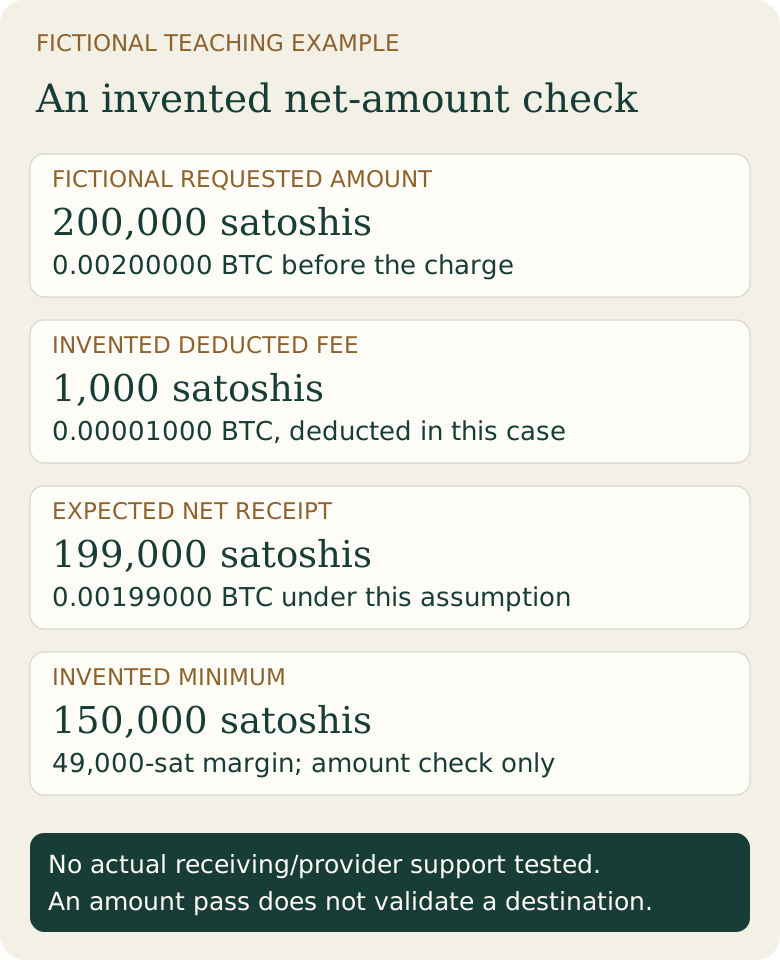
Assume a fictional withdrawal requests 0.00200000 BTC and the service explicitly deducts an invented 0.00001000 BTC charge from that amount. The hypothetical receipt is 0.00199000 BTC, or 199,000 satoshis. If the destination requires at least 0.00150000 BTC, the calculated receipt is 49,000 satoshis above that threshold.
That comparison passes only the stated amount check. It does not validate the asset, network, address, provider support or actual credit. If the service instead charges the fee separately, a 0.00200000 BTC receipt and a 0.00201000 BTC debit would describe a different fee treatment.
Use the actual quote and receiving terms, not these invented fees or limits. If a Lightning invoice requests an exact amount or has an expiry, follow that invoice and the sender’s supported flow rather than applying an on-chain minimum rule.
Scroll across the table to see all columns.
| Item | BTC | Satoshis |
|---|---|---|
| Requested amount | 0.00200000 | 200,000 |
| Fee deducted under this assumption | 0.00001000 | 1,000 |
| Expected receipt | 0.00199000 | 199,000 |
| Invented destination minimum | 0.00150000 | 150,000 |
| Illustrative amount margin | 0.00049000 | 49,000 |
What if the balance is WBTC, cbBTC or another Bitcoin-related token?
Confirm the token’s exact identity and network using its project and the receiving service’s current documentation. A native-BTC receiving address is not a token-conversion service. The wrapped Bitcoin to BTC guide covers the separate deposit, conversion and native-BTC withdrawal decisions.
Use the cbBTC versus WBTC comparison for those two products. Do not reuse support instructions for one token as evidence that another is accepted. This guide does not offer swaps, redemptions, bridging or recovery.
Which records should you check before a purchase?
Keep the actual offered asset/network, destination instructions, supported address format, quote expiry, expected net amount and provider order reference together. Use the network-versus-withdrawal-fee guide to label costs correctly. A small test transfer can have its own fees and minimums; it does not override a processor invoice or replace the other checks.
If the receiving wallet or sending provider cannot confirm the route, pause and ask through its official channel before committing funds. If something has already been sent, preserve its transaction and order references and follow the responsible service’s process. A pending balance is not proof of irreversible loss, successful delivery or guaranteed recovery.
How should you use this checklist with Fiat2Bitcoin?
Review available purchase methods and inspect the offer actually returned for your location and amount. Confirm its provider’s receiving-address requirements rather than inferring support from this educational worksheet. Fiat2Bitcoin does not control customer wallet keys or provide an address-conversion or recovery service.
The selected purchase provider handles verification, payment, wallet checks, delivery and refunds. A quote, accepted payment, provider delivery and receiving-wallet credit are distinct events. Keep the original order reference when asking about them.
What if the address is rejected before you can continue?
A sender rejecting an address does not prove that the receiver has lost access or that a different network is safe. Match the native asset, receiving route, full address and sender-supported format before submitting another order. The invalid-address decision guide separates a wrong field, a network mismatch and an unsupported address type.
Example: a wallet supplies a bitcoin: URI containing an amount, while a checkout requests an address only. Use the receiver’s genuine address-only control and verify any invoice amount separately. If the QR includes alternative payment instructions, review what the wallet actually selects using the QR guide.
Sources & further reading
These sources explain the payment systems and rules discussed in this guide. For your purchase, check the provider’s current offer and terms.
- Trezor: Bitcoin account and receiving-address types
- Coinbase: Match the supported receiving network
- Bitcoin developer guide: Transactions
- BIP 321: Current Bitcoin payment URI specification
- BIP 21: Superseded payment URI specification
Published by Fiat2Bitcoin. Worked examples use fictional figures and records; they are not current prices or customer transactions. How we prepare our guides.