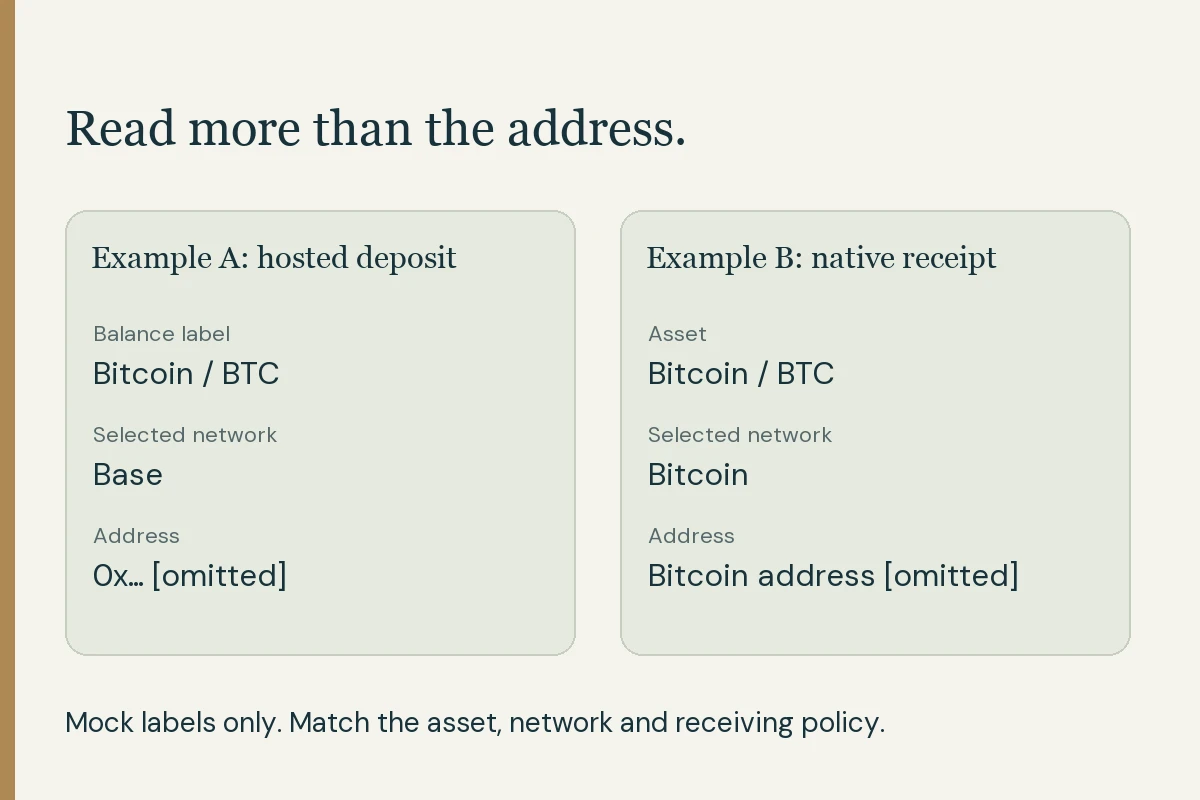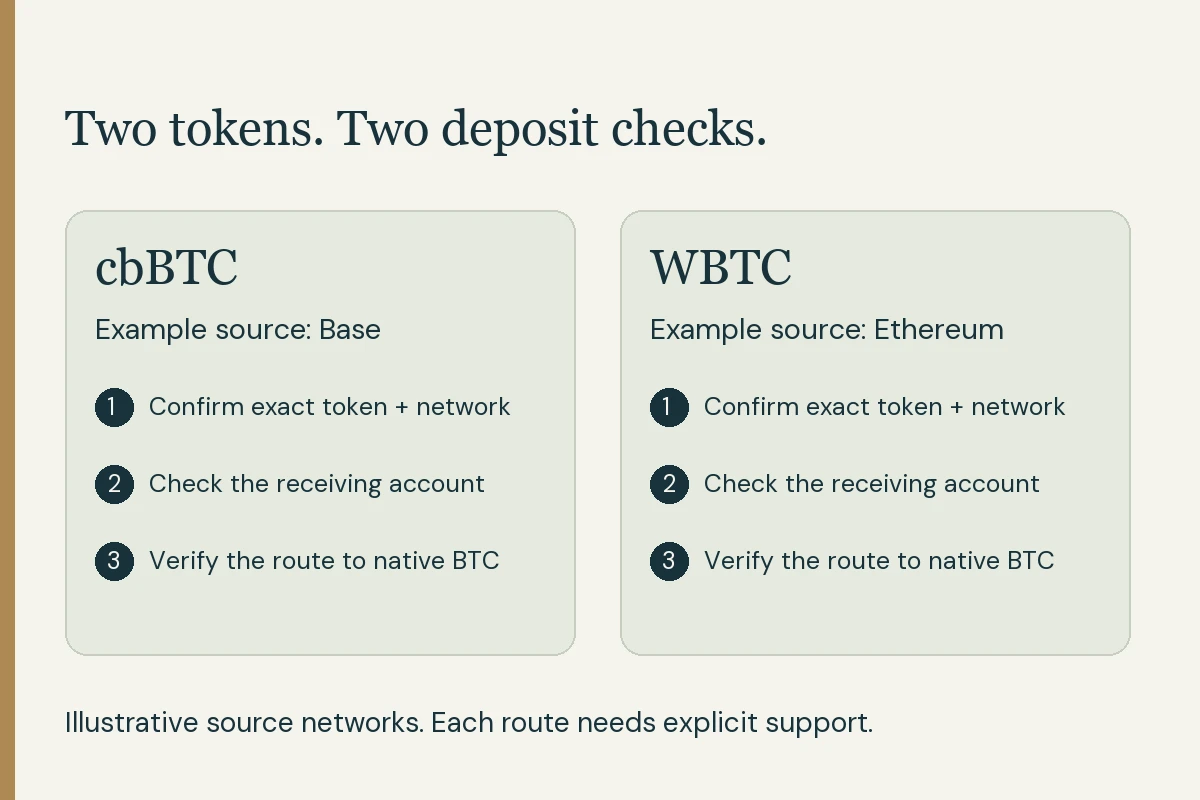
A balance close to Bitcoin’s price can still be a different asset on a different network. This comparison helps you identify the product and ask the receiving service the right questions. For the complete two-transfer process, follow the wrapped Bitcoin to BTC guide.
What is the practical difference?
Coinbase describes cbBTC as its Bitcoin-backed wrapped product on its official cbBTC page. WBTC publishes its own authorized networks and token details. Check those issuer/project records alongside the actual destination’s deposit instructions.
Scroll across the table to see all columns.
| Check | cbBTC | WBTC |
|---|---|---|
| Identity | Coinbase Wrapped BTC; confirm the exact network/token. | Wrapped Bitcoin; confirm the exact authorized network/token. |
| Hosted Coinbase example | Eligible supported deposits can credit a Coinbase BTC balance. | Obtain an explicit WBTC deposit and conversion answer; do not apply cbBTC instructions. |
| Self-custody wallet | The wallet must support this token on its source network. | The wallet must support this token on its source network. |
| Goal: native BTC | Verify conversion, available BTC and a withdrawal over Bitcoin. | Verify conversion, available BTC and a withdrawal over Bitcoin. |
How do you confirm which token you hold?
Open the asset’s details in the sending wallet. Record its ticker, network and token identifier; compare the identifier with the official project record for that network. A familiar name or icon is only a starting point. Keep the public token identifier separate from your personal receiving address.
The network is part of the match. An address beginning with 0x can appear on several EVM networks. The 0x receiving-address guide explains why the address format alone cannot select a deposit network.
When does a Coinbase account turn cbBTC into BTC?
Coinbase’s consumer wrapped-assets instructions, checked November 12, describe eligible wrapped deposits crediting the underlying balance. The selected asset and supported network determine the receiving instructions. Regional and product restrictions apply.
An account on Coinbase and a self-custody wallet are different destinations. Use the documentation for the actual product. Coinbase Exchange publishes separate wrapped-asset instructions. Before funding either route, confirm that native BTC will be available to withdraw and review its minimum, fee and any hold.
Two wallets can show similar amounts but need different routes
Fictional example: Wallet A holds 0.00200000 cbBTC on Base. Wallet B holds 0.00200000 WBTC on Ethereum. Their owner wants native BTC in a Bitcoin wallet. The same displayed quantity does not make the deposits interchangeable.
Scroll across the table to see all columns.
| Record | Wallet A | Wallet B |
|---|---|---|
| Starting asset/network | 0.00200000 cbBTC / Base | 0.00200000 WBTC / Ethereum |
| First question | Will my actual receiving account accept cbBTC on Base? | Will my actual receiving account accept WBTC on Ethereum? |
| Next question | How is the deposit credited, and when can I withdraw native BTC? | What supported conversion/redemption step leads to withdrawable native BTC? |
| Final destination | BTC over Bitcoin to the owner’s verified Bitcoin receive address. | BTC over Bitcoin to the owner’s verified Bitcoin receive address. |
How much native BTC would arrive?
Use the actual conversion result and withdrawal preview. As a separate invented accounting example, assume a service has already credited 200,000 sats of available BTC and deducts an included 1,500-sat withdrawal charge. The recipient receives 198,500 sats, or 0.00198500 BTC. This assumes no further deduction at that stage.
Source-network costs, conversion charges and spreads belong in the full record too. The example supplies no live fee, exchange rate or promise of 1:1 conversion. The network-fee versus withdrawal-fee guide explains how to avoid counting an included charge twice.
Fill in this worksheet before the first transfer
- My starting token and network: [record both, with the official token identifier].
- My actual receiving product/account: [confirm deposit support and eligibility].
- My conversion and withdrawal conditions: [minimums, holds, charges and available BTC].
- My final withdrawal preview: [native BTC, Bitcoin network, full destination and net amount].
- My records: [source-network transaction, conversion record and final Bitcoin transaction].
Which questions matter beyond the transfer?
Read each product’s current custody, backing, redemption and restriction terms. Ask who can redeem, which service will serve your account, and what happens if a transfer or redemption is paused. A reserve statement and a wallet’s technical token support answer different questions. This guide does not rank either product’s investment safety.
Check your account for current purchase options; the provider’s offer and eligibility checks apply. These third-party examples explain compatibility; Fiat2Bitcoin does not provide a wrapped-token redemption or swap service. For purchase planning, return to the buy Bitcoin guide.
Sources & further reading
These sources explain the payment systems and rules discussed in this guide. For your purchase, check the provider’s current offer and terms.
- Coinbase: cbBTC product and published process
- WBTC: Authorized networks and token details
- Coinbase: Consumer wrapped-asset deposits and restrictions
- Coinbase Exchange: Separate wrapped-asset process
Published by Fiat2Bitcoin. Worked examples use fictional figures and records; they are not current prices or customer transactions. How we prepare our guides.