Which car sellers accept Bitcoin?
Ferrari announced a European-dealer cryptocurrency-payment rollout in July 2024, following its US introduction. That dated announcement establishes a published programme, not current acceptance by every dealer, every country or every vehicle. Ask the actual dealer to confirm your order’s payment route in writing.
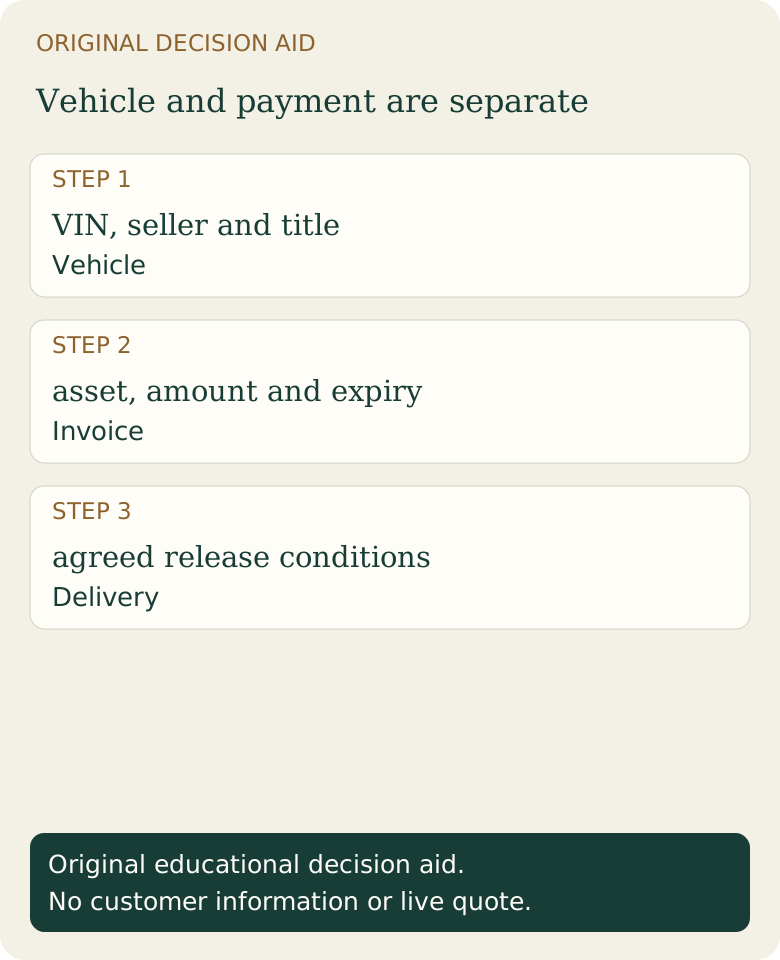
A marketplace listing that mentions crypto does not establish title, ownership, stock or authorization to sell. A payment processor’s invoice also does not inspect the car. Use independently verified seller contacts and the normal vehicle-purchase checks appropriate to your location.
Original checklist: settle the vehicle questions before payment
Keep seller verification and payment verification as separate tasks. Resolve any discrepancy before requesting the payment invoice.
Scroll across the table to see all columns.
| Question | Evidence for this purchase | Do not infer from |
|---|---|---|
| Who owns and sells it? | Seller identity, title/lien records and permitted transfer process | A wallet address or payment badge |
| Which vehicle and condition? | Matching VIN, inspection, history and written description | A stock photo or model name |
| What is the final total? | Itemized price, taxes, fees, delivery and any trade-in credit | An advertised deposit or BTC conversion |
| When does possession transfer? | Written clearance, title and delivery conditions | A transaction confirmation alone |
| What if the sale fails? | Refund currency, deductions and cancellation terms | A promise of identical BTC repayment |
Original example: vehicle invoice versus total wallet debit
Assume an invented used-car price of USD 28,000.00, fictional tax of USD 2,100.00 and document/delivery charges of USD 400.00. The hypothetical invoice total is USD 30,500.00. These numbers are not an actual vehicle offer or a tax-rate claim.
At an invented USD 100,000 per BTC invoice rate, the requested amount is 0.30500000 BTC. A separately charged 0.00003000 BTC wallet fee makes the wallet debit 0.30503000 BTC. Subtracting that fee from the invoice amount could leave the merchant underpaid. Follow the actual processor’s exact asset, network, expiry and amount instructions.
Would a refund return the same number of bitcoins?
Not necessarily. Suppose a hypothetical contract refunds USD 30,500.00 and uses an invented USD 125,000 per BTC conversion at refund time. That equals 0.24400000 BTC before deductions, not the original 0.30500000 BTC. A contract specifying BTC-denominated repayment could have different consequences. Read the agreed terms before paying.
Ask what happens to a deposit, title delay, unavailable vehicle, partial refund, expired invoice or overpayment. Do not send a second payment merely because a dealer display is slow. Trace the existing order and transaction first.
Which records should you keep?
Preserve the vehicle contract, VIN, seller identity, invoice, payment receipt, transaction reference, tax documents and title/delivery records. IRS digital-asset guidance explains US tax treatment of disposals, including exchanges for goods or services. Spending BTC can require gain/loss records; personal circumstances and other jurisdictions differ.
Fiat2Bitcoin does not sell or inspect vehicles, verify title, hold deposits or act as escrow. Our purchase-cost guide and wallet compatibility guide explain the separate Bitcoin side of a purchase. Review available buying methods only after confirming the actual seller’s requirements.
Sources & further reading
These sources explain the payment systems and rules discussed in this guide. For your purchase, check the provider’s current offer and terms.
Published by Fiat2Bitcoin. Worked examples use fictional figures and records; they are not current prices or customer transactions. How we prepare our guides.