What are the warning signs?
Cash App’s scam guidance warns about impersonation and sharing sign-in codes. The FTC’s crypto-scam guidance describes guaranteed-return schemes, impersonation and demands for crypto. A familiar logo, caller ID or payment screenshot does not authenticate the person contacting you.
A common pattern is a small initial payment followed by demands for a larger unlock fee, tax or verification payment. Another is a fake support contact asking you to move funds to a safe wallet. Stop and verify independently; do not let the caller walk you through a new transfer.
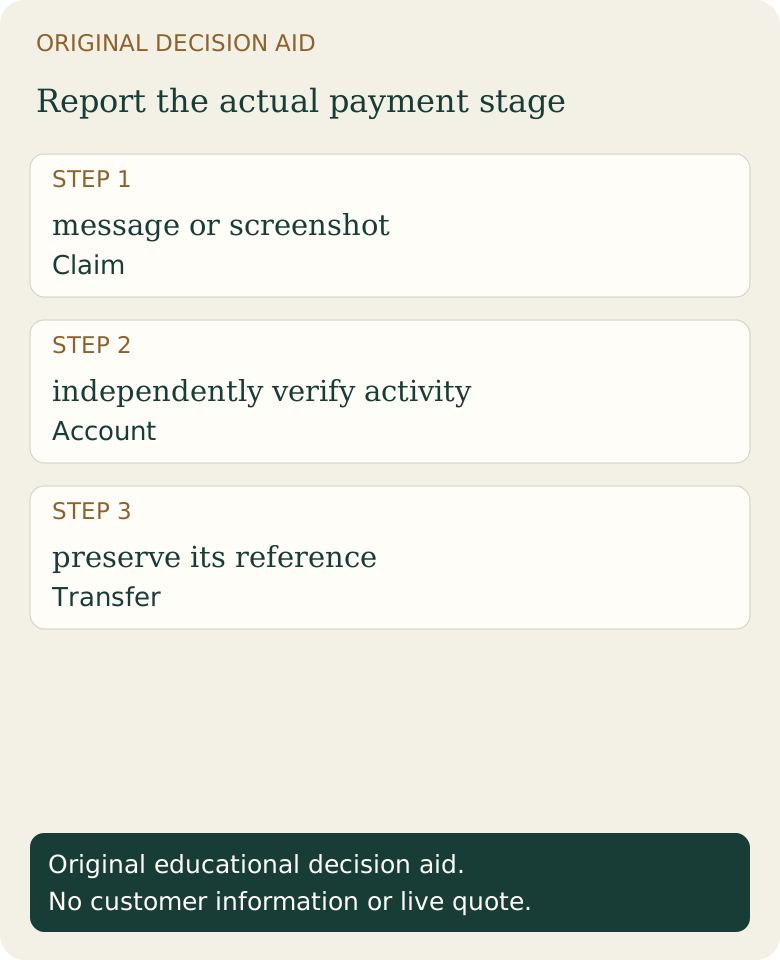
Original triage: what actually happened?
Describe the stage from the genuine app, bank record or blockchain reference. A screenshot supplied by the other person is not authoritative evidence.
Scroll across the table to see all columns.
| Observed evidence | What it establishes | Next step |
|---|---|---|
| Only a message or screenshot | A claim, not account receipt | Open the app independently; do not pay to release it. |
| Bank debit or card entry | A funding/payment event | Record the reference; ask the bank/app about that exact entry. |
| BTC purchased in the app | An asset purchase | Check whether any separate withdrawal was authorized. |
| Withdrawal pending | A request awaiting the service’s outcome | Contact official support before retrying. |
| Confirmed on-chain transaction | A network transfer | Preserve its ID and report promptly; do not promise reversal. |
Original evidence record: keep it specific and private
Write a local timeline with the time and timezone, app transaction reference, amount and asset, relevant bank reference, claimed identity and how contact began. Retain the original messages and URLs as evidence without opening unknown links. If a blockchain transaction exists, preserve its ID and the network shown.
Do not include passwords, sign-in codes, recovery words, full card numbers or unnecessary identity documents in a report. Send only what the official reporting process requires. A public social-media post with an unredacted screenshot can expose more personal information and attract recovery scammers.
Who should you contact?
Use Support reached from the genuine Cash App or its verified website. Cash App’s Bitcoin disclosures identify its support route. Use the current contact information there, rather than a phone number or social account sent by a stranger.
If a bank or card payment is involved, promptly contact that institution through its own verified channel. US consumers can also report to the FTC’s official reporting site. Give each organization the affected reference and ask what options apply to that stage. Available remedies depend on the facts and are not guaranteed.
Can Cash App or Fiat2Bitcoin reverse the Bitcoin transfer?
A completed Bitcoin network transfer differs from a reversible account correction or a pending request. Read Bitcoin reversal limits and transfer stages. Do not pay a stranger who guarantees recovery.
Fiat2Bitcoin is not Cash App support and does not recover or reverse its customers’ payments. This guide is educational and involved no real account test or customer report. Avoid buying additional Bitcoin as a proposed fix for a suspected scam.
Sources & further reading
These sources explain the payment systems and rules discussed in this guide. For your purchase, check the provider’s current offer and terms.
- Cash App: scam warning signs
- Cash App: Bitcoin disclosures
- FTC: cryptocurrency scams
- FTC: official fraud reporting
Published by Fiat2Bitcoin. Worked examples use fictional figures and records; they are not current prices or customer transactions. How we prepare our guides.