
Who and what does the capital-charge guidance address?
Q6 of the current CFTC staff FAQ concerns a futures commission merchant, or FCM, computing regulatory capital on proprietary non-security crypto positions. “Proprietary” means the firm’s own position in this context. It is not a synonym for every customer’s wallet, every crypto business or every transaction involving Bitcoin.
The FAQ describes the Market Participants Division’s staff position. Preserve that qualification when reading or sharing a headline: it is not a statement that Congress created a new retail Bitcoin tax. Actual firm obligations require the applicable regulations, staff conditions and the firm’s facts; this educational guide is not a compliance opinion.
The CFTC’s September 24 release explains that these FAQs were updated after their original March 20 publication. Use the updated document linked below, rather than assuming an older article covers every later clarification. We retrieved the primary documents November 18, 2026.
How does a simplified 20% inventory calculation work?
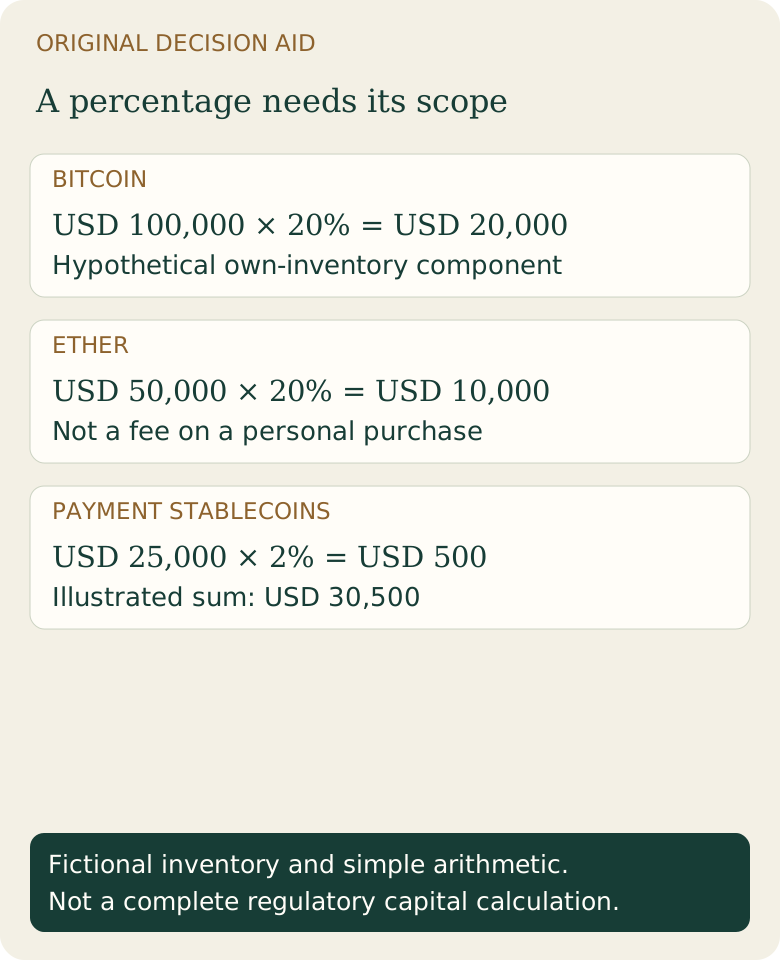
Isolate the stated percentage from the rest of the regulatory calculation. In a hypothetical standalone illustration, USD 100,000 of bitcoin inventory × 20% = USD 20,000. The same assumed value in ether gives USD 20,000 at that rate. These are arithmetic charge components, not amounts billed to a retail buyer.
A mixed illustration makes the scope easier to see: USD 100,000 bitcoin × 20% = USD 20,000; USD 50,000 ether × 20% = USD 10,000; USD 25,000 qualifying payment stablecoins × 2% = USD 500. Adding these illustrated components gives USD 30,500.
This is not a calculation of any actual firm’s required capital, available capital or compliance status. Valuation, position basis, applicable definitions, other deductions, offsets and other requirements need separate analysis. The word “minimum” also matters: do not infer a guaranteed maximum deduction.
Scroll across the table to see all columns.
| Hypothetical own inventory | Illustrative rate | Arithmetic component |
|---|---|---|
| Bitcoin: USD 100,000 | 20% | USD 20,000 |
| Ether: USD 50,000 | 20% | USD 10,000 |
| Qualifying payment stablecoins: USD 25,000 | 2% | USD 500 |
| Sum of these illustrated components | Not a full capital calculation | USD 30,500 |
How are capital, customer collateral and margin different?
Three questions are easy to collapse into one: what a firm owns, what a customer posts, and what may secure a particular derivatives exposure. Q6’s inventory percentage answers only the first type of capital question. A haircut does not itself authorize an asset in every account or contract.
The updated FAQ discusses residual interest, customer-fund investments, uncleared swaps and clearing organizations in separate answers. For example, Q3 does not permit bitcoin or ether as the FCM’s residual interest in customer segregated accounts under the cited no-action position. Q5 treats eligible tokenized collateral separately from treating every crypto asset as eligible margin.
If you are investigating a real derivatives arrangement, identify the entity type, whose assets are involved, the account and whether the transaction is cleared. Use the applicable answer and source conditions. A spot Bitcoin purchase through a payment provider is not evidence that the provider is an FCM or that this inventory treatment applies to its checkout.
How can you check a headline about the CFTC charge?
Use the following original scope test before drawing a conclusion. If an article omits the regulated entity or the kind of position, the percentage alone is not enough to identify its effect.
Scroll across the table to see all columns.
| Claim you encounter | Question to ask | What the quoted Q6 percentage cannot establish |
|---|---|---|
| “Bitcoin has a 20% charge” | Whose inventory and which regulated entity? | A universal retail transaction fee |
| “Stablecoins need only 2%” | Does the asset meet the applicable payment-stablecoin definition? | That every stablecoin qualifies |
| “The firm passed its capital test” | Where is the complete calculation and applicable authority? | Compliance from one multiplication |
| “Crypto can be used for all margin” | Which account, contract, entity and collateral rules? | Permission for every derivative or account |
Which source and calculation records should you keep?
Download the original worked-example worksheet for the assumed positions, decimal arithmetic, document date and limitations. The inputs are fictional USD inventory values; no company balance sheet or customer position is represented.
For actual research, retain the current FAQ version, the exact question number, any relevant staff letter and the applicable regulation. Distinguish a staff non-objection position from a rule text and from a commentary headline. Obtain qualified advice for an actual capital filing or eligibility decision.
If your question is instead the cost of a personal Bitcoin purchase, start with the purchase-fee guide. For price benchmarks used in comparisons, the CME CF Bitcoin reference-rate guide explains a separate pricing concept. Neither becomes a capital calculation merely because it contains a Bitcoin price.
Sources & further reading
These sources explain the payment systems and rules discussed in this guide. For your purchase, check the provider’s current offer and terms.
- CFTC: updated September24 FAQ, especially Q3/Q5/Q6
- CFTC: announcement of September24 FAQ update
- CFTC Staff Letter26-05: no-action position and conditions
Published by Fiat2Bitcoin. Worked examples use fictional figures and records; they are not current prices or customer transactions. How we prepare our guides.