
Where is the official Bitcoin reference-rate methodology?
Use the administrator’s BRR documentation page and its Reference Rates Methodology PDF. The reviewed PDF identifies version 17.4, dated August 24, 2026. Its qualitative method and BRR parameters describe the daily calculation. For BRTI, use the separate Real Time Indices Methodology PDF, reviewed as version 17.0, dated September 21, 2026.
These links point to the publisher’s documents; we do not host copies or supply licensed index data. If a direct PDF request is blocked, open the official documentation page and its download link. Confirm the current edition before a professional valuation or product calculation. A version date is not the observation time of a price.
BRR vs BRTI: what is the practical difference?
CME’s introductory explanation distinguishes the daily reference rate from the real-time product. The administrator’s BRTI page identifies a separate order-data index. Do not substitute one ticker for the other simply because both describe Bitcoin in US dollars.
Scroll across the table to see all columns.
| Question | BRR | BRTI |
|---|---|---|
| What is it? | Daily Bitcoin reference rate | Separate real-time Bitcoin index |
| What does the basic method use? | Eligible transaction prices and sizes | Eligible order-book data under its own methodology |
| Which timing matters? | Named fixing and timezone | Timestamp of the particular real-time observation |
| Is it my retail purchase offer? | No; obtain the provider’s actual quote. | No; obtain the provider’s actual quote. |
How does the basic BRR calculation work?
The reviewed reference-rate methodology groups eligible trades into time partitions, calculates a trade-size-weighted median within each partition, then equally averages the partition medians. The BRR parameters specify twelve five-minute partitions over the hour ending at 4 p.m. London time. Other named variants can use a different fixing; do not assume BRR and BRRNY have the same observation window.
Download the invented example data to check the arithmetic locally. The full document also includes eligibility, data-quality and contingency rules. The simplified examples below illustrate two arithmetic stages only. They do not reproduce every rule, determine an official fixing or validate a market dataset.
Original example: a weighted median is not an ordinary average
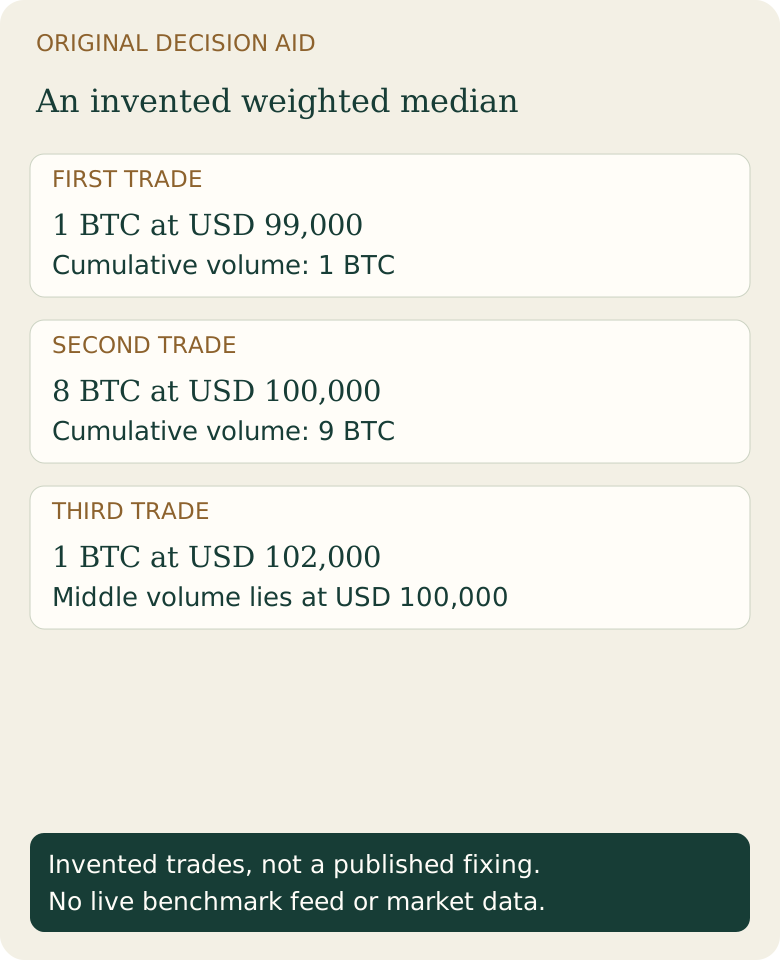
Invent three trades in one hypothetical partition: 1 BTC at USD 99,000, 8 BTC at USD 100,000 and 1 BTC at USD 102,000. The total size is 10 BTC. In price order, cumulative volume moves from 1 to 9 to 10 BTC. The middle of that volume lies inside the USD 100,000 trade, so this example’s volume-weighted median is USD 100,000.
The equally weighted average of the three trade prices is USD 100,333.33 when rounded to cents. Their volume-weighted average is USD 100,100.00: (99,000 × 1 + 100,000 × 8 + 102,000 × 1) / 10. These differ from the weighted median. All trades, sizes and prices here are invented; the example deliberately avoids an exact-half-volume tie.
Scroll across the table to see all columns.
| Trade price, USD/BTC | Trade size, BTC | Cumulative size in price order |
|---|---|---|
| 99,000.00 | 1 | 1 |
| 100,000.00 | 8 | 9 |
| 102,000.00 | 1 | 10 |
Original example: average twelve partition medians
Now assume a separate fictional set of twelve already-computed partition medians: the first six are USD 100,000 and the next six are USD 100,400. Their equal-weight average is (6 × 100,000 + 6 × 100,400) / 12 = USD 100,200.00. Each partition has a one-twelfth weight in this final stage; this is not an instruction to weight the final average by each partition’s trade volume.
This example supplies the medians directly rather than claiming to supply a complete hour of qualifying trades. It is a teaching calculation checked with exact arithmetic, not a published BRR value, a BRTI calculation, a current Bitcoin rate or a tradable quote.
Scroll across the table to see all columns.
| Hypothetical partitions | Median in every partition | Contribution to sum |
|---|---|---|
| 1–6 | USD 100,000.00 | USD 600,000.00 |
| 7–12 | USD 100,400.00 | USD 602,400.00 |
| All twelve | Sum / 12 | USD 100,200.00 average |
Original checklist: what must match before comparing two prices?
Check the exact identifier, asset/currency pair, observation date/time and timezone, methodology edition and the field’s role. An ETF’s valuation reference, its share trading price, an exchange’s last trade and a retail checkout offer can be different numbers for legitimate reasons. Read the actual product’s disclosures rather than assuming all Bitcoin-related figures are interchangeable.
For a separate purchase comparison, record the total cash debit and net BTC delivered, including applicable charges. The spread guide and ETF-versus-Bitcoin guide explain those distinct questions. The reference-value calculator multiplies an entered amount and rate; it does not generate an official benchmark.
Where should you check a current BRTI or BRR value?
Use the official BRR page or official BRTI page and inspect the displayed timestamp. A value copied from a search excerpt can be stale even when the underlying product is described as real-time. This article intentionally provides no live value, chart, quote or historical-price series.
The administrator publishes usage and licensing information for powering products with real-time or historical data. We have not obtained or connected such a feed for this guide. Educational methodology coverage does not establish licensed data access or satisfy a search specifically asking for a current index value.
Sources & further reading
These sources explain the payment systems and rules discussed in this guide. For your purchase, check the provider’s current offer and terms.
- CF Benchmarks: BRR and official documentation
- CF Benchmarks: Reference Rates methodology PDF
- CF Benchmarks: BRTI and data-usage information
- CF Benchmarks: Real Time Indices methodology PDF
- CME Group: introduction to the reference rate
Published by Fiat2Bitcoin. Worked examples use fictional figures and records; they are not current prices or customer transactions. How we prepare our guides.