
What do the primary payment pages establish?
HOSTKEY’s dedicated-server payment page describes paying through BitPay and states that customers using that route need BitPay ID. The same page contains broad privacy marketing; that does not override its specific identity requirement. Treat the explicit payment conditions as the operational evidence, then check the actual order’s terms.
Namecheap’s BitPay instructions describe adding funds to a Namecheap account. Account funding is different from a payment applied directly to a particular dedicated-server invoice. Its instructions also make the exchange-rate commitment conditional on the active payment window. Neither page proves that every product, country or new account is eligible.
Scroll across the table to see all columns.
| Published source | What the page documents | Question still requiring the actual order |
|---|---|---|
| HOSTKEY dedicated-server page | A BitPay route with a stated BitPay ID requirement | Exact machine, account eligibility and current invoice conditions |
| Namecheap BitPay instructions | A process for funding an account balance | Whether that balance can pay the intended server order and renewal |
| Bitcoin.org privacy guidance | Bitcoin payment records can expose information | Which account and processor data the host requires |
An exact-satoshi fictional first-invoice budget
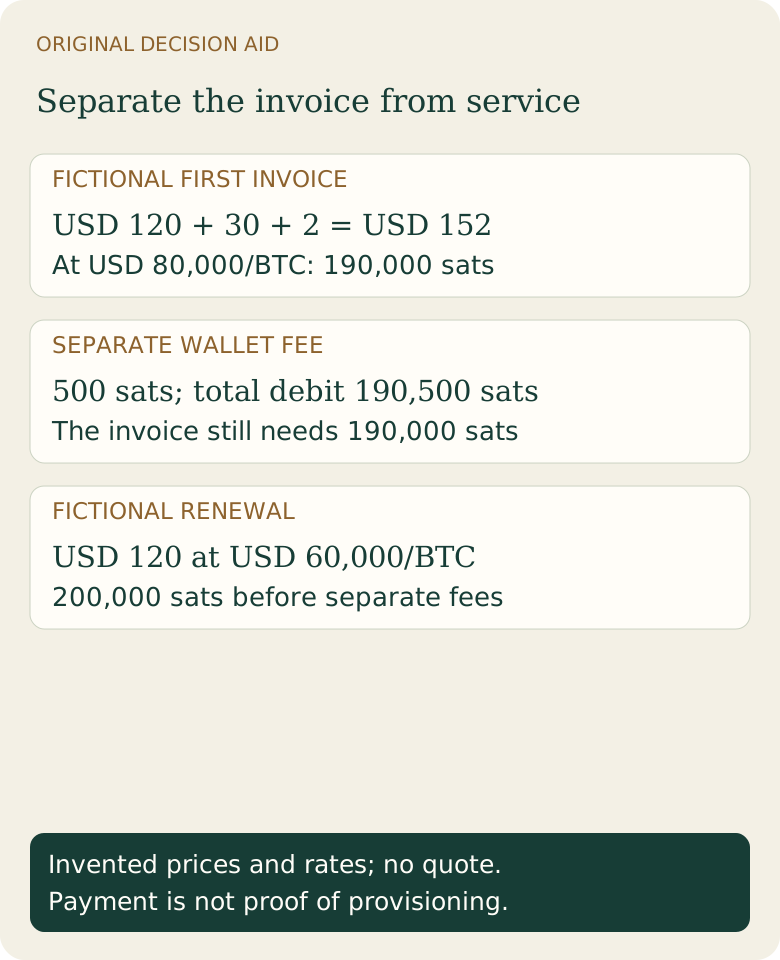
Invent a first order with a USD 120 monthly server charge, USD 30 setup charge and USD 2 payment-processing charge. Assume no tax or other charges: the invoice totals USD 152. These are invented numbers, not HOSTKEY or Namecheap prices, fees or a recommendation.
At a fictional quote of USD 80,000 per BTC, USD 152 / USD 80,000 = 0.00190000 BTC, or 190,000 satoshis. Add an invented separate wallet network fee of 500 satoshis. Under that separate-fee assumption, the total wallet debit is 190,500 satoshis, or 0.00190500 BTC. The invoice still needs its full 190,000 satoshis; subtracting the wallet fee from it creates a short payment.
Scroll across the table to see all columns.
| Component | Fiat basis or calculation | BTC / satoshis |
|---|---|---|
| Server + setup + processing | USD 120 + USD 30 + USD 2 = USD 152 | Invoice basis only |
| Invoice payment | USD 152 / USD 80,000 per BTC | 0.00190000 BTC / 190,000 sats |
| Separate wallet fee | Invented network fee | 0.00000500 BTC / 500 sats |
| Total wallet debit | 190,000 + 500 sats | 0.00190500 BTC / 190,500 sats |
Does the BTC amount stay fixed each month?
Not if the obligation is priced in a fiat currency and converted at each invoice. For a separate fictional renewal, assume only the USD 120 monthly service charge and a quote of USD 60,000/BTC. That becomes 0.00200000 BTC, or 200,000 satoshis, before any separate fee. A smaller dollar bill can require more BTC than the earlier USD 152 invoice when the conversion rate changes.
Check whether crypto payments recur automatically, require a new invoice, use an account balance or need manual payment before a deadline. Do not assume a successful first payment activates recurring billing. Record renewal time, suspension rules and any price changes separately from setup costs.
What should be verified after payment?
Keep the provider order reference and the processor invoice reference linked. Payment detection, settlement, account credit, order acceptance and provisioning can happen at different times. A transaction ID does not confirm the promised CPU, storage, network capacity or administrative access.
Check the actual service specification, location, availability, bandwidth allowance, overage billing, operating-system licence, management level, backup scope and cancellation terms before payment. After provisioning, verify the delivered configuration against the order through the host’s supported process. We have not rented, benchmarked or administered a server for this guide.
Scroll across the table to see all columns.
| Evidence | What it answers | Still separate |
|---|---|---|
| Current invoice | Asset, network, amount and expiry | Service availability and eligibility |
| Provider payment status | Whether the payment met invoice conditions | A ready server |
| Provisioning record | Which service was allocated | Its measured performance |
| Renewal terms | What is due next and when | Permission to assume automatic payment |
| Refund terms | Currency basis, exclusions and process | A guaranteed refund or return of the original BTC quantity |
How should you handle privacy and an unresolved order?
Bitcoin.org explains that public payments and address reuse can reveal transaction relationships. A host can also collect account and processor information. Bitcoin payment is not proof of anonymity, freedom from identity checks or permission to ignore the host’s acceptable-use rules.
For an unresolved payment, use the existing order and processor reference before paying again. Review the transaction-ID guide and wallet-compatibility checklist. Download the original server worksheet to reproduce the budget and record your own comparison locally.
Fiat2Bitcoin does not sell or provision servers and does not manage a host’s refunds. The named services are documented examples, not integrations or rankings. For a separate BTC acquisition decision, compare purchase methods and purchase costs. Buying BTC does not reserve a server.
Sources & further reading
These sources explain the payment systems and rules discussed in this guide. For your purchase, check the provider’s current offer and terms.
- HOSTKEY: dedicated-server payment and BitPay ID statement
- Namecheap: account funding through BitPay
- Bitcoin.org: public payments and privacy limits
Original documented-route analysis and hypothetical invoice/renewal arithmetic. No account creation, checkout, payment, server rental, provisioning or benchmark was performed. How we prepare our guides.