
Which public NEoWave Bitcoin resources were checked?
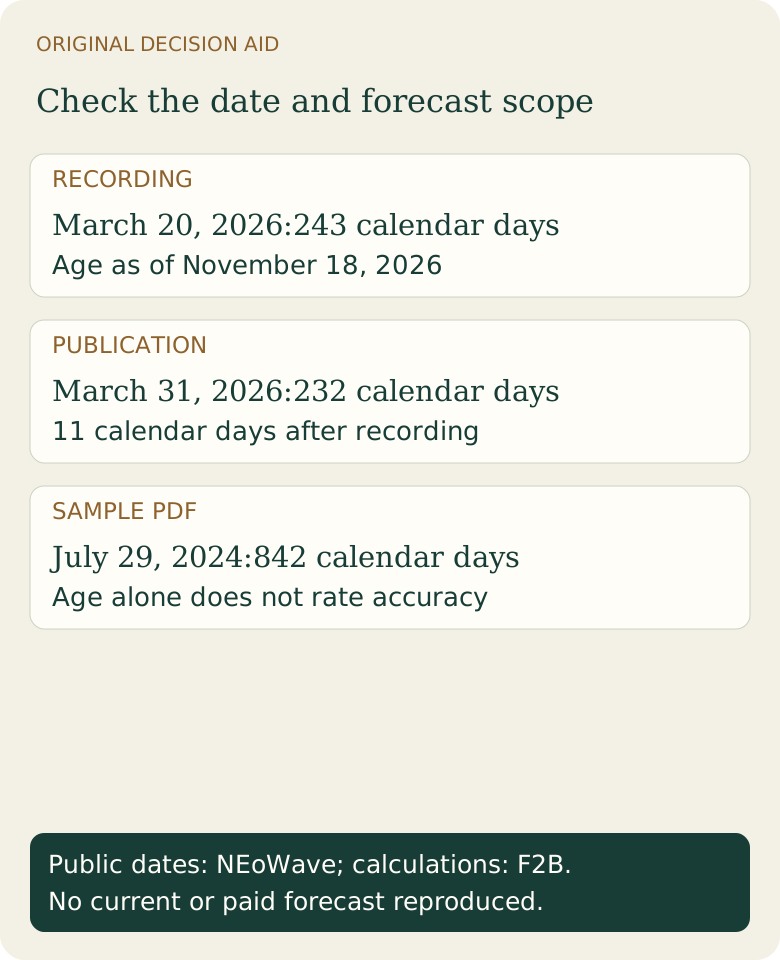
We examined NEoWave’s Bitcoin webinar page, the related publisher blog post and its publicly available weekly Bitcoin PDF sample on November 18, 2026. The landing page identifies the recording date as March 20, 2026. The blog post is dated March 31, 2026 and also describes the March 20 recording. The sample PDF’s own heading is dated July 29, 2024.
Those are document and recording dates, rather than an independently verified timestamp for every observation used in the underlying analysis. A page accessed today can host an older recording. A recently crawled search result can likewise point to an old chart.
The recording is offered for purchase by its publisher. We used the public descriptions and dated sample only; no paid recording, subscriber chart, sign-up, payment or current proprietary target was accessed. This guide identifies the sources and their scope instead of supplying an unexamined market forecast.
How old were these resources on November 18, 2026?
The following is Fiat2Bitcoin’s original calendar-date calculation using the dates printed on the examined publisher resources. Age here means subtraction of calendar dates. It is not an elapsed-hour measurement, a count of market sessions or a rating of forecast quality.
Scroll across the table to see all columns.
| Resource | Printed date | Calendar days to review date |
|---|---|---|
| Bitcoin webinar recording | March 20, 2026 | 243 days |
| Related publisher blog post | March 31, 2026 | 232 days |
| Public weekly Bitcoin sample PDF | July 29, 2024 | 842 days |
Why do the recording and blog dates differ?
The blog date is 11 calendar days after the recording date: March 31 minus March 20. Publishing a description later does not change when the presentation was recorded. Keep those fields separate when saving the source.
A complete evidence note should also identify the last observation on the chart, the instrument, quote unit, interval and intended horizon. A weekly chart is not the same observation interval as a daily or intraday chart. A forecast extending into 2026 can still have been issued earlier.
Older material can remain useful for studying a method or historical scenario. To describe a forecast as current on a particular date, however, identify the latest relevant publisher issue or revision and its observation cutoff. The dated resources reviewed here do not establish what any unexamined November subscriber issue says.
Which details belong in a forecast-evidence record?
This original worksheet helps a reader preserve the actual scope of a forecast before interpreting a headline or screenshot. It does not measure the predictive accuracy of Elliott Wave, NEoWave or any particular analyst.
Scroll across the table to see all columns.
| Field | What to record | Why it matters |
|---|---|---|
| Source and issue | Exact publisher URL, file and issue date | A repost or search snippet may have a different date |
| Observation cutoff | Last data date/time shown; timezone if supplied | Publication time need not equal the final market observation |
| Instrument and quote unit | Exact asset/pair and units shown | Similar-looking levels can describe different instruments or currencies |
| Interval and horizon | For example, weekly observations and a specified future window | A forecast’s scope is more specific than a year in a title |
| Condition and revision | The stated condition, invalidation rule and later revision, if examined | A conditional scenario should retain its conditions |
| Evidence status | Read directly, described publicly, unavailable or unresolved | A description of paid content is not access to its contents |
How can a summary lose an important condition?
Take a fictional teaching statement, unrelated to Glenn Neely’s actual forecasts: “If the next weekly observation of index X exceeds 100, reassess scenario A during the following four observations.” The number 100 is an invented, unitless index threshold, not a Bitcoin price or a trading instruction.
A note saying only “scenario A changes above 100” would omit the observation interval and the review window. A note saying “Bitcoin will rise” would add an asset and directional promise that the fictional statement never supplied. Preserve what the source actually says before deciding whether a summary is faithful.
If the next observation remains below 100, the imagined condition has not triggered. That alone does not prove another scenario, a market top, a return or an executable trade. This example tests the completeness of a written summary; it is not a backtest or a prediction model.
How can you reproduce the date checks?
Download the dated forecast-source worksheet. It includes the source URLs, printed dates, review date, calendar-day differences and the fictional condition record. It contains no paid charts, proprietary targets or copied subscriber analysis.
Parse each ISO date as a calendar date. Subtract March 20, 2026 from November 18, 2026 to obtain 243 days; subtract March 31 to obtain 232 days. The difference between those gaps is 11 days, matching the recording-to-blog interval. Subtract July 29, 2024 to obtain 842 days for the public sample.
If you repeat the exercise on another date, update the review date and recompute the gaps. Do not change the printed source dates to make an old document appear new. For a precise timestamp comparison, retain the timezone and time-of-day evidence as well; this worksheet makes only a calendar-date calculation.
What should a reader seeking current analysis check next?
Use the publisher’s own issue information to identify the latest material for the exact instrument and interval you need. Record which document you actually examined. If only a public description is available, leave the detailed forecast fields unresolved rather than filling them with guessed targets.
Promotional performance claims require their own evaluation of original issue records, conditions, revisions and a defined measurement period. This guide does not independently validate the publisher’s advertised forecasting results, recommend a subscription or establish future performance.
Keep a forecast separate from another type of market evidence. Our June 2026 sentiment review analyzes a dated index dataset; it is not a substitute for a current price forecast. Our Bitcoin versus ETF guide and purchase-fee guide address product and transaction questions that a chart cannot resolve for a buyer.
Sources & further reading
These sources explain the payment systems and rules discussed in this guide. For your purchase, check the provider’s current offer and terms.
- NEoWave: Bitcoin webinar recording date and public description
- NEoWave: March 31, 2026 blog describing the March 20 recording
- NEoWave: publicly available weekly Bitcoin sample dated July 29, 2024
The resource dates are taken from examined public documents; calendar gaps are Fiat2Bitcoin calculations as of November 18, 2026. The index-X condition example is fictional and is not an analyst’s actual Bitcoin forecast. How we prepare our guides.