
What does “replaced” mean?
A replacement spends at least one input also used by an earlier unconfirmed transaction. Nodes that accept the replacement remove the conflicting earlier transaction from their mempools. The replacement has its own transaction ID and can change outputs as well as fees.
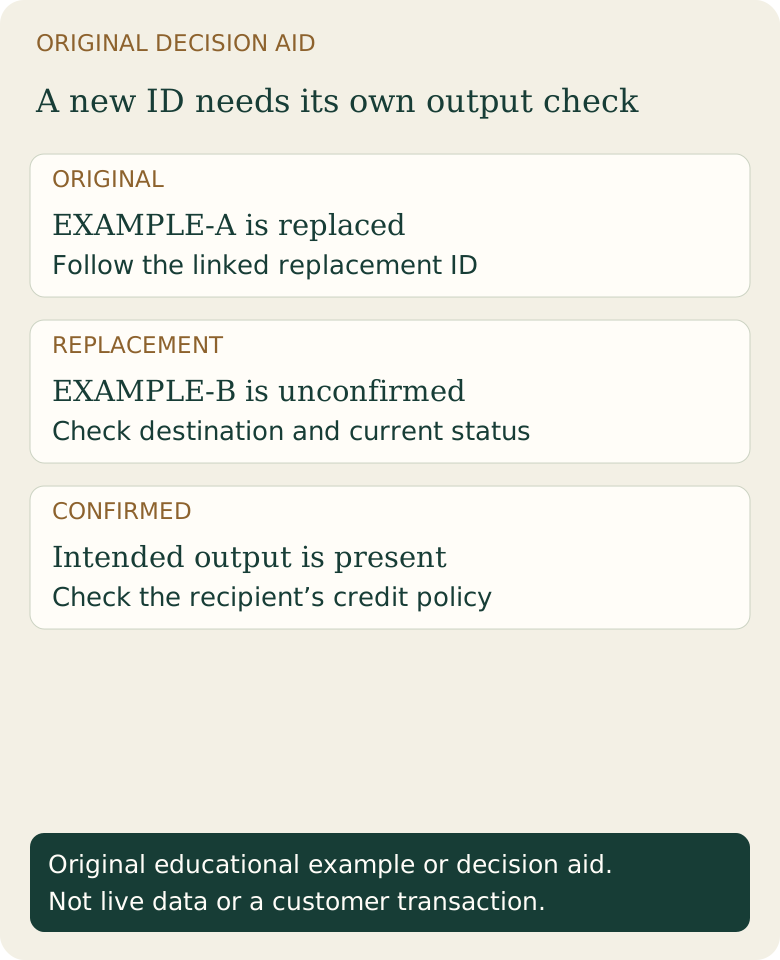
“Replaced” on one explorer is a report about that service’s observed transaction history. Inspect the linked replacement and its current confirmation status. If it confirms in the current chain, the conflicting original cannot also confirm there. A replacement that merely remains pending is not final settlement.
Follow this record before deciding whether you were paid
Scroll across the table to see all columns.
| What you see | What it means | Next check |
|---|---|---|
| Original ID: EXAMPLE-A | Status: replaced by EXAMPLE-B | Open the replacement record |
| Replacement ID: EXAMPLE-B | Status: unconfirmed | Compare the intended receiving output; keep following its status |
| Replacement ID: EXAMPLE-B | Status: confirmed, intended output present | Check the receiver’s confirmation and deposit policy |
| Replacement has a different destination | The old payment request was not necessarily fulfilled | Stop and contact the actual sender through a trusted channel |
RBF versus child-pays-for-parent
With replace-by-fee, a wallet capable of spending the relevant inputs constructs a replacement. A sender’s wallet may expose an increase-fee action; a hosted sender may require its own support process. Do not assume a historical opt-in flag tells you every node’s current replacement policy.
With child-pays-for-parent, a party able to spend a suitable output creates a child transaction with a fee that improves the parent-plus-child package. A recipient cannot do this just by knowing an address or viewing a transaction. Wallet support, spendable outputs, package policy and adequate funds all matter.
A fee calculation is not a relay-policy test
Check a parent-and-child fee model
A zero arithmetic child fee means the parent already covers this target in the simplified model; it does not mean a zero-fee child will be accepted.
Hypothetical package: the parent is 200 vB and pays 200 satoshis. A proposed child is 150 vB. At a chosen combined rate of 10 sat/vB, 350 vB × 10 requires 3,500 satoshis in total fees. Subtract the parent’s 200 and the arithmetic child fee is 3,300 satoshis.
This is a teaching calculation, not a fee recommendation, mempool estimate or promise that a wallet will accept a package. Descendants, actual transaction sizes, replacement rules and current relay requirements can change the practical answer. Use the calculator in this section to check these assumptions, then follow the real wallet’s preview.
Can a fee bump pay the recipient twice?
A direct replacement conflicts with the original, but an independently constructed second payment can be a separate spend. Verify whether the wallet action replaces the old transaction or creates another transaction before approving it. Do not follow a stranger’s demand to resend the full purchase to a new address.
For a purchase sent by a provider, ask that provider for the current transaction ID and order status. It controls its outgoing transaction. Read unconfirmed transaction checks for the broader status decision tree and Bitcoin transfer timing for the difference between confirmations and account credit.
Sources & further reading
These sources explain the payment systems and rules discussed in this guide. For your purchase, check the provider’s current offer and terms.
- Blockstream: Replace-by-Fee
- Bitcoin developer guide: Payment processing
- Bitcoin developer guide: Transactions
Published by Fiat2Bitcoin. Worked examples use fictional figures and records; they are not current prices or customer transactions. How we prepare our guides.